The Dow's Blind Spot (and Why the Next Pick Won't Be Mag-7)
 |
| By Gavin Magor |
Something momentous happened in the stock market yesterday.
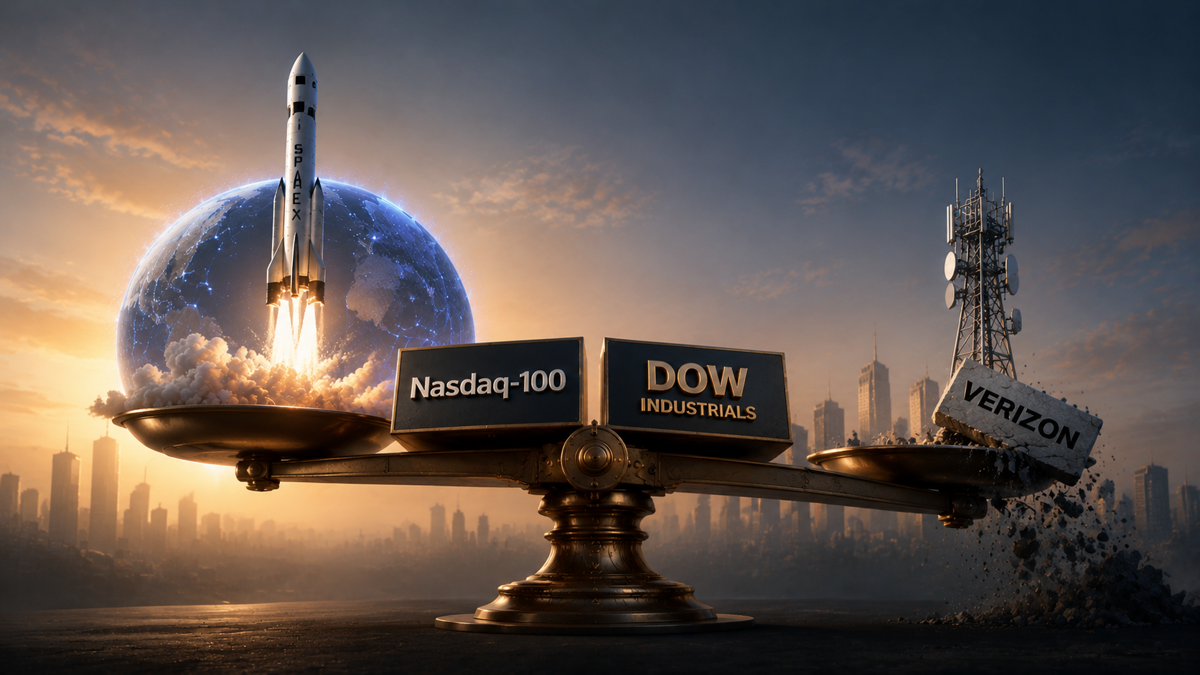
That “something” was SpaceX (SPCX) joining the Nasdaq-100.
Not only is it unusual for a brand-new stock to achieve that honor. But it also got a “Fast Entry” pass to enter without having to remove another company first.
You probably know index funds are required to buy stocks when they get added to major indexes.
So, those funds had to take money from other high-tech holdings to accommodate the new buy.
In SpaceX’s case, that amounted to some $2.5 trillion of capital.
But the impact on the other stocks — the Magnificent 7, among others — was negligible.
The index surged yesterday, led by some of its biggest names.
The bigger story, however, is a change to another major index …
While the Nasdaq-100 saw a few dollars flow away from the Mag-7, the Dow Industrials moved more chips to the Big Tech table.
Before the market opened last week, Alphabet (GOOGL) replaced Verizon (VZ), which joined the Industrials in 1984.
What’s interesting here is not just that Alphabet is perhaps the first purely digital business to be considered an industrial …
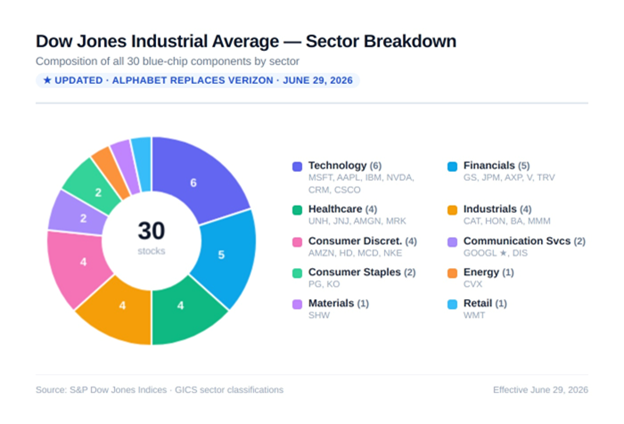
Rather, this is the second time a Mag-7 booted out a beloved telecom.
AT&T (T) was in the Dow for much of the 20th century. That is, until its spot was given to Apple (AAPL) in 2015.
With the latest switch, there are no more telecoms left in the Dow for the first time in modern history.
Same Story, Different Decade
The Nasdaq-100 tends to reflect the current marketplace.
Its latest bet on the space economy is clearly a timely one.
Meanwhile, the Dow tends to reflect what the market has already done.
It’s not unusual to see a lower-priced stock in a slowing sector get replaced in the Dow with one that’s experienced a great deal of growth.
Apple, for example, was the fourth Mag-7 to join the Dow to reflect the tech-driven economy of that era.
Alphabet is the fifth because it’s entrenched in the dominant growth themes of this era: AI, the cloud, digital advertising, autonomous mobility and health tech.
Why the Next Dow Entrant May Not Be ‘Magnificent’
That leaves Meta Platforms (META) and Tesla (TSLA) as the only Mag-7 members that haven’t earned a spot in the Dow.
If I had to guess, META would likely get its invitation first. That’s simply because it’s one of the most profitable companies in the world.
I wouldn’t bet on Tesla at all because of its “C-,” or “Hold,” status in the Weiss Ratings universe.
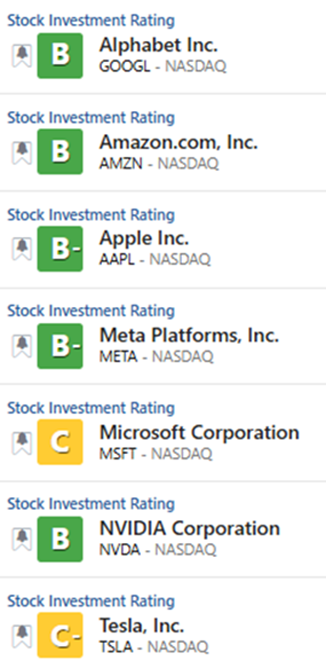
At least, neither it nor Microsoft (MSFT) would be considered for my portfolio at this time, for the same reason.
When the Dow does have another opening, my bet is that neither META nor TSLA will even be a draft pick.
After all, if the Dow wants to be more reflective of the current marketplace, it should look toward the Nasdaq for ideas.
Your Weiss Ratings editors believe space tech indeed represents the next generation of industrial stocks.
But the first space tech to enter the Dow may not be SpaceX.
I may change my tune once we SpaceX earns its first Weiss stock rating. Until then …
It Pays to ‘Think Different’
Just like the Nasdaq and Dow, your portfolio can and should evolve over time.
You want those that are strong today and that also have plenty of runway left.
This is what I recently told my Weiss Ultimate Portfolio readers.
The main differences between index investing in the Dow versus what we try to do in Dr. Martin Weiss’ real-money portfolio are …
One, our ratings change daily. And therefore, so can our holdings. The current average tenure of a stock in the Dow is 25 years. We can be far more flexible because …
Two, we can target nearer-term gains. A stock or an entire industry doesn’t have to wane before we consider replacing it. We can take profits or preserve capital at any time.
Three, we buy when the time is right, rather than because we must. The Dow must hold 30 stocks. But the number of high-rated stocks changes every day. Use the Weiss stock ratings to your advantage to get in when one gets upgraded.
As for what not to do …
Don’t Cry for Verizon, Intel or Exxon
Removal from the Dow breathed new life into Intel (INTC).
That former mega-tech was booted after a quarter-century to make way for another Mag-7, Nvidia (NVDA), in November 2024.
Since then, NVDA has gained a solid 31%.
During that time, Intel partnered with Apple and found its place in this AI-driven economy.
And INTC gained more than 390%!
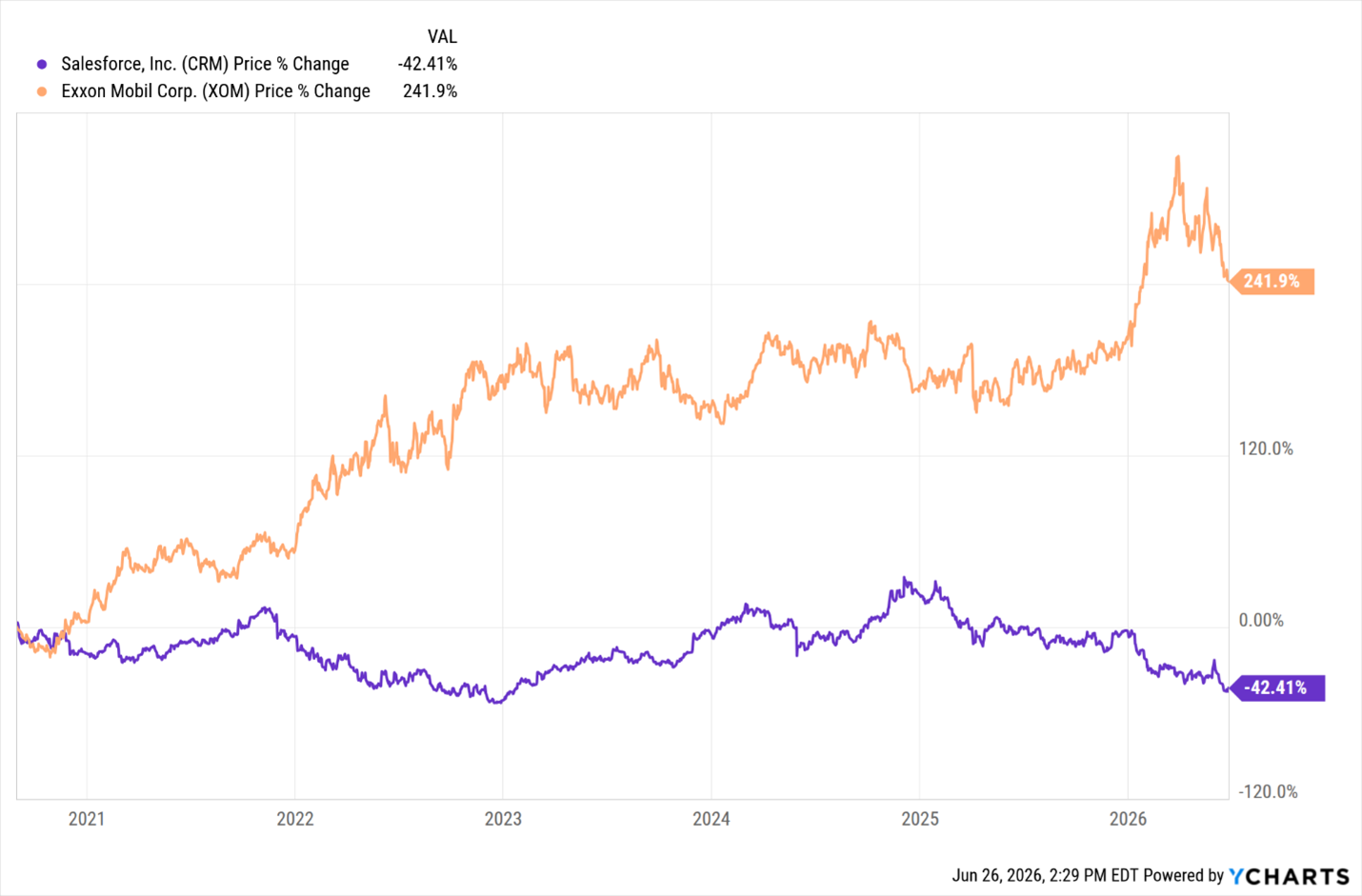
Same story for Exxon Mobil (XOM) after its 92-year Dow stay ended in mid-2020. Shares have gone up 241% whilst its replacement, Salesforce (CRM), fell some 42%.
Now, not every business booms after its Dow death knell.
But so long as it grows its balance sheet … rewards its shareholders … and earns/maintains a Weiss “Buy” rating …
You may very well see it in this very space in the future.
Cheers!
Gavin
P.S. This is also why Dr. Martin Weiss and income expert Nilus Mattive recently joined forces on a new project. One that is also more flexible, forward-looking and profitable than the Dow. I urge you to see what the 16x Income Surge is all about.