The Fed Hiked Rates. So Why Are Markets Celebrating?

 |
| By Sean Brodrick |
Lord, save me from a weird market — or at least let me profit from it!
Yesterday, the Federal Open Market Committee (FOMC) raised the target range for the Federal Funds rate by 25 basis points to 3.75% to 4%.
And today, bond yields are lower, the U.S. dollar is weaker and gold is higher.
That’s weird, right?
The Fed just hiked. Traders expect another increase before year-end. And yet stocks and gold are up while the dollar is down.
The answer is hiding in a bunch of little blue dots.
The Fed can hike now — and signal another hike later — while markets still rally if investors decide the path beyond that is less hawkish than they feared.
That is what happened yesterday.
Here’s the Fed’s latest “dot plot” published yesterday. Each dot shows where an FOMC participant thinks the Federal Funds rate should be at the end of a given year.
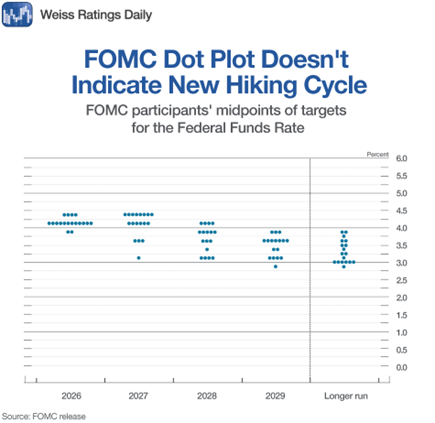
Two participants actually see rates LOWER by the end of this year. But the median projection points to one more 25-basis-point hike.
Then comes the important part: The median stays around 4.1% through the end of 2027 before slipping to 3.9% in 2028 and 3.6% in 2029.
In other words, the Fed is telling markets: One more hike? Yes. An extended hiking cycle? No.
Now that traders can see something resembling a ceiling on rates, longer-term Treasury yields can fall even as the Fed continues tightening.
Gold gets the same relief.
The nightmare scenario for gold wasn’t one more quarter-point hike. It was a long, open-ended cycle of ever-higher rates. The dot plot makes that look less likely. Stock traders can breathe easier for the same reason.
And the dollar? A less-hawkish future path takes some of the wind out of its sails.
Of course, we’re not out of the woods.
There’s still a very public disagreement in Washington over where rates should be. President Trump and Treasury Secretary Scott Bessent are pushing lower rates.
More importantly, inflation is still the problem the Fed has to beat.
Two big forces keeping it elevated are the energy shock from the war with Iran and the impact of tariffs.
Here’s a slide from a presentation I gave Supercycle Investor subscribers:
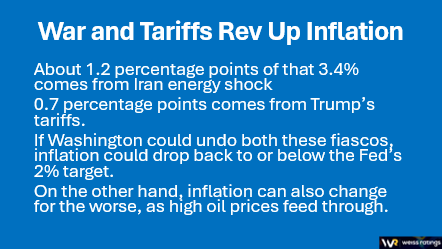
The Fed’s own projections assume inflation cools sharply from here, with headline PCE inflation falling from 3.7% this year to 2.3% in 2027 and reaching 2.0% by 2029.
If the energy shock lasts longer or tariffs keep feeding through to prices, that glide path gets a lot bumpier.
So what do you do with a Fed that may hike once more, then sit on relatively high rates for a while? I see three ways to play it.
TIPS (Treasury Inflation-Protected Securities)
If inflation stays sticky and the Fed holds rates near current levels through 2027, TIPS give you direct protection that ordinary Treasurys do not.
TIPS pay a fixed coupon, while their principal adjusts with the Consumer Price Index (CPI).
And real yields are unusually juicy right now: roughly 2.4% on five-year TIPS and 2.6% on 10-year TIPS. That means you can lock in a substantial real yield before adding whatever inflation adjustment comes along.
Large-Cap HALO Equities
HALO stands for Heavy Asset, Low Obsolescence.
I mean companies that own hard-to-replace assets and ALSO have pricing power and strong cash flow.
Why?
High rates punish speculative businesses, weak balance sheets and companies that constantly need fresh financing.
They are much less threatening to companies throwing off piles of free cash flow, carrying manageable debt and selling things customers can’t easily do without.
Midstream Energy Infrastructure
Top midstream operators can offer hefty distribution yields backed by long-term, “take-or-pay” tollbooth contracts.
Many pipeline and terminal contracts include inflation escalators tied to CPI, PPI or other indexes. So inflation can actually push contracted revenues higher over time.
Then comes the second half of the trade.
When the Fed eventually cuts, today’s fat yields on T-bills and money market funds should shrink.
Income investors will look for higher yields — and midstream partnerships and infrastructure offer 7%-plus distributions.
The easiest way to play that last idea is the Alerian MLP ETF (AMLP). It has a Weiss Rating of B and, as of this draft, a dividend yield of 7.33%.
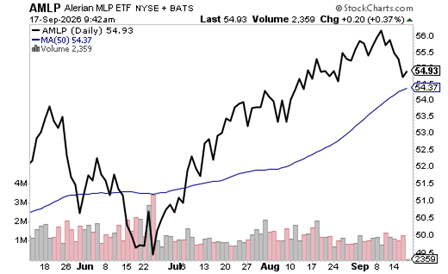
You can see AMLP has pulled back from its recent highs and even kissed its 50-day moving average intraday.
That’s the kind of reset I like to see in an uptrend. My target is $72 a share.
So yes, the Fed hiked rates.
And yes, stocks and gold rallied while yields and the dollar weakened. It only looks crazy if you focus on yesterday’s hike and ignore what the Fed told us about tomorrow.
The dots suggest the Fed may be close to the end of this hiking cycle. Rates can stay high for a while without marching higher forever.
That creates opportunities. It will be a wild ride, but don’t be scared.
It’s time to target profits!
All the best,
Sean