 |
| By Nilus Mattive |
From an investment perspective, it doesn’t really matter whether the war in Iran is right or wrong.
And it’s still pretty hard to calculate exactly how it’s all going to shake out in terms of timeline and consequences.
So, for now, I’d rather focus on two things we know with absolute certainty.
First, oil prices have been spiking.
A simple chart tells the story …
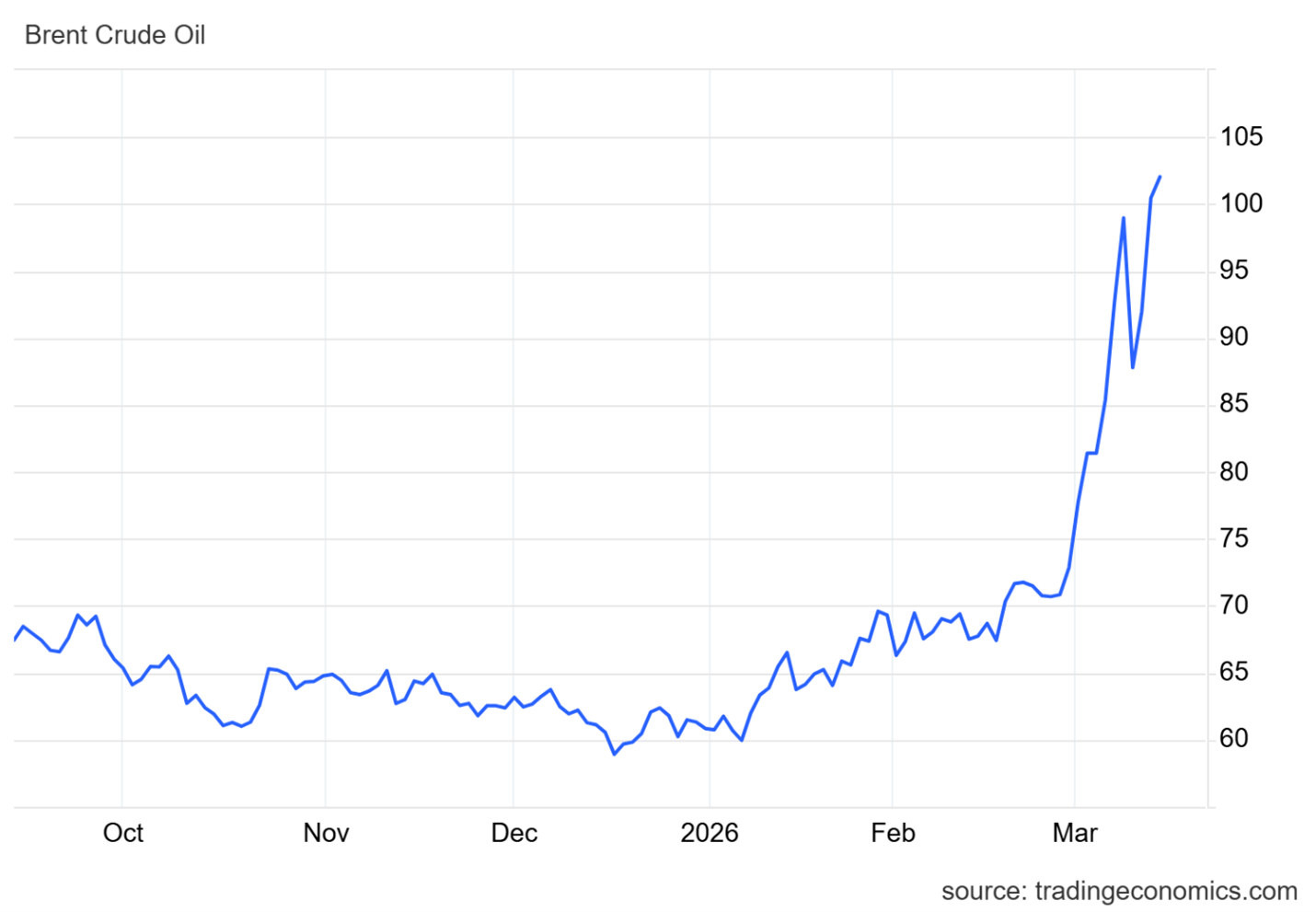
Brent crude surged from about $66 a barrel on Feb. 1 to about $102 a barrel at the end of last week.
That’s more than 55% in a matter of days and more than 67% since the beginning of the year.
It’s entirely because of the situation in Iran, which brought oil tanker traffic through the Strait of Hormuz to a standstill and resulted in attacks on facilities and infrastructure throughout the Middle East.
Now, perhaps the spike will still be relatively short-lived … especially now that governments are taking action to release strategic reserves among other measures.
But even under the best-case scenario, at least a moderate amount of damage to the global economy has already been done.
The average price for a gallon of gasoline in the U.S. spiked more than 10% just in the first week of the war and has continued to rise since then.
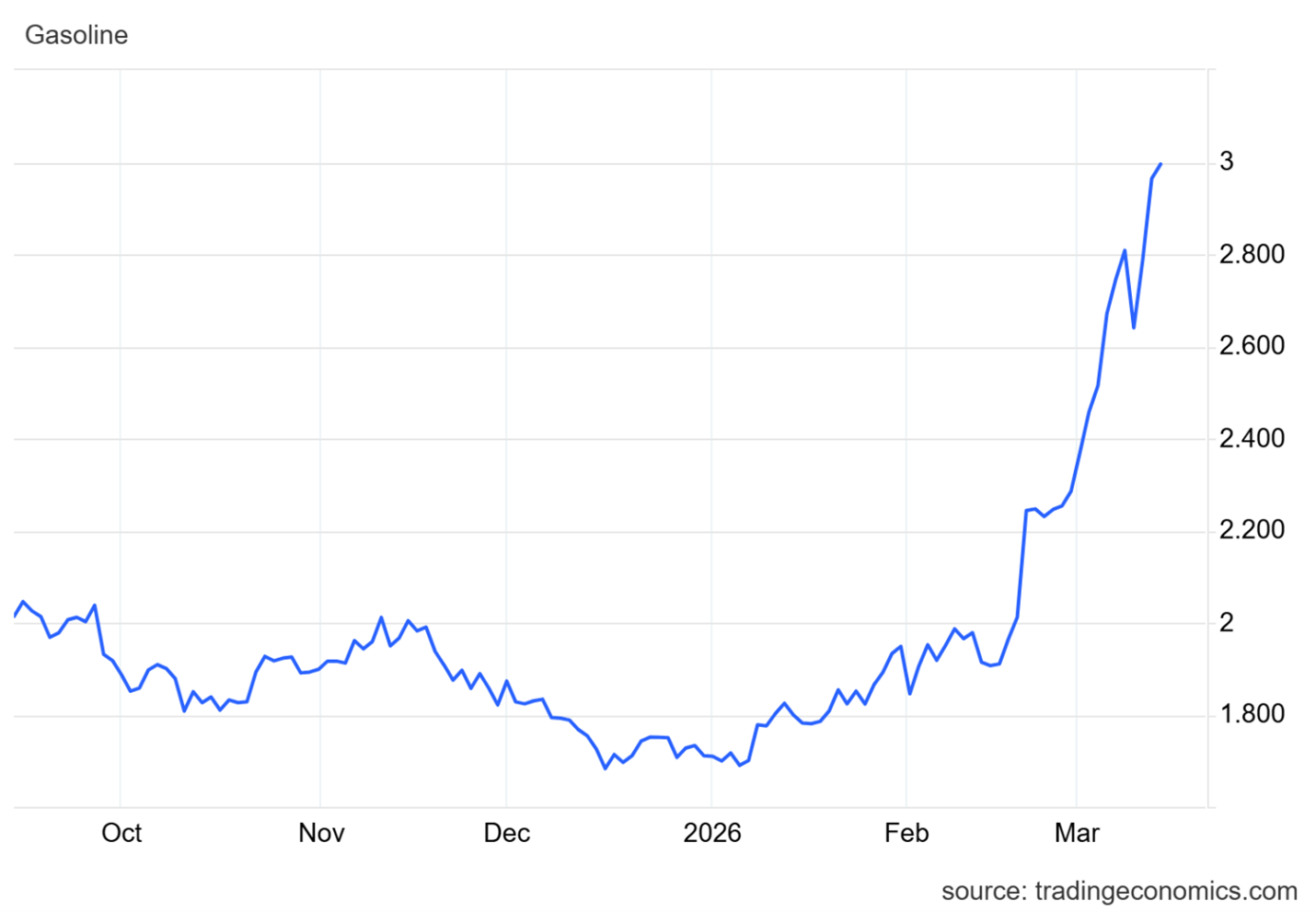
That’s bad enough because it immediately impacts Americans’ budgets and spending power.
Worse, higher oil prices will also ripple through many other sectors and industries …
Adding fuel to an inflationary fire that has continued to burn hotter than expected.
Just consider that right before the attack on Iran, we learned that the Fed’s favored inflation gauge — the Personal Consumption Expenditures (PCE) Index — jumped more than expected in December to a year-over-year gain of 2.9%.
Two more important notes on that:
That’s a “core” measure that doesn’t even include energy prices.
Plus, it’s delayed data because of the government shutdown.
The same is true of the number we just got on Friday. It showed a 3.1% increase.
This reflects information from January which is also before the effects of this war.
Bottom line: You can be certain that inflation today and in the near-term future will stay hotter now.
Second, the costs of the war itself are constantly rising.
Wars cost us in so many ways. Lives, global relationships, buildings, infrastructure … the list goes on and on. And they also come at great financial cost, too.
In the case of Operation Epic Fury, it’s estimated that the U.S. spent about $3.7 billion in the first 100 hours of the conflict. And the bill for each subsequent day is somewhere in the neighborhood of $890 million.
Think about that: Almost a billion dollars up in smoke every 24 hours!
This will only add to America’s pile of debt … which was already hitting one new record after another before the conflict began.
Indeed, putting aside these new war-related costs, the debt was already rising about $6.4 billion every single day.
It now stands just shy of $39 trillion, about $2 trillion higher than March of last year.
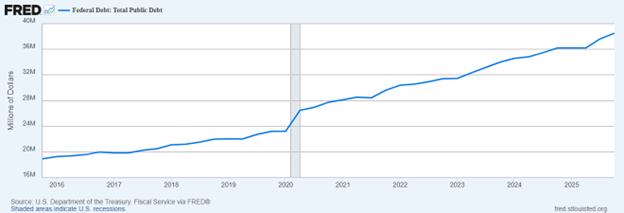
For quite some time, I’ve been telling you that inflation remains a major problem and that government debt is spiraling out of control.
The harsh reality is that the situation in Iran has already made both worse.
Don’t Believe the Dollar Rally One Bit
The U.S. dollar started rising right after the first bombs fell in Iran.
That’s because investors around the world flocked to the currency, which is still viewed as one of the safer places to park cash during crises.
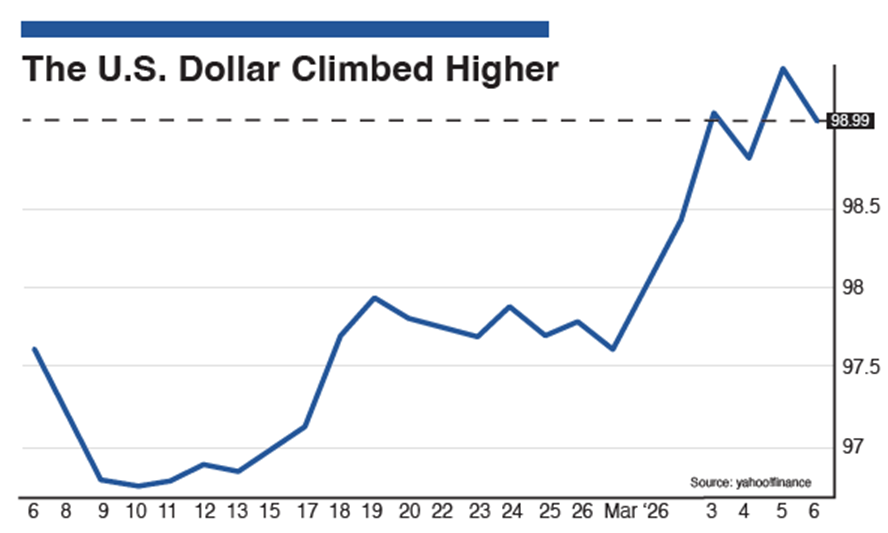
But based on everything I just said, there’s no reason to expect the dollar’s recent strength to last.
And there are MANY reasons to be worried about the U.S. financial system going forward.
Thus, you should also ignore gold’s recent middling performance and all the people pointing to that as proof that the big bull run is over.
As I explained last week, gold often underwhelms during the height of an actual crisis.
Given inflationary forces … accelerating government debt … and global tensions … we have the perfect storm for higher gold prices longer term.
I also think it’s worth noting that crypto has been keeping its head up quite nicely ever since the war broke out.
In my mind, that’s for all the same reasons I just outlined.
Because like gold, crypto also serves as a store of value outside government controls.
So, as I keep saying, if you do not have a portion of your portfolio allocated to precious metals … and another portion allocated to crypto … right now is the perfect time to make those changes.
Only you can decide how much of each is appropriate.
However, it’s easy to do in any account through various ETFs, including the SPDR Gold Shares ETF (GLD) for gold and the Grayscale Bitcoin Trust ETF (GBTC) for Bitcoin.
Best wishes,
Nilus Mattive
P.S. For even more leverage, you should also consider companies tied to contra-dollar assets like gold and other metals.
And the private investment Chris Graebe talks about in this video is a perfect example.