 |
| By Nilus Mattive |
I started my career on Wall Street back in 1999, right at the very height of the Dot-Com-fueled “irrational exuberance.”
Back then, investors — and I use that term lightly — cared very little about companies making real products or generating steady profits.
Those types of stocks were considered boring. Slow growth. Old-line dinosaurs.
You could find many such companies trading at very low valuations. Nobody wanted them at all.
Meanwhile, the same people would gladly pay just about ANY price for a company showing big revenue gains or making big promises related to a new thing called the Internet.
Does any of this sound familiar to you?
If not, just substitute “internet” for “AI.”
Yes, I’ve been saying this for a while now.
That doesn’t make it less true.
Indeed, Alan Greenspan first used the term “irrational exuberance” back in 1996 to describe what some people considered an overly speculative mindset gripping stock investors.
The Dot-Com Bubble continued to inflate all the way into the year 2000. That was when Robert Shiller used the phrase to title his now-famous book.
The same month the book went to press was when the party finally ended with a spectacular stock market meltdown.
By all means, enjoy whatever gains you’re making right now.
Just know this current euphoria won’t last forever.
This Time Won’t Be Different
The signs are everywhere.
The same halo effect on anything related to AI.
The same ultra-stretched valuations.
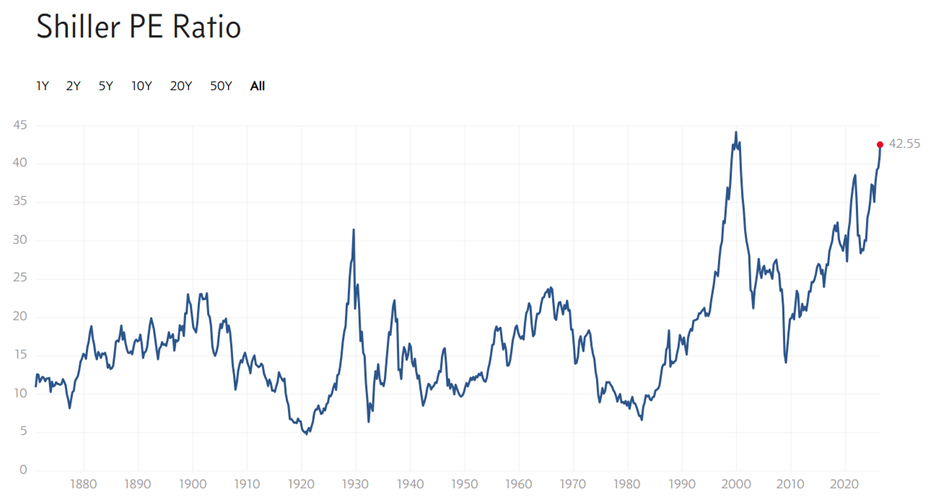
Anecdotally, I’m also seeing the same universal interest in investing that I did back in 1999.
Friends, family and acquaintances all want to talk about investing with me.
Some are sharing their big gains and war stories. Many more are asking how to get started.
I’m also seeing wildly irrational moves in some of the stocks I personally own or follow.
Take Perpetua Resources (PPTA), which I have written about here before.
A few years ago, the gold and antimony mining company was a promising-but-still-risky project.
Today, it’s an entirely different story.
All of its permits are in.
Companies like JPMorgan Chase (JPM) and Agnico Eagle Mines (AEM) have taken substantial stakes.
And on May 21, the Export-Import Bank of the United States (EXIM) officially approved a massive $2.9 billion loan that will effectively fund the entire project.
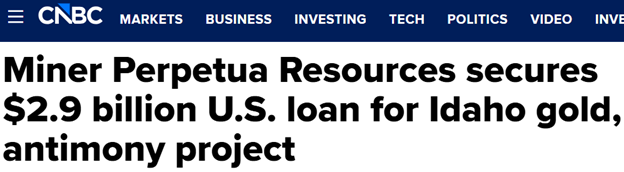
The terms of the loan, which is basically coming straight from the federal government, are also quite favorable at just one percentage point above long-term Treasury rates.
Rather than soar on that final bit of news, the stock actually pulled back.
In contrast, a group of technology stocks — names like IBM (IBM), D-Wave (QBTS) and Rigetti (RGTI) — started soaring right around the same time.
The reason? News that the U.S. government would throw as much as $2 billion into nine different quantum computing firms under the U.S. CHIPS and Science Act of 2022.
This is absolutely great news, yes. But it’s not substantially different than what Perpetua announced.
In fact, Perpetua’s loan will be worth 50% more than the amount being pledged to all nine of the tech companies.
Heck, the loan is worth the company’s entire market cap right now. And it doesn’t include the issuance of any equity in return.
The action certainly isn’t based on fundamentals, either.
I would argue a company like Perpetua is on a much clearer path to profitability than a company like Rigetti or D-Wave. It’s also much easier to value using standard industry metrics.
For example, with gold at $4,500, the net present value (NPV) of Perpetua’s mine is roughly $6.1 billion.
That means the stock is trading at about half that, which is a lower valuation than it often had BEFORE major risks like permitting and financing were removed and at the low end of what a project like this would normally be trading at.
It’s substantially harder to say what Rigetti or D-Wave will make from quantum computing because they’re still quite early stage.
We can’t even say if they’ll make anything or even emerge as dominant players in the space.
Heck, we can’t even say much about the space itself, other than it seems promising.
None of this is an argument against putting money into the companies, mind you.
I leave the final word on that to serious tech analysts like our in-house expert Michael Robinson.
Likewise, Perpetua remains a relatively risky miner with several more hurdles still ahead of it.
My bigger point is that hype, momentum and speculation are driving market action a lot more than cold, hard logic … and you can see this in daily juxtapositions like the examples I just shared.
The good news is that we can profit from this current dynamic — while also maintaining a much bigger margin of safety — by continuing to focus on high-quality, durable businesses that aren’t getting a lot of attention at the moment.
Because if there’s one thing I’ve learned during past market cycles, it’s that paying fair prices for good fundamentals is always the better game in the end.
Best wishes,
Nilus Mattive
P.S. I have many other actions you can take if you share in my pessimism about today’s AI-driven market.
I put them together in a special presentation here. I hope you check it out.