 |
| By Mark Gough |
One of the fastest-growing markets is not stocks, bonds or even crypto.
And now, this “hot commodity” is in the crosshairs of an important court battle with a major market regulator.
The impact of this decision could have wide-ranging implications for everyone from individual traders to Fed governors.
Let me explain …
Last week, the Commodity Futures Trading Commission filed an amicus brief — a formal “friend of the court” filing — with the Ninth Circuit Court of Appeals.
The brief made one thing clear: The CFTC views prediction markets as firmly within its jurisdiction.
Now, it’s seeking to codify its understanding into law.
The CFTC’s amicus filing with the Ninth Circuit Court of Appeals.
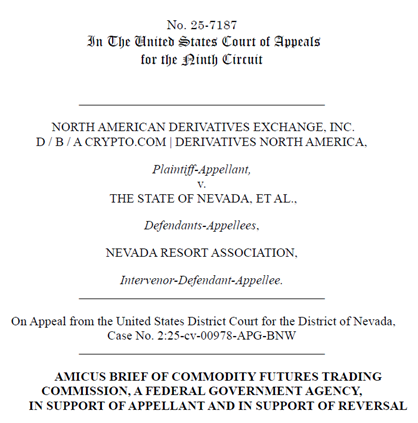
Specifically, the court will decide whether the “event contracts” that prediction markets run on can qualify as commodity derivatives under the Commodity Exchange Act (CEA).
Even if you don’t follow or trade on prediction markets, there are plenty of influential people who do.

That’s why it’s important to understand …
How Prediction Markets Work
Prediction markets allow participants to trade “event contracts.”
These are based on the outcome of future events … or whether they could happen at all.
Most event contracts are binary:
- $1 if the event occurs.
- $0 if it does not.
If a contract trades at 62 cents, the market implies a 62% probability.
These markets have existed in limited academic and commercial forms for decades.
What has changed in recent years? Scale and accessibility.
Modern platforms now list contracts tied to elections, economic releases, policy decisions and sporting outcomes.
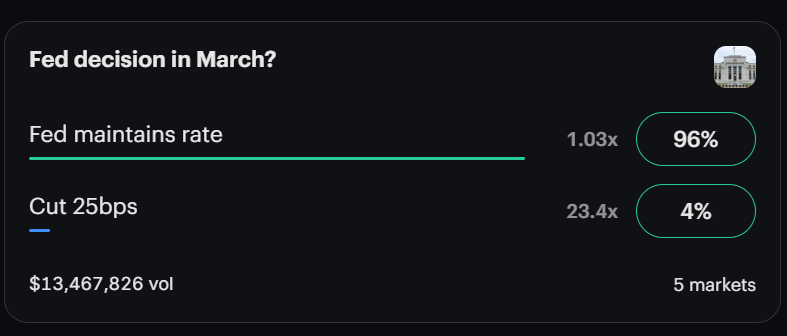
No wonder the Fed is watching them!
The prediction markets can be quite lucrative. Just look at this year’s Super Bowl data.
DeFi Rate tracked the volume for Super Bowl pools on 68 platforms.
Combining the volume for just the two top platforms, Kalshi and Polymarket, reveals an incredible $1.63 billion total.
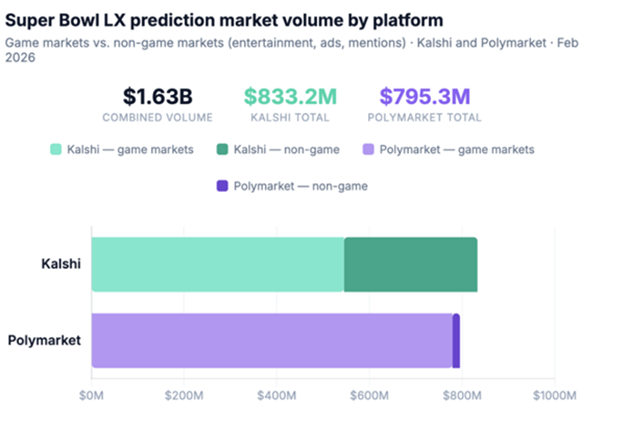
For perspective, Kalshi alone saw over $800 million in volume.
That was a 2,700% year-over-year increase just in one market.
With growth like that, a regulatory debate was only a matter of time.
The Legal Question: Derivatives or Gaming?
The dispute ultimately hinges on classification.
States contend that the event contracts tied to sports outcomes resemble unlicensed sports wagering. So, they should be treated as such.
However, the platforms argue that once the CFTC allows a contract under federal law, state interference is preempted.
The CFTC’s amicus brief asks the courts for an official answer.
- If prediction market contracts qualify as commodity derivatives, then federal jurisdiction applies.
- If they are deemed gambling products, then state regulators may assert authority.
This is more than just debating a dictionary definition.
It’s a legal battle that can move a large amount of power out of the hands of states.
So, what happens if the long arm of the (financial) law lengthens its reach?
What’s at Stake?
At stake is not just the legality of specific contracts, though that’s important.
The broader question here is how far federal derivatives law extends into event-based financial products.
If the Ninth Circuit Court rules in the CFTC’s favor, then we have a rough idea of what could come next.
The CFTC has indicated that upcoming rulemaking will clarify how specific provisions in the CEA apply to modern event markets.
That includes …
- The scope of prohibited gaming contracts.
- Public interest standards.
- Market integrity and anti-manipulation safeguards.
- Compliance obligations for platforms.
The outcome will define the regulatory perimeter for event-based trading in the U.S. going forward.
And now is the time for this clarity.
Prediction markets have seen meaningful growth in participation over the past year.
Particularly around elections and major sporting events.
There are even bets on how long the partial government shutdown will last.
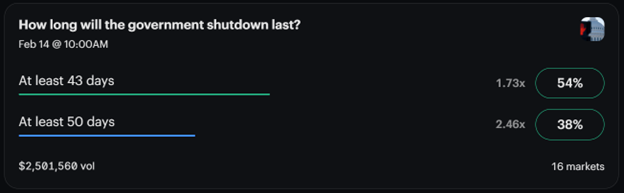
If the U.S. can figure out how to regulate it, U.S. investors will be able to access their share of this impressive market before it’s done growing.
For now, prediction markets continue to operate, but under active legal challenge.
So, you’ll need to remain cautious when dealing with prediction markets.
There’s another market that is already regulated by the CFTC and doesn’t have to operate “under active legal challenge”: gold.
The CFTC regulates the gold market so certain companies can’t charge exorbitant prices or sell unscrupulous precious metal products.
Of course, the far better way to buy gold is one my colleague, Sean Brodrick, recently told readers about.
Here’s how he recommends you take advantage of his $10k-per-ounce gold price target without buying a single ounce.
Best,
Mark Gough