
 |
| By Sean Brodrick |
Gold is coming off its worst quarter since 2013. But finally, FINALLY, it seems precious metals are stabilizing after a sharp drawdown.
Gold remains roughly 20%-25% below its January highs but logged a roughly 2%-3% weekly gain, while silver rallied about 6%-7% on short-covering and macro relief.
While that’s not much of a bounce … yet … it may be the start of something bigger. I’m talking about seasonal trends.
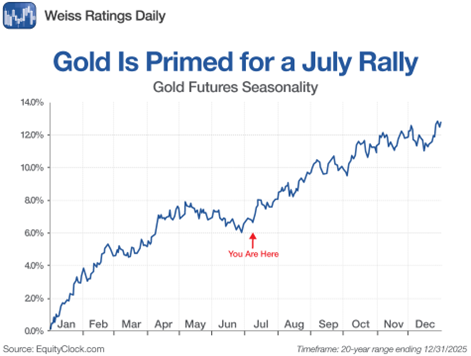
This chart of seasonal percentage moves in gold futures shows it usually bottoms in early July. It then rallies through the end of the year.
Are we going to see the same thing this year?
After all the sound and fury of the Q1 sell-off, gold still has a structurally bullish setup resting on a three-legged catapult:
- Ongoing central-bank buying.
- The Fed backing off its tough-on-inflation stance.
- A tight mine-supply pipeline after a decade of underinvestment.
A look at these three shows us the path forward …
Central Bank Demand
Global central banks have shifted from being marginal diversifiers into persistent, structural buyers of gold.
World Gold Council data show central banks added a net 41 metric tonnes of gold in May, extending the post‑March re‑acceleration of official-sector demand.
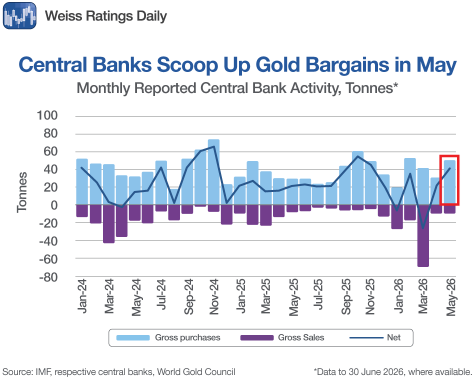
In fact, gold now composes a larger share of central-bank reserves than U.S. Treasuries for the first time since the mid‑1990s.
This is a powerful signal that reserve managers are reweighting away from dollar assets toward bullion.
Fed’s Tough Talk Fizzles
Real yields are interest rates after adjusting for inflation.
When they fall, that tends to support gold because it lowers the “opportunity cost” of holding a non‑yielding asset like the yellow metal.
Gold has been under pressure because the market thought new Fed Chair Warsh was signaling “more rate hikes, faster.”
Instead, in the last week or so, the tone from the Fed and surrounding commentary has shifted toward “higher for longer, but no hurry to hike.”
And in the last week, the data is clear that the labor market is losing momentum.
Nonfarm payrolls rose only 57,000 in June, less than half the consensus expectation (~115,000) and far below earlier‑year prints.
Not only should that give the Fed pause, but it also raises the potential that the Fed’s next action will be to cut rates.
Gold Haunted by Mine Underinvestment
The past decade’s underinvestment is now biting, and the project pipeline to 2030 is thinner and more politically challenged than in prior cycles.
Miner spending on new projects is off the trough it hit a few years ago, but still very low.
In fact, PwC’s “Mine 2026” estimates that mining development capital — the capex that actually creates new supply, not just sustaining — is running about ONE-EIGHTH of where it should be.1
And S&P’s latest “World Exploration Trends 2026” shows that global nonferrous exploration budgets were $12.4 billion in 2025, marking a third consecutive year of decline in nominal terms.2
While gold exploration budgets went up, they’re nowhere close to where they need to be.
It takes years — sometimes decades to bring a new mine online. The data shows that the next 15 years will be lean ones for new mines coming online.
That means the underlying global supply will remain tighter than tight — supporting prices.
How You Can Play It
Something like the iShares Gold Trust (IAU) — which owns physical gold — is a fine way to play it.
But I’d bet on junior gold miners, because they are leveraged to the underlying metal.
And an easy way to buy a basket of juniors is to buy the VanEck Junior Gold Miners ETF (GDXJ).
In fact, a chart shows the GDXJ has pulled back to a 50% retracement of the big rally that started last year.
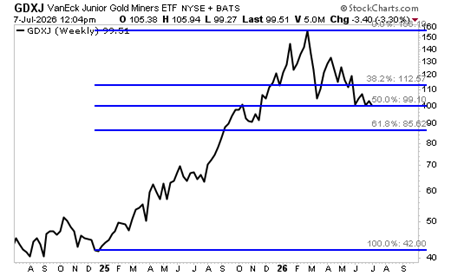
Any market technician will tell you this is a good place for the next big rally to start.
Do we know that will happen for certain? No. But we do know that seasonality favors gold right now.
Heck, last year, gold rallied about 45% from early July 2025 through year-end.
So for many reasons, I think gold — and miners — deserve a place in your portfolio now.
The market hates gold … for now.
This is where rallies are born. And you could make a fortune by getting ahead of the Street.
All the best,
Sean
P.S. ETFs like those above will give you a solid start. But if you really want to take advantage of this three-legged catapult, you’ll need this.
1 https://www.pwc.com/gx/en/industries/energy-utilities-resources/publications/mine.html