 |
| By Jim Nelson |
You'd never rebuild your house every two years.
Big Tech is about to do exactly that.
You see, everyone is focused on the cost of building AI data centers.
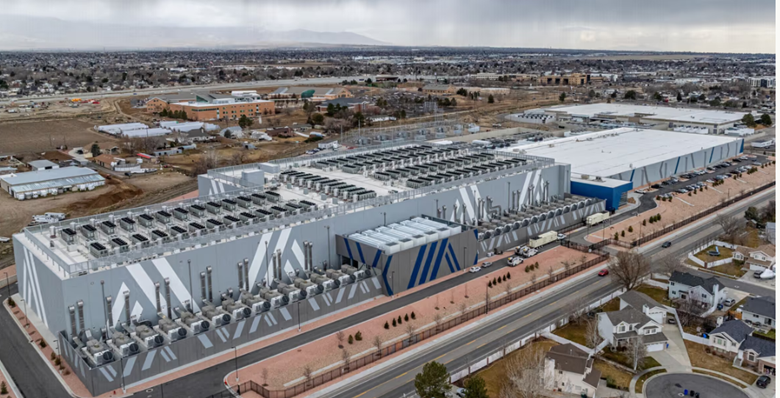
The land, the power infrastructure, the cooling systems, the concrete …
And the billions of dollars flowing from Microsoft (MSFT), Alphabet (GOOGL), Amazon (AMZN) and Meta (META) into what has become the defining capital expenditure race of our era.
Those numbers are staggering on their own.
Gartner puts total global data center investment in the hundreds of billions annually, with AI infrastructure driving the lion's share of new spending.
But there's a cost that almost no one thinks about — the replacement cost.
And when you understand how dramatically that number has grown, and how fast the cycle is moving, it reframes the entire economics of AI infrastructure.
The Chip Has Changed Everything
Let's start with how data centers used to work.
In a traditional data center, chips like processors, memory and networking silicon represented roughly 15% to 25% of the total build cost.
The rest went into the physical infrastructure: the building, the power systems, the cooling, the cabling, the concrete.
And those chips were replaced approximately every five years, which was just long enough to depreciate the investment meaningfully before the next generation arrived.
That model made financial sense.
The math was predictable and operators could model their total cost of ownership with reasonable confidence over a decade-long horizon.
But AI data centers have broken that model entirely.
In an AI-optimized facility, the kind being built right now to train and run large language models, chips now represent 40% to 55% of the total build cost, nearly half, or more than half, of everything spent to bring that facility online.
Here’s the cap ex breakdown of a typical facility:
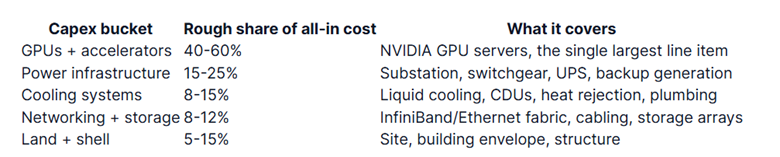
That shift alone changes the economics substantially.
But it's the second number that really changes the picture …
The Replacement Cycle
Those chips, now representing the dominant cost of the entire facility, are being replaced every 18 to 36 months.
The days of five-year replacements are gone.
The pace of advancement in AI silicon has been relentless. So aggressive that each new generation of chips renders the previous generation materially less effective.
And this new 18-36-month replacement timeline is still shrinking.
But we’ll be conservative and look at the math at this current rate …
You build a state-of-the-art AI data center where chips represent, say, 50% of your build cost.
Then 18 to 36 months later, the chips need to be replaced to remain competitive for frontier AI workloads.
And because each successive generation of AI silicon is more powerful than the last, that replacement round doesn't cost you what you paid the first time.
Naturally, it costs you more.
In some cases, much, much more.
The cost of one replacement — chips only, not the building, not the power infrastructure, not the cooling — can exceed the original all-in cost of constructing the entire facility.
Concrete included.
What This Means for the Companies Building
This is no theoretical concern. It's an operational reality that the largest technology companies in the world are already navigating.
Microsoft, Google, Amazon and Meta have each committed to multi-hundred-billion-dollar AI infrastructure programs over the next several years, with full awareness of the replacement cycle dynamics.
After all, these are sophisticated operators with large teams modeling exactly this kind of long-term cost structure.
But the commitment to absorb those costs is itself a signal.
When the largest, most cash-generative technology businesses on the planet decide that these off-the-charts replacement economics are acceptable, that tells you something important about how they view the strategic stakes.
They're not building data centers to depreciate over a decade. Rather, they’re building infrastructure they expect to continuously upgrade.
Why?
Simply because the competitive cost of falling behind is higher than the financial cost of staying current.
All of this has cascading implications for the companies supplying the chips.
The Investment Angle
Every 18 to 36 months, every major AI data center in the world needs to be re-equipped with a new generation of silicon that costs more than the generation it's replacing.
In the most important technology race of the century, the only thing more expensive than upgrading is not upgrading. This investment makes the difference between surviving or not.
That's not a one-time market phenomenon, but a recurring revenue model at the infrastructure level.
It’s the kind of deeply embedded, competitive spending necessity that doesn't go away when budgets tighten.
And while members of the Mag 7 are experiencing record revenues, their spending is also off the charts.
Over this latest period, they are increasingly relying on debt — both on and off the books — to compete.
As this replacement cycle gets shorter, that will mean even more debt, private credit facilities and financing arrangements.
And because these AI data center owners aren’t simply going to banks for loans, we won’t know how much strain that puts on the entire credit landscape.
That’s exactly what Dr. Martin Weiss and safe-money expert Nilus Mattive have been working to unravel.
Their conclusion is beyond worrying.
They are calling this a new subprime crisis that could be even more damaging than the last one nearly two decades ago.
Fortunately, they also have solutions. Simple moves to avoid the worst of the fallout.
In fact, they just shared all of that in a brand-new presentation.
This data center buildout is just the start. The real problem could come from the second and third rounds of spending.
That’s why you need to stay vigilant and ahead of the real costs to you.
Sincerely,
Jim Nelson