 |
| By Gavin Magor |
The stock market is about to lose its weekends.
Robinhood Markets (HOOD) said this week that, starting early next year, its customers will be able to trade a curated list of U.S. stocks and ETFs 24/7, including Saturdays and Sundays.
The plan still needs regulatory review, but management told its HOOD Summit audience the fight for weekend trading is over.
Robinhood also rolled out AI trading agents that can build strategies and place trades around the clock, plus crypto perpetual futures with up to 10 times leverage on Bitcoin and Ether.

Its chief brokerage officer summed up the pitch: Breaking news doesn't wait for an opening bell.
What's Actually Changing
The Robinhood 24 Hour Market already runs from 8 p.m. Sunday to 8 p.m. Friday, Eastern time.
Weekend trading closes the last gap.
It also sets up a race.
The Nasdaq Stock Market won SEC approval in April for a 23-hour, five-day (23/5) session, with Dec. 6 set as the start date.
Four other exchanges, including NYSE Arca and Cboe's EDGX, have conditional approval for the same schedule.
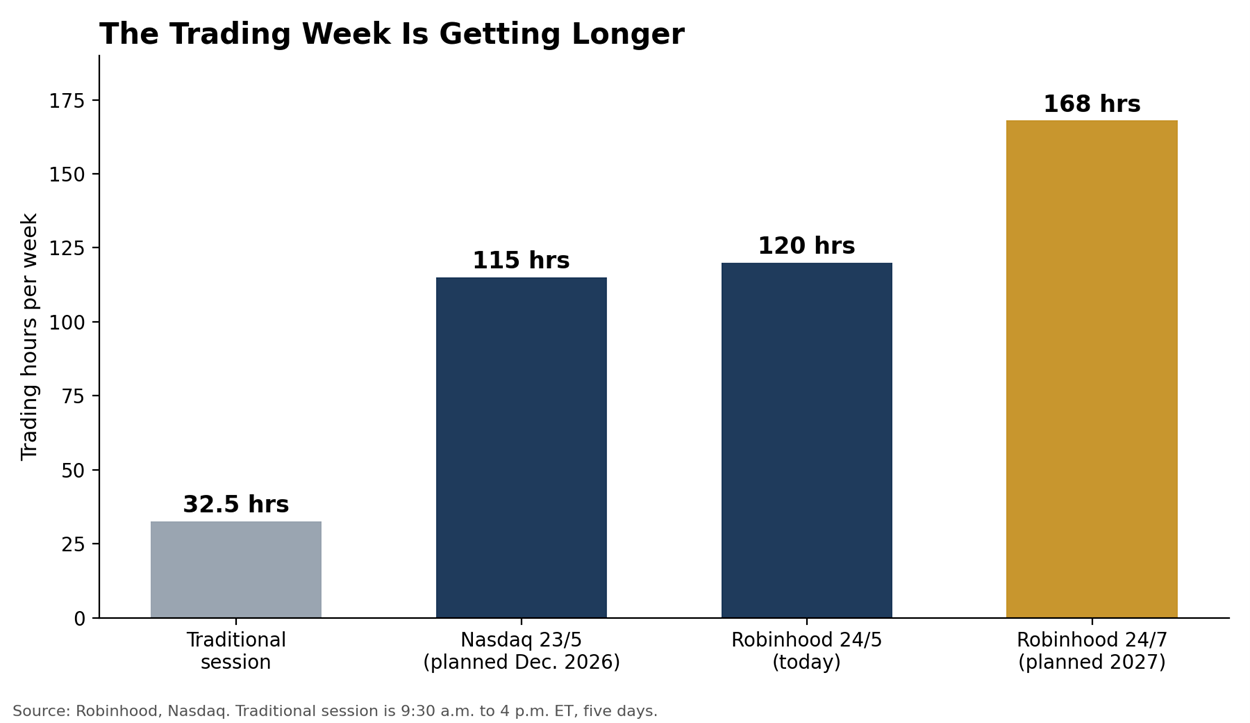
So, a trading week that has long been 32.5 hours is heading toward 168.
The Weekend Test Came Early
Investors got a preview of round-the-clock pricing before the product even launched.
Robinhood's shares traded as high as $119.25 overnight Wednesday after the announcement, up from Tuesday's close of $116.22.
By Thursday’s closing bell, HOOD had slipped to $111.15.
That's what happens when a market has more hours to change its mind.

Robinhood carries a Weiss rating of “C,” a HOLD.
Its beta, a measure of how much a stock swings relative to the market, is 3.20.
The shares have lost 20% over the past year, after gaining more than 1,000% over three years.
Follow the Growth
Robinhood's August operating data shows where its momentum really comes from.
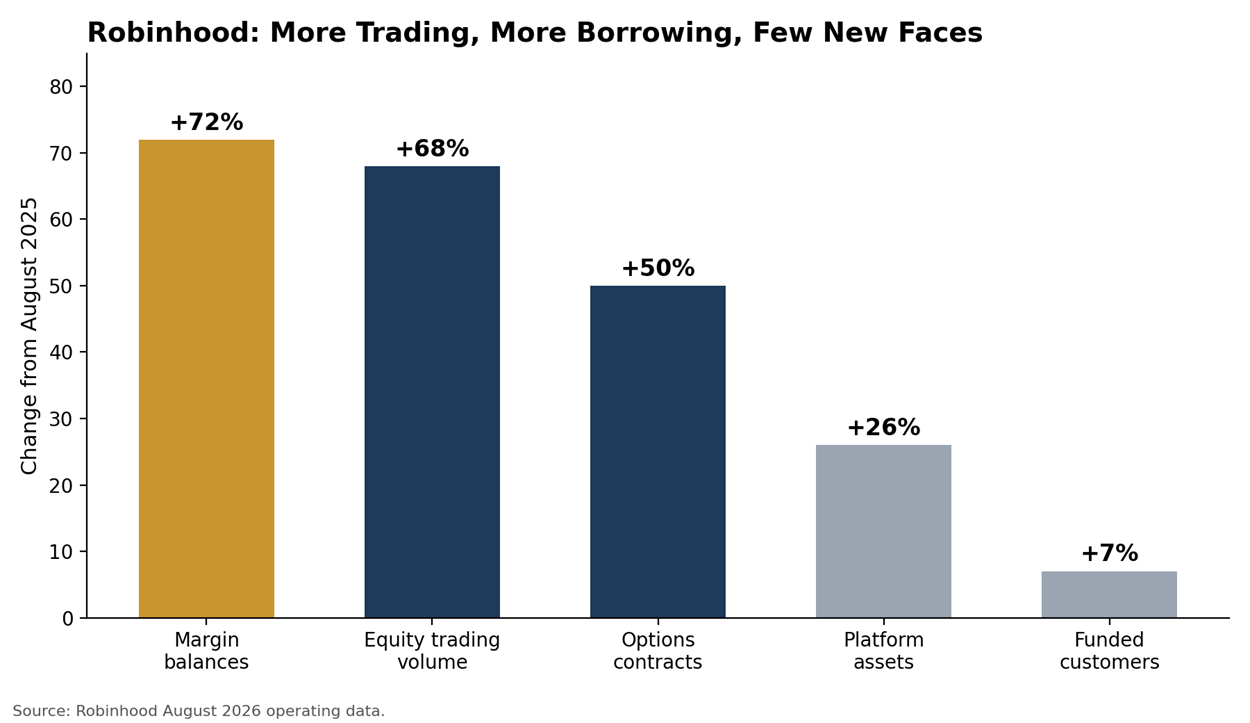
Funded customers grew about 7% from a year earlier, to 28.6 million.
Margin balances, the money customers borrow to trade, jumped 72% to $21.5 billion.
Equity trading volume rose 68%, and options contracts rose 50%.
In other words, the growth is coming less from new investors and more from existing ones trading more, often with borrowed money.
Weekend hours, AI agents and leveraged crypto futures all push in that same direction.
That's good for Robinhood's revenue.
Whether it's good for Robinhood's customers is a separate question.
I expect the rest of the industry to match weekend hours within a year, just as it matched Robinhood on zero commissions.
Who Else Wins When the Market Never Closes
Whilst Robinhood grabbed the headlines, the steadier way to own this trend is through the companies that run the pipes and hold the accounts.
Nasdaq (NDAQ): the toll collector.
Nasdaq carries a Weiss rating of “B,” a BUY.
Every extra hour of trading on its exchange is another hour of fees.
It's also looking further ahead, with a $100 million stake in Kraken's parent company, Payward, as it builds toward tokenized stocks.
Its beta is 0.96, it pays a 1.26% dividend yield, and it trades at 26.8x earnings, against Robinhood's 51.2x.
Charles Schwab (SCHW): the quiet incumbent.
Schwab also carries a Weiss rating of “B,” a BUY.
It already offers overnight trading, five days a week, in every S&P 500, Nasdaq-100 and Dow 30 stock, plus more than 600 ETFs.
It trades at 18 times earnings with a beta of 0.85.
The shares are down 11.7% over the past 30 days, which looks to me like an opportunity rather than a warning.
Interactive Brokers (IBKR): the professional's platform.
Interactive Brokers carries a Weiss rating of “C+,” a HOLD.
It already offers near-24-hour trading six days a week, and its shares are up 34.4% this year.
It's a quality operator, but the rating says the risk-adjusted case isn't there yet.
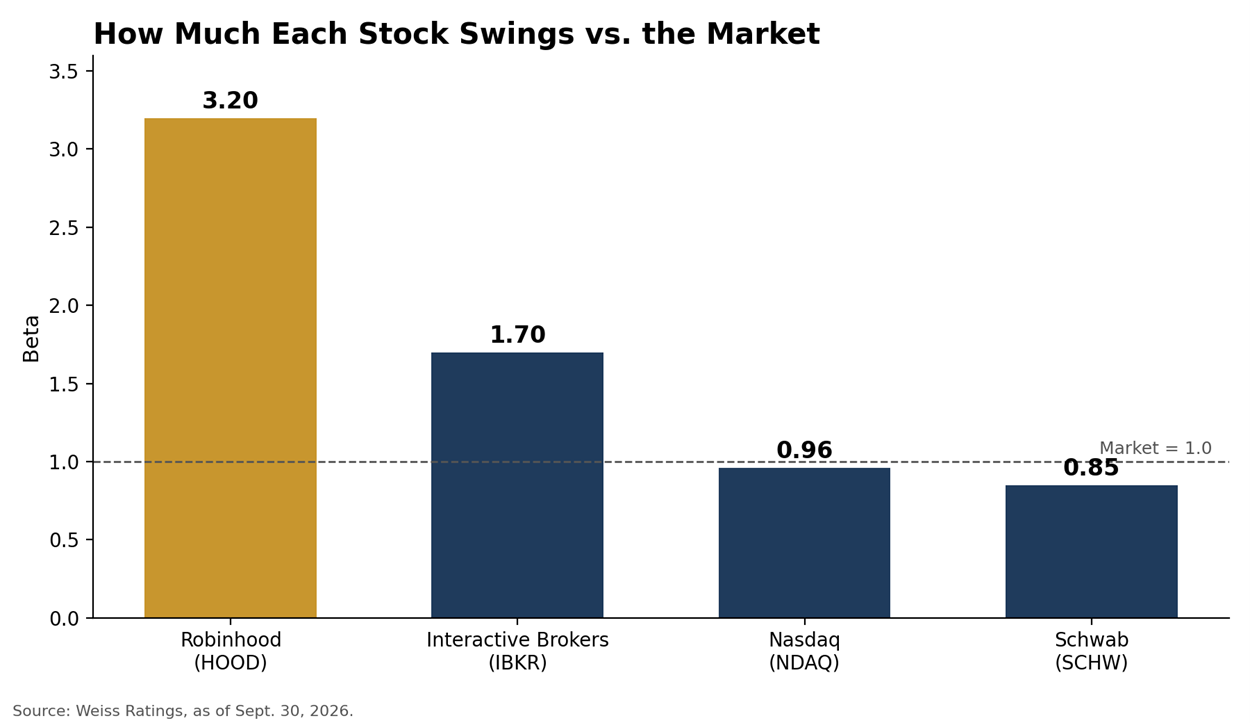
The company selling excitement turns out to be the most exciting stock in the group.
What This Means for You
Weekend trading will be thin trading, at least at first.
Fewer buyers and sellers means wider gaps between bid and ask prices, and bigger swings on less news.
So, if you ever trade outside normal hours, use limit orders, not market orders.
Treat a Saturday price as a rumor, not a verdict.
And if a stock you own drops on a Sunday, you don't have to answer it on a Sunday.
For my part, Saturdays in Vermont are for splitting wood, not splitting hairs over a bid-ask spread.
What I'm Watching
- Whether the SEC signs off on weekend stock trading, and which stocks make Robinhood's curated list.
- Nasdaq's planned Dec. 6 launch of its 23-hour session.
- Robinhood's September operating data, especially margin balances.
- Schwab's third-quarter results in mid-October.
Bottom Line
Robinhood is betting that more hours will mean more trading.
The numbers suggest it's right.
But the better way for most investors to profit from a market that never sleeps is to own the businesses that collect a fee every hour it's open, like Nasdaq and Schwab.
The stock market is about to lose its weekends.
You don't have to lose yours.
Cheers!
Gavin