The U.S. Government Stole Gold Once. They Could Do It Again

|
Key Takeaways
|
 |
| By Nilus Mattive Reviewed by: Jim Nelson |
I don’t wear much jewelry, but I recently bought a new ring.
It’s a collaboration between two different artists who use U.S. currency as their primary medium.
The central part of the piece is an old U.S. Mercury dime that has been reworked.
Instead of showing a young Lady Liberty wearing a winged Phrygian cap, it now shows a robber wearing a ski mask.
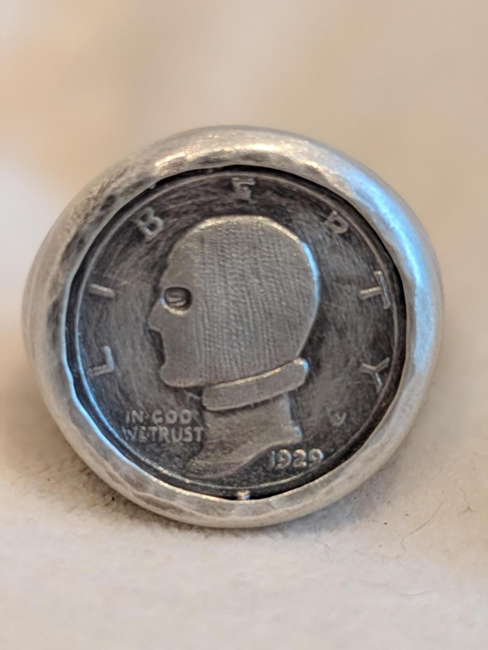
There’s a lot of history packed into my new ring … and plenty of lessons that connect to the present time.
Let’s start with …
The Era of Hobo Nickels & Rockefeller’s Dimes
People have been carving, cutting and altering coins to make art for roughly 2,000 years. But it really started gaining popularity in the United States back in 1913.
That’s the year the Federal Reserve was founded, and a permanent income tax was instituted, which would be reason enough for people to want to destroy some coins.
However, it had a lot more to do with the introduction of the buffalo nickel.
The coin was 75% copper and 25% nickel … relatively soft and large … and thus easily altered with knives, nails or other tools.
In the wake of the 1929 stock market crash, transient laborers and homeless men had a lot of time on their hands.
So they passed their days turning the buffalos into bearded men, skulls or other animals and traded these “hobo nickels” for food, shelter, train rides or small amounts of cash.
What about my ring, which is actually a Mercury dime rather than a buffalo nickel?
It was far less common to carve up dimes back then. However, one man — John D. Rockefeller — became famous for handing out Mercury dimes to regular people as a way of connecting with them.
He often accompanied the gifts with little talks about saving and being thrifty. Some estimates say he gave away as much as $35,000 in dimes over his lifetime.
Of course, Rockefeller was the richest man of his time and one of the people often cited as a “robber baron” because of the strong-arm tactics he used to build and maintain Standard Oil.
Some people even say his dime giveaways were just a way to clean up his image.
Which is why it’s especially funny that the image on my ring’s dime has been altered to show a man in a ski mask.
Better yet, the dime dates to 1929, the year of the most infamous stock market crash in history … the final result of an industrial boom driven by wild speculation and unchecked greed.
Here we are almost exactly 100 years later in a very similar environment. The similarities are uncanny.
Of course, in the wake of the 1929 stock market crash, the U.S. government became the biggest thief of them all!
With 25% of the population out of work …
The stock market still losing value …
And people carving up nickels to make them worth a little more …
The government needed a way to print more money and get the economy back on track.
The problem: They were on the gold standard, which meant U.S. currency was backed by actual metal.
Lawmakers couldn’t just lower interest rates and inject more money into the system.
Gold kept them honest. They had to compete with other countries for investment money. And that meant keeping interest rates higher.
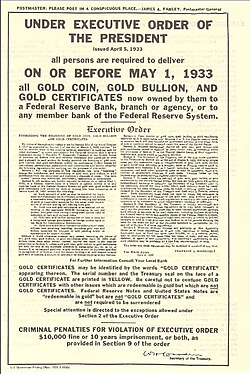
The solution was the issuance of Executive Order 6102 on April 5, 1933. It effectively outlawed private ownership of gold coins, gold bullion and gold certificates within the continental United States.
From that point forward, individual citizens were only allowed to keep up to $100 in face value of gold or about five troy ounces along with rare collector coins or metal needed for industrial purposes.
Everything else had to be turned in by May 1 at an exchange rate of $20.67. Failure to accept this deal was punishable by fines up to $10,000 (about $260,000 today) and/or 10 years in prison.
If that isn’t theft, I don’t know what is!
But it got worse …
The following year, the U.S. created The Gold Reserve Act of 1934. It raised the official price of gold to $35 per troy ounce, effectively devaluing the U.S. dollar and handing the government a massive profit on all its newly stolen gold.
Private gold ownership remained illegal for the next 40 years.
Bottom line …
As my ring reminds us, the first several decades of the 20th century were dominated by a handful of ruthless tycoons …
Who ushered in a technological revolution …
That turned into a speculative frenzy and an even bigger crash …
Which forced everyday citizens to do anything they could to make ends meet …
While the government did everything it could to rob the population blind in an effort to “fix” things.
Worried that history could be repeating itself a century later?
You’ll want to hear Dr. Martin Weiss’ warning and list of solutions here.
Best wishes,
Nilus Mattive