 |
| By Sean Brodrick |
What with the tech-stock roller coaster and various shenanigans in Washington, D.C., you may have missed the bull market unfolding right under your nose.
And that’s because …
Gold is back, baby!
Gold roared roughly 15% higher in August through Monday, briefly topping $4,680 an ounce — its highest level in more than three months.
What’s driving the rally? And, more importantly, what’s the best way to play it?
I have some ideas.
Here are three forces driving the move.
3 Forces Fueling Gold’s New Bull Run
The long-term forces I’ve talked about for years remain firmly in place: central-bank gold buying, tight mine supply, fewer major gold discoveries and the relentless debasement of paper currencies.
Now, three additional forces are kicking the bull market into a higher gear.
No. 1: Treasury Market Intervention & Dollar Weakness
Sources close to Treasury Secretary Scott Bessent say he could tap nearly $1 TRILLION from Treasury’s general account to fund bond buybacks.1
That comes on the heels of Treasury announcing it would double the size of its liquidity-support buybacks of long-dated government bonds.
Those purchases put downward pressure on yields and the dollar while raising fresh questions about Washington’s $40 trillion debt load, fiscal sustainability and eventual dollar debasement.
All of that is bullish for hard assets.
If the idea of $40 billion in Treasury buying helped send gold higher, imagine what a trillion-dollar money cannon might do.
And remember, gold is priced in dollars.
A weaker greenback makes gold cheaper for foreign buyers and tends to push its dollar price higher.
No. 2: The Fed’s Tough Talk Is Losing Its Bite
All that tough talk Fed Chair Kevin Warsh made about inflation and interest rates is increasingly being viewed as just that — talk.
I’ve said for a while that I don’t expect the Fed to raise rates until after the midterms, and maybe not until 2027.
Wall Street is coming around to my view.
Rate-hike expectations peaked in early August, when markets priced in a 55% probability of a 25-basis-point hike at the Sept. 16 Fed meeting.
Now that probability is down to 37%. And I think it goes lower still.
That matters because higher interest rates increase the opportunity cost of holding gold, which pays no interest.
Take those expected rate hikes off the table and one of the biggest potential headwinds for gold disappears.
No. 3: Central Banks Are Buying with Both Hands
Central bank buying of gold has been a major driver for a while. But more recently, the People’s Bank of China (PBoC) expanded its gold reserves by 20 metric tons in July.
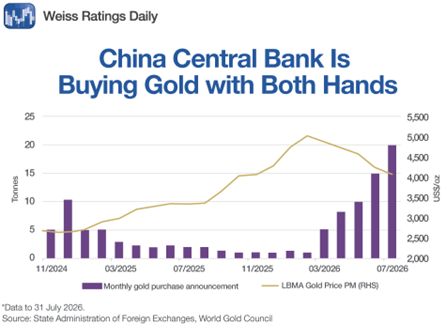
Goldman Sachs estimates China also bought 88 tonnes through London’s over-the-counter market in May and June, although official figures are lower.
The PBoC’s July purchase was its biggest since October 2023 and extended its buying streak to 21 consecutive months.
Official Chinese gold reserves now stand at a record 2,366 tonnes.
And China isn’t alone.
Global gold ETFs have swung sharply from outflows to inflows.
Big money isn’t merely returning to gold — it’s buying at an accelerating pace.
Throw in the latest U.S./Canada trade SNAFU and the uncertainty it creates for economists, investors and traders, and gold has another tailwind.
More fear usually means more demand for gold.
How You Can Play This
Last week, I recommended a fund that holds physical gold. That’s fine if you want direct exposure to the metal.
But if you really want to leverage this move, I believe you need to own the miners.
Why?
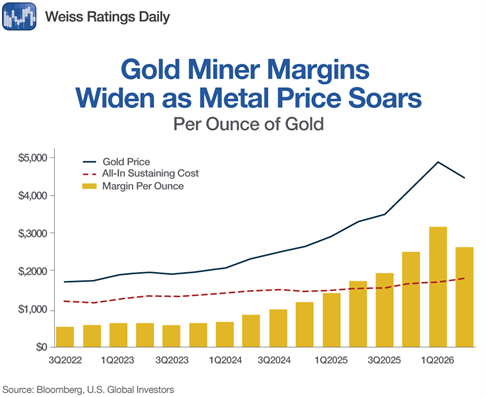
Because their profit margins are widening like the Grand Canyon.
U.S. Global Investors reports that since the third quarter of 2022, the average price that senior gold producers have received for an ounce of gold has risen by 161%.
Meanwhile, miners’ all-in sustaining costs (AISC) — which include sustaining capital as well as the cost of digging the stuff out of the ground — rose just 53%.
As a result, the average margin exploded from about $521 per ounce to roughly $2,636 per ounce.
And we have a great example in the Wealth Megatrends Portfolio.
At the same time that gold rose roughly 15% in August through Monday, Newmont (NEM) — the world’s biggest gold miner — rocketed from $91.34 to $131.84.
That’s a 44% gain in less than four weeks!
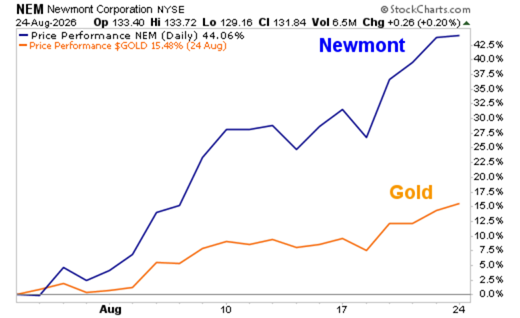
In other words, Newmont delivered roughly three times gold’s percentage gain during this recent run.
Why? Because gold miners like Newmont have turned into free-cash-flow machines. And I believe the market is still underpricing just how profitable they’ve become.
Record cash generation combined with rising revenue and earnings gives gold equities one of their strongest fundamental setups in years.
The sector stopped burning cash and started printing it. Valuations haven’t fully caught up.
Newmont is just one of the gold miners in the Wealth Megatrends portfolio, and they all rebounded in August.
You can find out more here.
But if you’d rather buy a basket of miners, my pick is the VanEck Junior Gold Miners ETF (GDXJ).
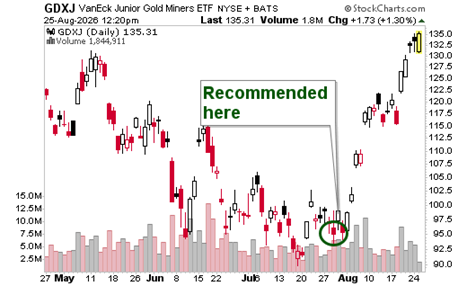
If you’d bought GDXJ when I last recommended it on July 29, you’d already be up about 40%.
And I don’t think this run is anywhere near done.
Consider this: From its October 2023 bottom to its January peak, GDXJ soared more than 415%.
I strongly believe gold is heading to $10,000 an ounce.
From current levels, that’s another move of roughly 112%.
If I’m right, the miners — and GDXJ — should have much bigger percentage moves.
That’s the leverage I want as gold’s new bull run gathers steam.
P.S. I’m headed to MoneyShow Orlando from Oct. 5 through Oct. 7, and I hope you’ll join me.
I’ll be speaking on two of my favorite investment themes: “Critical Metals for Maximum Profits” and “The Next 3 Space, Robotics and AI Stocks Ready to Blast Off.”
And I’m just one of a terrific roster of speakers covering the biggest opportunities in today’s markets. It should be a great event — and a great chance to meet fellow investors in person.
Check out MoneyShow Orlando here, and I hope to see you there.
1https://www.cnbc.com/2026/08/24/bessent-1-trillion-treasury-general-account-bond-buybacks.html