This Discount Retailer Repeats History by Ignoring the Market

|
Key Takeaways
|
 |
| By Nilus Mattive Reviewed by: Jim Nelson |
If you’ve been following my research here for any length of time, you know just how negative I’ve been on the AI trade.
You also know I’ve been warning that when it unravels, so will the major indexes because they’ve become so heavily weighted toward the technology sectors.
But I normally reserve my solutions — including specific stock recommendations — for my paid publications.
Today, however, I want to break that rule just to show you what a “Safe Money” stock actually looks like.
And since it’s already up more than 20% in the last two months, I don’t think anyone paying for my ideas will mind.
Indeed, that’s exactly what I want to show you.
Take a look at this chart, which compares this stock to the broad S&P 500 since my original recommendation on Sept. 11.
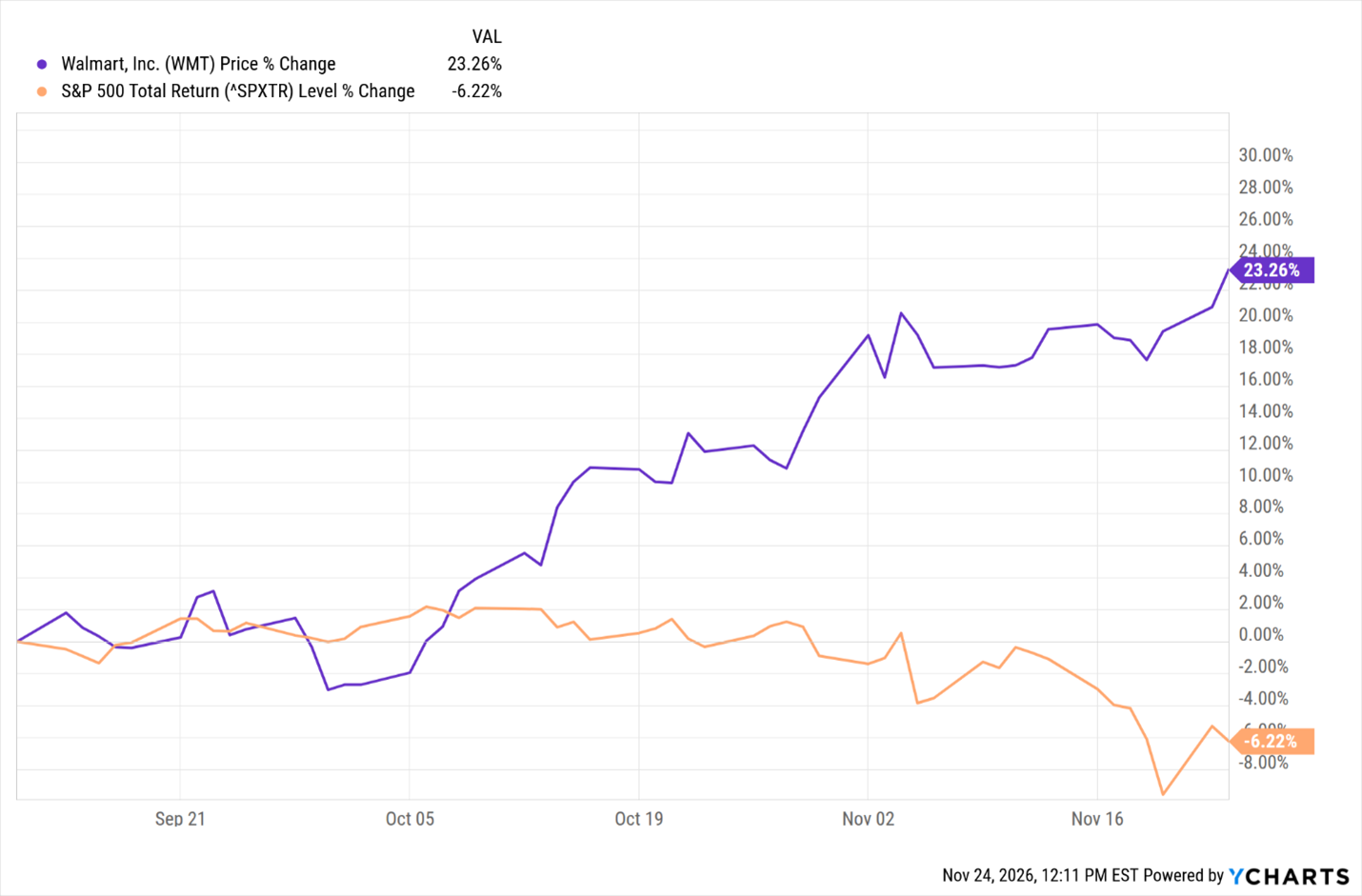
As you can see, the market dropped 6.2% while my recommended stock gained 23.26%.
That’s almost 30 percentage points of outperformance in roughly nine weeks.
Coincidence? Luck? Neither.
Before I profiled the company, I told my Safe Money readers …
“There’s no doubt that everything I’ve just described could absolutely torch the stock market, just as it did during the last financial crisis.
“If anything, the risk is far higher now.
“That’s because the Mag 7 stocks and other tech names currently account for a huge percentage of the overall S&P 500 Index.
“That means millions of retirement portfolios are carrying far more direct exposure to them than the owners even realize.”
And then here’s the writeup I gave them word for word …
As the Financial Crisis hit in full force and the U.S. economy plunged into recession, major U.S. stock market indices got completely hammered.
By March 2009, the S&P 500 was down more than 50% from where it had started 2008.
But a few well-known blue-chip stocks managed to buck the trend entirely.
Walmart (WMT) was one of them …
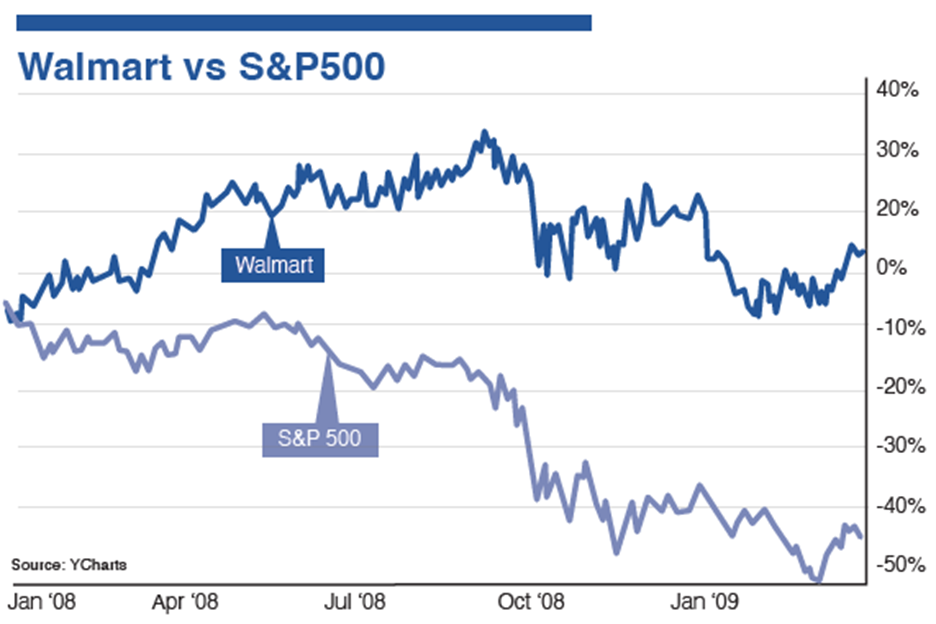
The company actually benefited as cash-strapped American consumers turned to its low-priced offerings, which is why its stock actually gained some as the broad market fell.
The ubiquitous chain has continued to grow since then and constantly finds new ways to capture more of its customers’ money.
Take delivery.
Back in 2008, Walmart was still very much a chain of brick-and-mortar stores.
Today, the company competes with companies like Amazon by leveraging the fact that 90% of Americans live within 10 miles of one of its stores.
Through its website and app, the company can use each location like a mini fulfillment center.
It also sells items that aren’t offered in its physical stores.
In a sign of how far things might go, the company just announced a new partnership with Dunkin’ Donuts to deliver drinks and meals alongside retail purchases.
The program expands on a trial it has been conducting with Subway.
Recent results have been strong overall.
During its Aug. 20 earnings call, the company beat expectations on both revenue and profits.
Sales were up 5.9% to $187.9 billion, and earnings per share hit 81 cents.
Management also raised its full-year guidance, saying it expected per-share earnings between $2.80 and $2.87.
However, investors focused on the fact that comparable store sales only rose 2.6%, the slowest pace in more than six years, and sold the shares aggressively.
I think that is creating a good entry point for patient, conservative investors.
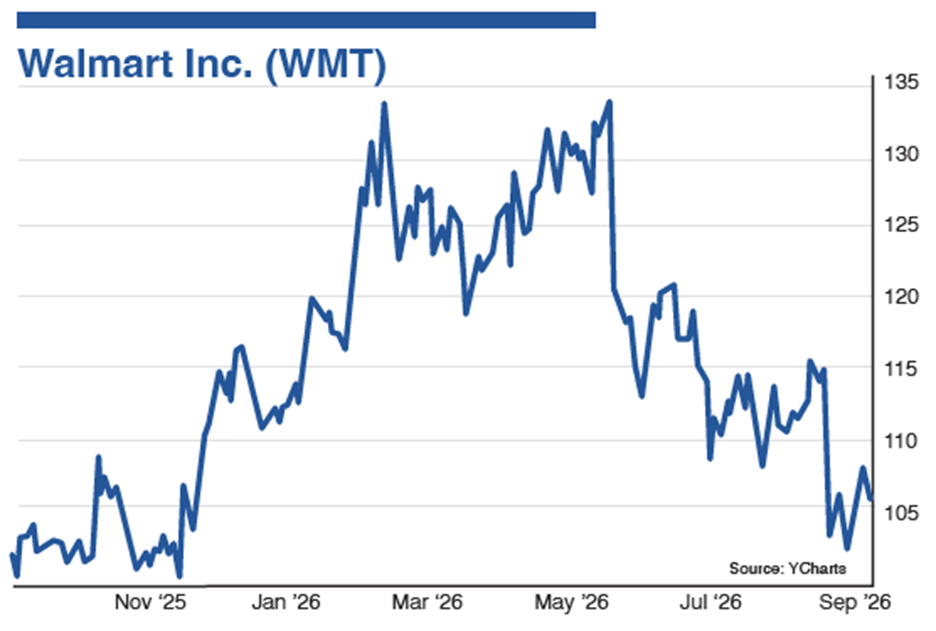
No, Walmart still isn’t dirt cheap by historical standards — it currently trades at 38 times trailing 12-month profits versus a 10-year average of 28.
However, given its highly defensive business … 53 straight years of dividend increases … and constant pursuit of new growth avenues, it’s very attractive.
Meanwhile, just a return to its previous high would amount to a 26% gain from current levels.
That makes it a solid addition to the Safe Money Report Model Portfolio right now. The Weiss Ratings agree, currently giving the stock a “B-” rating.
Therefore, I recommend buying whatever amount of the stock is appropriate for your own portfolio.
Well, here we are nine weeks later, and it did exactly what I said … it bounced back right toward that previous all-time high.
Why?
For starters, the company’s third-quarter results were great.
Sales were up 5.2% to $188.8 billion, and adjusted per-share earnings came in at $0.65. Both were better than expected.
On top of that, U.S. e-commerce revenue soared 23%. Walmart also raised its full-year guidance.
Meanwhile, more investors are now trying to get to safety … companies like Walmart that did well the last time the market crashed and the economy tanked.
We just happened to get there before them.
Is it too late for you to buy in now?
Only you can decide. But the Weiss Ratings are still giving the stock a “B-” rating. And I certainly think WMT is still a better play than most of the other alternatives out there right now.
Best wishes,
Nilus Mattive
P.S. Of course, if you really want to milk “safe money” companies like this for maximum income … using strategies that focus on dividends and turn volatility into extra cash payments … then I have an even better idea for you. Just click here to learn all about it now.