 |
| By Al Qureiyeh |
If you’ve been watching your investment account climb higher this spring, congratulations.
You earned those gains by doing something that most ordinary investors fail to do: You didn’t panic when stocks went through a rough patch.
You held the line, ignored the scary headlines and trusted the Weiss safety ratings.
But it is our job to tell you what the loud talking heads on financial TV won't …
The massive rally you just lived through wasone of the strangest, most lopsided and top-heavy one-month moves in 50 years of stock market history.
Buried deep inside this market movement are three clear warning signals.
They are the exact kind of indicators that a veteran Wall Street trader with 20 years on a trading desk would notice.
And they all say the same thing: This is not the time to chase expensive tech stocks.
This is the exact moment to lock in some wins, reinforce your foundation and buy yourself some peace of mind.
Let's look at exactly what the data is telling us under the hood.
What Just Happened in Your Portfolio
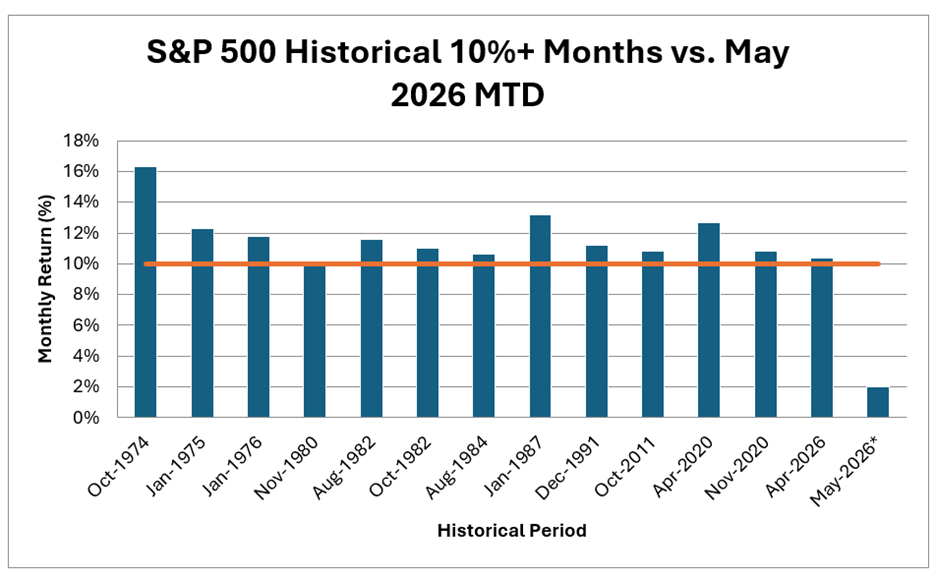
In April, the S&P 500 surged by more than 10% in a single month.
To give you a clear sense of how incredibly rare that is, it has only happened 13 times in the last 50 years.
Our research team compiled every single one of these historic moments, as you can see here:
During that historic month, the S&P 500 crossed above the 7,000 milestone for the first time ever on April 15, finishing that session at 7,022.95.
It is now sitting closer to 7,500.
On the surface, that looks like nothing but clear skies and good news.
The catch is how it happened.
When you open up the hood of this market, three highly uncomfortable signals stand out.
Signal No. 1: This Wasn't a Stock Market Rally. It Was a Chip-Stock Rally Wearing a Costume.
The "SOX" is Wall Street's shorthand for the Philadelphia Semiconductor Index — a basket of about 30 of the largest computer chip and hardware manufacturers in the world (names you know well, like Nvidia, Intel, Broadcom and AMD).
In April, this chip index skyrocketed by 38% in 30 days.
Here is why that number should make you pause: That was the chip sector's single best month since February 2000.
If that date sounds familiar, it should.
February 2000 was the absolute, literal peak of the infamous Dot-Com Bubble — the exact moment right before technology stocks lost more than three-quarters of their entire value over a painful two-and-a-half-year collapse.
Signal No. 2: The S&P 500 Kept Moving Up, While Half the Stocks in it Were Already Secretly Falling.
This is the hidden data point that should stop you in your tracks.
A reliable tool professional analysts use to measure the health of a market rally is called "breadth."
We ask a simple question: Of the 500 major companies in the S&P, how many are actually trading above their average price over the last 10 weeks?
If almost all of them are, the market is healthy, broad and stable.
If only a few are, the rally is fragile and hollow.
When the S&P 500 was punching through its records at the end of April, only 52% of the companies inside it were actually above their average line.
In plain English: Just over half the team was scoring points. The other half had already gone completely cold and was retreating.
The mainstream news was celebrating a historic championship victory, but fewer and fewer players were actually winning.
Signal No. 3: The "Fear Gauge" is Ignoring Massive Real-World Risks
You may have heard of the VIX — often called Wall Street’s "fear gauge."
When regular investors are scared or buying portfolio protection, the VIX goes up.
When they are relaxed and complacent, it goes down.
Over the last several weeks, the VIX hovered down near the 16 to 17 range.
It means that buying insurance for your stock portfolio is currently incredibly cheap.
But look at what is actually happening in the real world while investors are acting like nothing can go wrong:
- Inflation is Heating Up Again: The latest Consumer Price Index (CPI) numbers showed headline inflation jumping +0.9% in a single month, driven by a massive surge in energy and gasoline costs.
- A Historic Changing of the Guard at the Federal Reserve: On Friday, Kevin Warsh started as the new Federal Reserve Chair. He has openly advocated for a "regime change" at the Fed, including shrinking the central bank's balance sheet.
- Interest Rates are Frozen: The CME FedWatch tool shows a 97% probability that the Fed will leave interest rates completely unchanged at the upcoming June 16-17 policy meeting, keeping interest rates locked high at 3.50% to 3.75% for the foreseeable future.
When the market's fear gauge stays low despite sticky inflation, a new, unpredictable Federal Reserve leader and frozen interest rates, it isn't a green light to buy.
It is a blinking red light that investors are completely asleep at the wheel.
But you don’t have to be. Here are three moves to make to sleep better at night …
Move No. 1: Take Some Semiconductor Profits Off the Table
If computer chip stocks have run up significantly in your portfolio, sell a portion of those positions.
If you invested $10,000 and it is now worth $20,000, take your original $10,000 out and let the "house money" run.
Move No. 2: Spread Your S&P 500 Money More Evenly (The "Equal-Weight" Fix)
When you own a standard index fund like the SPDR S&P 500 ETF (SPY) or the Vanguard S&P 500 ETF (VOO), you are highly concentrated.
The seven largest companies get 30% of your money, while the other 493 get left with the scraps.
You can instantly fix this by moving a portion of your index money into an "Equal-Weight" fund like the Invesco S&P 500 Equal Weight ETF (RSP).
Move No. 3: Buy Yourself Some Cheap Insurance
Because the VIX fear gauge is so low, protecting your wealth is cheaper than it has been in years.
There are two simple ways to utilize this:
-
Shift cash into high-rated, stable, "boring" companies that sell products people must buy regardless of the economy.
Weiss currently rates retail and healthcare leaders like Walmart (WMT), Coca-Cola (KO) and Eli Lilly (LLY) as rock-solid B (Buy) opportunities.
- Move a portion of your cash into ultra-short-term U.S. Treasury funds like the iShares 0-3 Month Treasury Bond ETF (SGOV).
These operate essentially like high-yield savings accounts that trade like a stock. You will earn a reliable 4% to 5% interest yield completely risk-free while you wait for the stock market dust to settle.
The point of all this is to never chase what just happened in the rearview mirror.
Instead, your goal should be to protect your family's future.
The first step to do that is to consult the Weiss Ratings. To get the most out of them, you’ll need to watch this quick presentation.
Then take ten minutes to look over your holdings, speak with your financial professional and put your plan into action.
Take care,
AL Qureiyeh