 |
| By Sean Brodrick |
The closure of the Strait of Hormuz was a stark reminder of how much the world depends on oil …
How a must-have commodity shipped over long distances can be crucial to the global economy …
And those who control that commodity can hold the world in their palms.
Since Christopher Nolan’s “The Odyssey” is doing blockbuster box office and is on track to be the highest-rated R film ever, I thought we might look at the “oil of the Bronze Age” — and how it’s still important today.
In fact, if you have an appetite for risk, you can even make a potential fortune on it!
Folks in the Bronze Age used bitumen (crude oil), but it was mainly for religious purposes. The must-have “oil” I’m talking about is a metal — tin.
Why was that so important? Because tin combined with copper makes bronze. And while the ancient world had plenty of copper, tin was very scarce.
Before bronze, people used pure copper tools.
They were soft, dulled quickly and bent easily under stress.
Bronze altered the course of human history.
All those bronze weapons they stabbed each other with in the Trojan War depended on very long supply chains, as you can see from this map.
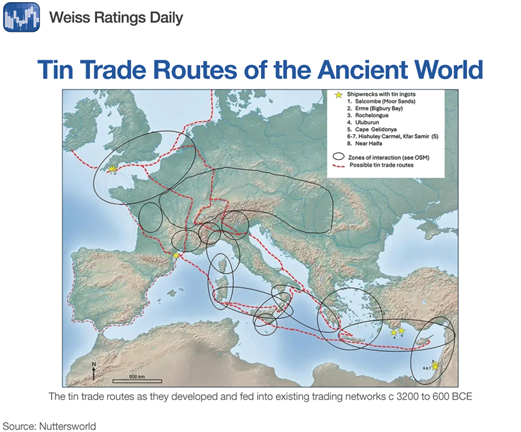
It’s wild to think that the bronze sword the Greek hero Achilles used to kill Troy’s Hector was made with tin brought all the way from the British Isles. But that’s one of the likely routes.
Tin was mined in Cornwall (Britain), Brittany (France) and the Iberian Peninsula, then shipped past the Strait of Gibraltar or transported down European river systems into the Mediterranean.
Alternatively, tin was hauled by overland caravans all the way from modern-day Afghanistan and Uzbekistan.
That was even harder than sailing it from Cornwall.
Because tin was so scarce, kingdoms of the Bronze Age couldn’t be isolationist. They were forced to trade.
Just as oil dependency forces modern nations to forge global alliances and secure shipping lanes, the hunger for tin fuelled the creation of the world’s first truly globalized economy.
The Collapse!
And everything was fine until supply lines broke. Around 1177 BCE, a combination of forces — a massive prolonged drought, famines and armed conflicts — disrupted the entire Mediterranean, including the tin trade.
Without tin, Bronze Age superpowers could no longer manufacture or repair bronze weapons and tools.
The whole system suffered a catastrophic, cascading collapse, plunging the region into a dark age of depopulation, illiteracy and abandonment of urban centers.
And if you think that can’t happen to the modern world, think again.
We’re dependent on long supply lines not only for oil but also for natural gas, fertilizers (urea and ammonia), helium, aluminum and more!
The Dark Age, following the collapse of the Bronze Age, lasted for roughly 400 years.
Let’s hope that if there’s a crash, we recover faster than our ancient ancestors.
When civilization eventually recovered, it was forced to pivot to iron.
Not because iron was structurally superior at the time, but because iron ore was available locally, freeing societies from the crippling dependence on imported tin.
Today’s Tin Market
Tin is still VERY scarce.
After hitting all-time nominal highs above $58,000 per metric tonne earlier this year, tin has consolidated but remains exceptionally strong, trading above $55,000 a tonne.
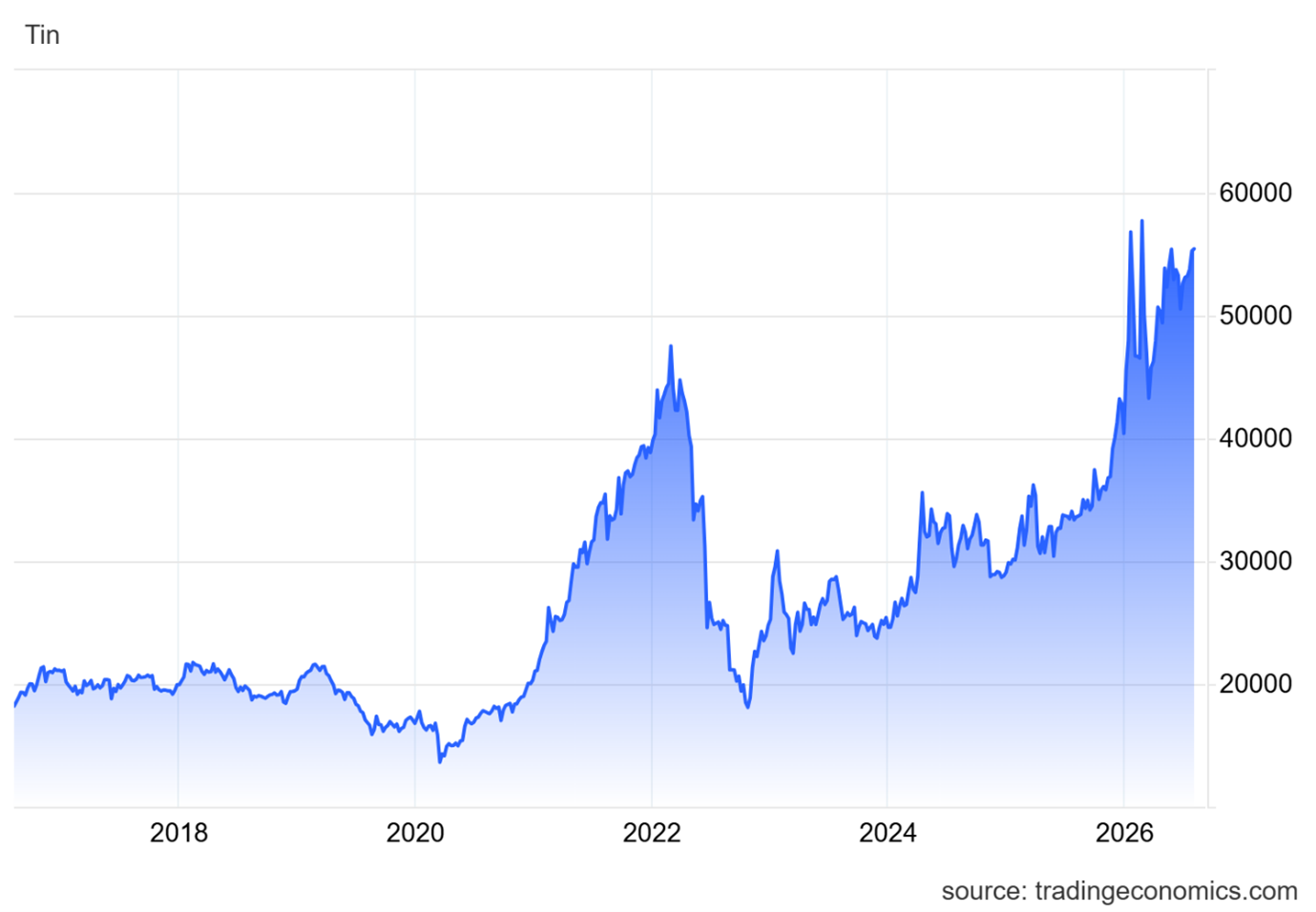
Why is it so expensive? Demand is soaring.
Roughly half of all mined tin is consumed as electronic solder.
The explosive expansion of AI data centers, semiconductors, solar power and electric vehicles is driving demand growth.
Analysts say tin prices will continue to trend upward and will probably hit $55,722 per tonne by mid-2027.
And sure enough, tin is on the “critical minerals” list issued by the U.S. government.
The major miners don’t offer tin exposure.
There are a handful of pure-play tin stocks, though.
Alphamin Resources (TSX-V: AFM) (OTC Pink: AFMJF) is the largest of them. And it comes with a big caveat — its big mine is in the Democratic Republic of Congo.
What’s wrong with the DRC? Everything! To quote famous mining analyst Obi-Wan Kenobi, “you will never find a more wretched hive of scum and villainy.”
Everything from armed conflict and disease outbreaks to human rights crises are present.
But if you have an appetite for risk and a spine of iron, here’s a chart of Alphamin …
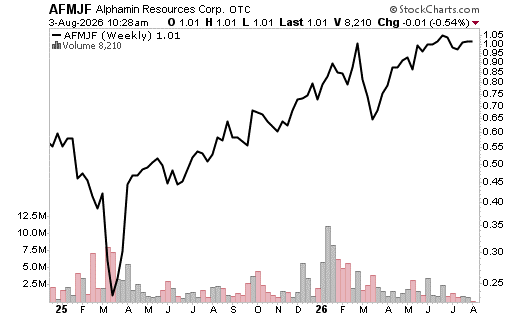
Unlike many mining stocks that peaked in January of this year, Alphamin keeps on trucking.
If you’d bought it back in March of last year, you’d have tripled your investment by now.
Alphamin has the world’s highest-grade tin mining complex and produces about 20,000 tonnes of tin per year.
That’s roughly 7% of global mined tin.
Meanwhile, the company trades at a forward price-to-earnings of 6 and a PEG ratio of around 0.15 (sources vary).
That sure looks cheap. Did I mention it sports a dividend yield of nearly 17%!?
Mind you, you’ll have to risk all the factors of the DRC — corruption, predatory taxation, weak courts, poor infrastructure and armed conflicts.
Maybe there’s a reason Alphamin is so cheap.
Or maybe, like the Greek heroes of old, you should gird your loins, grab your bronze sword and go for it.
All the best,
Sean Brodrick
P.S. My friends at the MoneyShow have just released their free report, "The 2026 Championship Portfolio: 12 Winning Investment Ideas for You."
It features a dozen investment ideas from some of the industry's top market experts — including one of my favorite picks.
You can download your complimentary copy by clicking here.