We Called It First. Now the Bill Comes Due After Tuesday.

|
Key Takeaways
|
 |
| By Gavin Magor Reviewed by: Leo Tavolaro |
If you own a bond fund, a pension or a Treasury note, Tuesday's vote changes who argues over your money, not whether it's owed.
Americans choose a new Congress on Tuesday, Nov. 3.
Forecasters favor Democrats to win the House, with the Senate much closer.
That's not a call I'm going to make, and it's not one you need.
Either way, Washington looks set to stay divided, and the bill for $40.6 trillion of debt still has to be paid.
Our 2010 warning, the deadline ahead and the trade I'd make now.
Whoever Wins, You're the Lender
When Washington borrows, it borrows from your 401(k), your bank and your bond fund, as well as from investors abroad.
Every dollar of interest it pays comes out of your taxes.
And the rate it pays sets the floor for your mortgage and your savings account.
Stocks have usually taken midterms in stride.
The S&P 500 has a long record of rising after midterms.
Since 1874, it has climbed in the year after 32 of the last 38.
Bonds are a different story this time, because a divided Washington arrives with a deadline attached.
The Split Comes With a Deadline
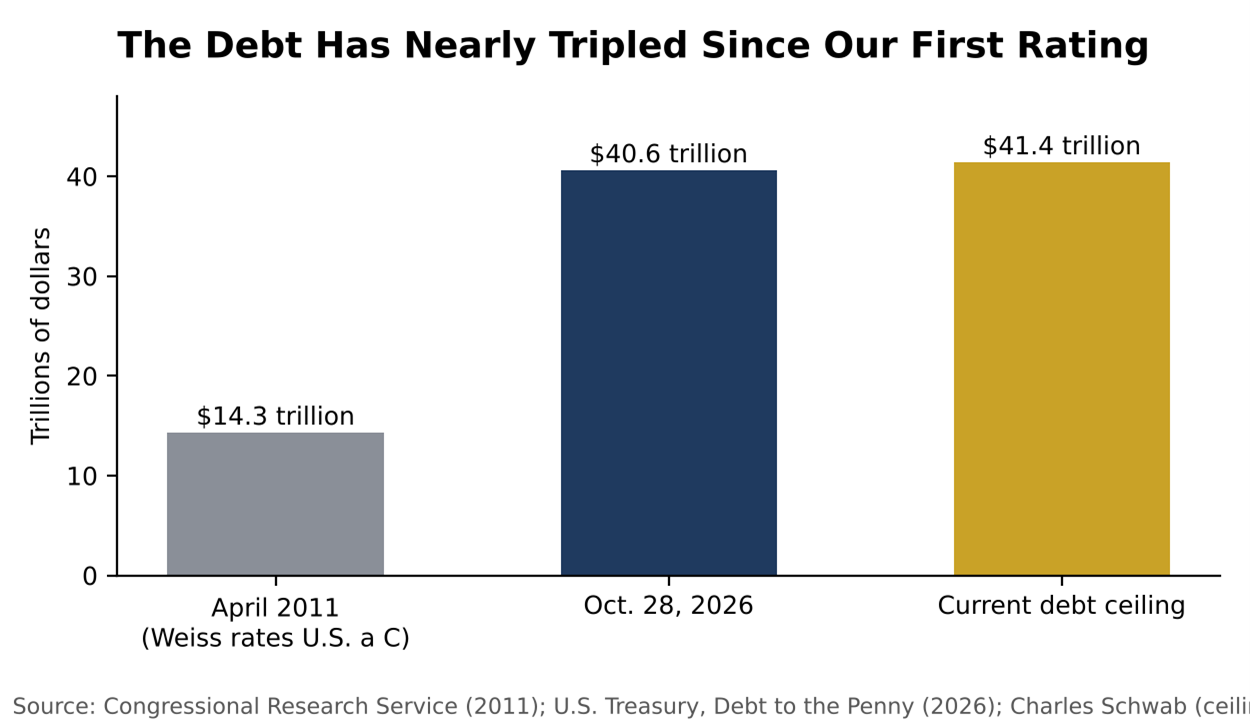
The legal limit on federal borrowing was set at $41.4 trillion last year.
Economists expect the Treasury to reach it by the middle of 2027.
Total federal debt stood at $40.6 trillion on Wednesday, Oct. 28.
If the House changes hands, the governing party loses the option of raising the limit without votes from the other side.
So the debt ceiling becomes the first real negotiation of the new Congress, whichever party holds which gavel.
I've watched this play out before, and I know how the bond market reviewed it.
We Called It First
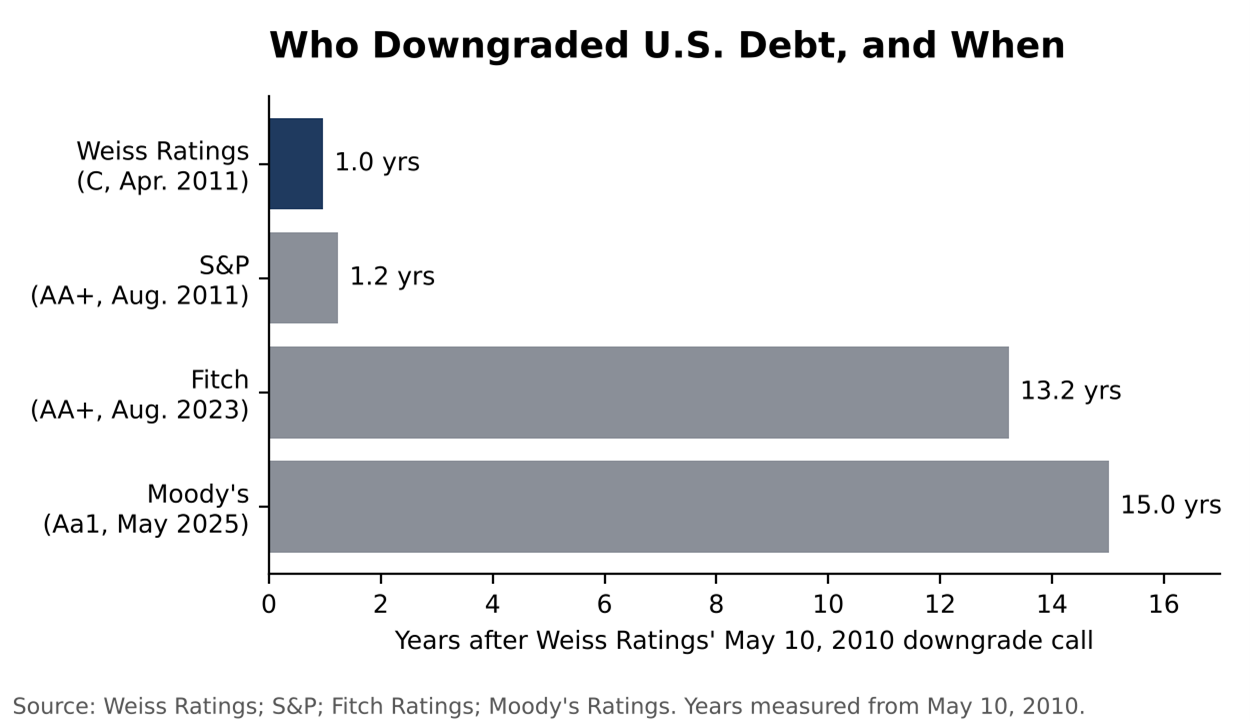
On May 10, 2010, Weiss Ratings wrote to Standard & Poor's, Moody's and Fitch, urging all three to downgrade U.S. debt.
Our founder, Dr. Martin D. Weiss, put it plainly: "The U.S. government's triple-A rating is an anachronism."
None of them moved.
So on April 28, 2011, we published our own sovereign debt ratings and gave the United States a C.
That July, we cut it to a C-, the equivalent of BBB- on the scales the big three use.
I was the analyst on that call, and I said it was "driven exclusively by the numbers."
I also warned that America "has already lost the golden halo" that made its bonds the world's automatic choice.
The Big Three Took 15 Years to Follow
S&P cut the United States to AA+ on Aug. 5, 2011, 15 months after our letter.
Fitch followed on Aug. 1, 2023.
Moody's held out until May 16, 2025, 15 years after we asked.
Every one of them ended up moving in the direction we pointed.
Our rating on U.S. debt still stands at C-.
We haven't changed it, yet.
The Debt Has Nearly Tripled
When we first rated the United States, total federal debt was $14.3 trillion.
It's now $40.6 trillion, nearly three times as large.
Net interest on that debt topped $1 trillion in the fiscal year that ended Sept. 30.
That's close to one in every five dollars Washington collected in taxes.
In 2011, the World Ran Toward Treasuries
S&P's downgrade did not push U.S. borrowing costs higher in 2011.
The 10-year Treasury yield was 2.58% on the Friday S&P acted.
Two trading days later, it had dropped to 2.20%.
Frightened investors around the world still treated Treasuries as the safest place to hide.
This Time, the World Is Charging More
The 10-year yield closed Thursday at 4.98%.
Earlier this month, it touched its highest level in 24 years.
Foreign central banks and governments have also been stepping back.
Their share of foreign-held Treasuries was 59% in 2020.
By 2025, it was down to 43%.
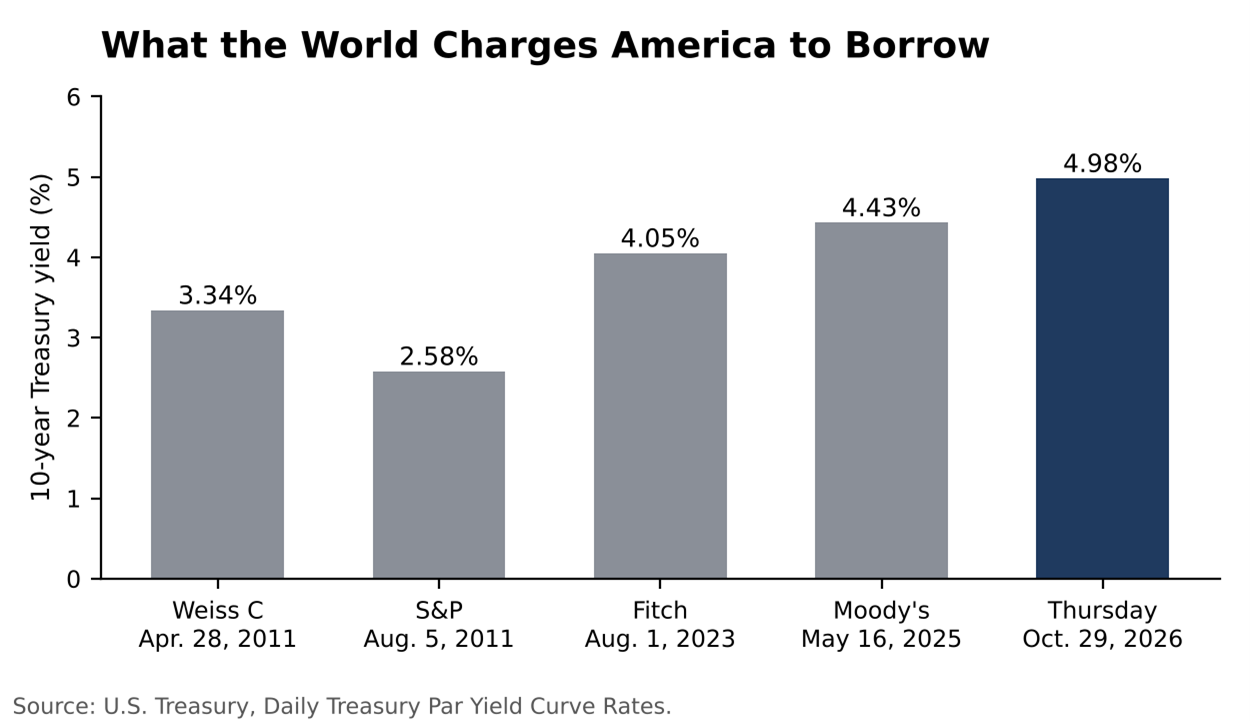
That's my answer to anyone who says a downgrade doesn't matter.
If the debt keeps running out of control, the rest of the world won't wait for us to change our rating.
It will demand higher rates anyway, and it has already started.
A debt-ceiling standoff in 2027 would hand it one more reason.
What the Ratings Say About Your Bond Funds
The longer a bond's maturity, the harder its price falls when rates climb.
iShares 20+ Year Treasury Bond ETF (TLT) rates a D, a SELL.
iShares 7-10 Year Treasury Bond ETF (IEF) rates a D+, a SELL.
Both are what you'd own if you expected Washington to fix its finances quickly.
I don't.
The Short End Is the Safer Place to Wait
iShares 1-3 Year Treasury Bond ETF (SHY) rates a C-, a HOLD.
If you own it, there's no rush to sell, because short maturities move far less when long rates jump.
For new money, I prefer owning the two-year Treasury note directly.
It closed Thursday yielding 4.61%.
You get your principal back in two years.
You can buy it at auction through TreasuryDirect or through your broker.
Gold Earns the Ratings Edge
iShares Gold Trust (IAU) rates a B-, a BUY.
It holds physical gold, and its lower share price makes it easy to add in small amounts.
Let the Ratings Do the Sorting
Every fund rating in this report came straight from the live Weiss Ratings pages.
Weiss Ratings Plus puts that same work in front of you, with real-time ratings, instant alerts on upgrades and downgrades, and exclusive analysis.
It's how you'll know the day a long Treasury fund earns a better grade.
And it's how you'll see our next move on U.S. debt as soon as we make it.
Click here to see what Weiss Ratings Plus can do for you.
The Golden Halo Moved
In 2011, I said America had lost its golden halo.
Fifteen years later, that halo has moved to gold itself.
SPDR Gold Shares (GLD) rates a B-, a BUY.
Gold pays no interest, but it can't be printed, downgraded or defaulted on.
It's the one asset in this report that doesn't depend on Washington reaching a deal.
Not only does GLD earn a high Weiss rating, but it also fits this market.
When the world demands more to lend to America, it's telling you to own something that isn't a promise from America.
For my part, I expect gold to hold its value through the debt-ceiling fight, whichever party holds the gavel.
GLD is my pick for new money in this market.
What I'm Watching
- The Treasury's quarterly refunding announcement on Wednesday, Nov. 4, for any increase in long-bond sales.
- The final Senate count, which can take days in the closest races.
- Who takes the House Budget and Ways and Means gavels in January, the first signal for the debt-ceiling talks.
- The Treasury's monthly foreign-holdings data, for any further pullback by central banks.
- The November 30-year bond auction, for how eager buyers are at these yields.
- Any change in our own C- rating on U.S. debt.
Bottom Line
Tuesday's vote will change who argues over your money.
It won't change the fact that it's owed.
We said so in 2010, and the numbers have only grown since.
Keep new bond money short, in the two-year Treasury note, and add SPDR Gold Shares, a BUY, before the debt-ceiling fight begins.
Cheers!
Gavin