Weaker Dollar After the Midterms Puts Coca-Cola in the Sweet Spot

|
Key Takeaways
|
 |
| By Gavin Magor Reviewed by: Leo Tavolaro |
If you own U.S. stocks, a quiet shift after Tuesday's vote may matter more to your portfolio than who runs Congress.
The dollar slipped.
And that is good news for some companies you already know by name.
One stealth winner, plus the overseas crowd I'm not joining.
Why a Softer Dollar Can Fatten Your Returns
When the dollar weakens, every euro or yen a U.S. company earns abroad converts back into more dollars.
That lifts reported sales and profits without selling a single extra product.
It also makes American goods cheaper for foreign buyers.
That helps U.S. exporters price competitively overseas and helps narrow the trade gap.
For my part, I have no problem with a weaker dollar.
Your next trip to Europe may cost a little more.
But U.S. stocks with big overseas sales stand to earn a little more for you.
What Moved Wednesday
The dollar index fell to a one-month low of about 101.3 on Wednesday.
That index measures the greenback against a basket of six currencies.
The euro rose to about $1.13.
The move followed Democratic wins in both the House and the Senate on Tuesday.
One currency strategist linked the slide to worries about tighter AI regulation and slower U.S. growth.
For you, that means the currency your foreign profits come home in just got a little cheaper.
The Gridlock Effect
President Trump keeps his veto, while Democrats will control both chambers.
A divided government tends to make big new spending harder to pass.
JPMorgan Asset Management's Tai Hui expects deficits to be "much more controlled or limited."
Less new borrowing means less upward pressure on Treasury yields.
Lower yields make parking cash in dollars a little less attractive to global investors.
That is a recipe for a gently softer dollar, not a collapse.
I expect the dollar to drift lower into early 2027 rather than reclaim its October high.
The Numbers Behind the Tailwind
The dollar has made only a partial recovery from last year's slide.
It fell 9.4% in 2025.
That was its biggest annual drop in eight years.
It started 2026 near 98.
Even after Wednesday's slide, it is still about 3% higher for the year.
So there is room for this year's gain to unwind further.
We have already seen what a weak dollar can do for companies that sell abroad.
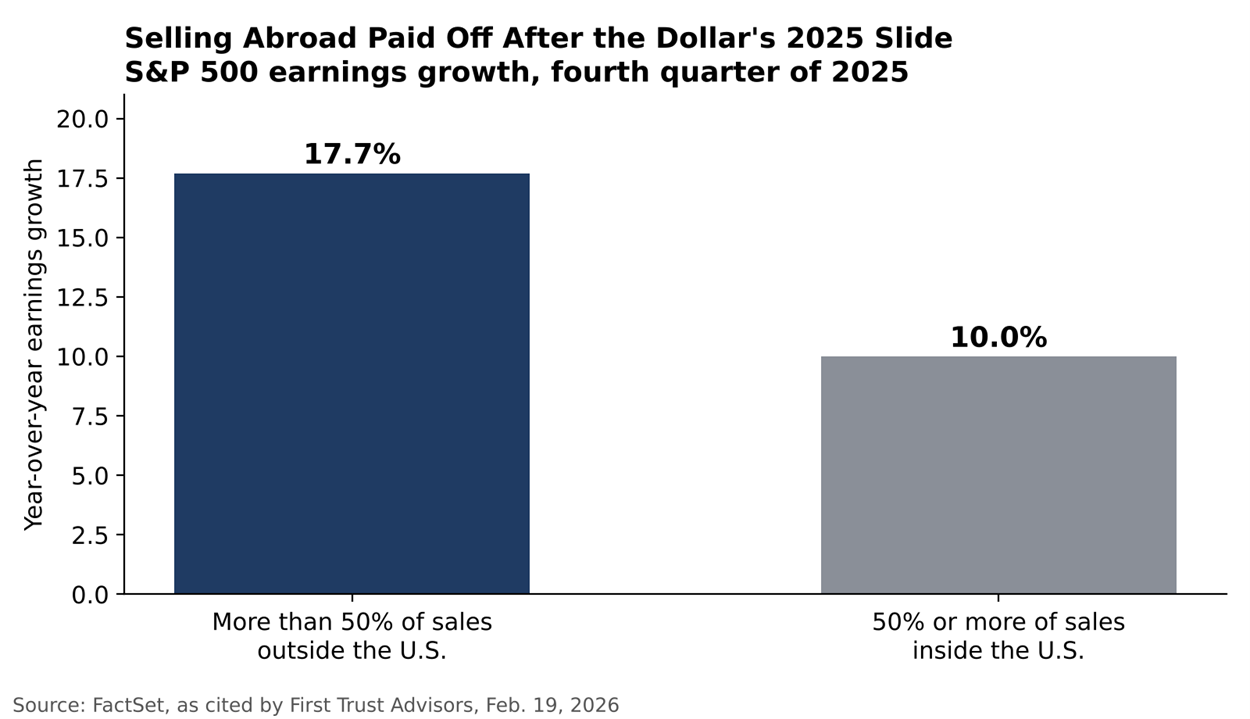
In the fourth quarter of 2025, earnings grew nearly 18% for S&P 500 companies selling mostly outside the U.S.
Companies selling mostly at home grew earnings 10%.
If the dollar keeps softening, that gap can open up again in your favor.
The Overseas Crowd I'm Not Joining
The standard advice when the dollar weakens is to buy foreign stocks directly.
Our ratings say that is the harder way to play it.
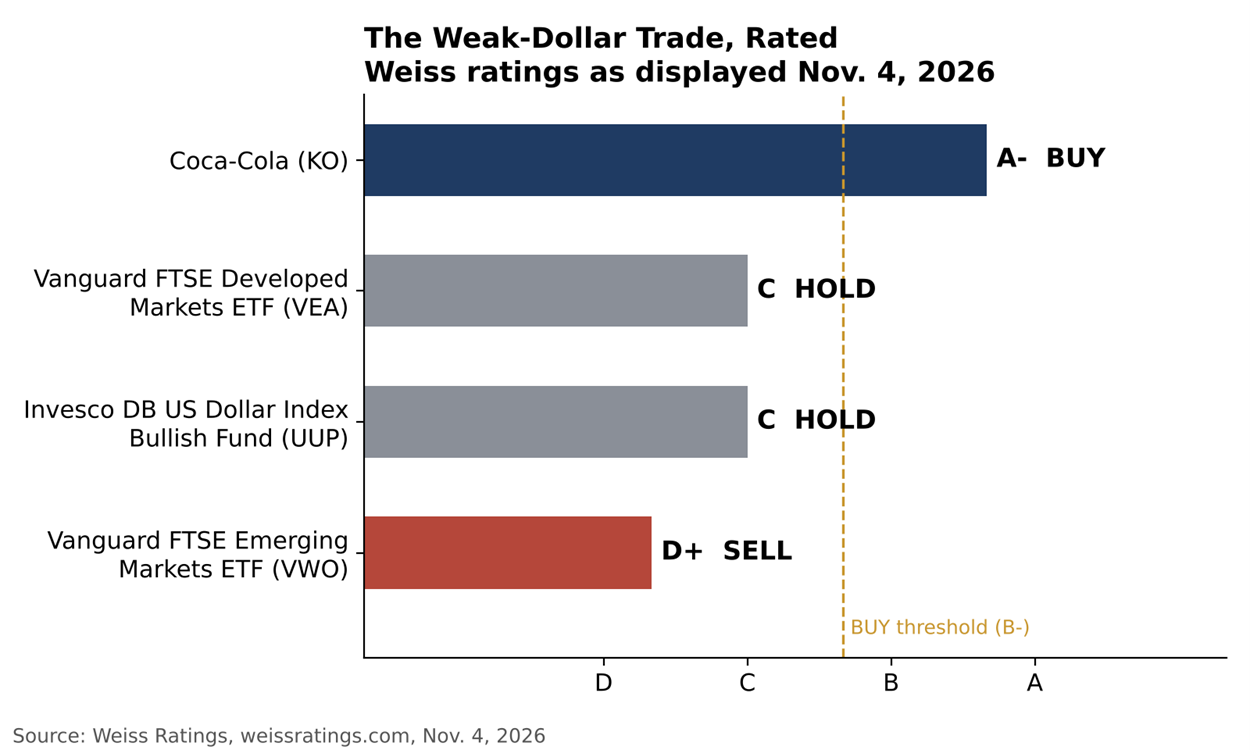
The Vanguard FTSE Developed Markets ETF (VEA) carries a Weiss rating of C, a HOLD.
If you own it, keep it.
But I would not add to it on a one-day currency move.
The Vanguard FTSE Emerging Markets ETF (VWO) carries a Weiss rating of D+, a SELL.
Its reward sub-grade is weak, so a softer dollar alone is not a reason to own it.
Betting on a dollar rebound does not earn our backing either.
Invesco DB US Dollar Index Bullish Fund (UUP) carries a Weiss rating of C, a HOLD.
There is a simpler way to collect on a weaker dollar, and it is sold around the world.
Coke Is It!
Remember those companies you already know by name?
Coca-Cola (KO) is my pick to catch this tailwind.
It carries a Weiss rating of A-, a BUY.
In 2025, 84% of its unit case volume was sold outside the United States.
Yet it reports every penny in dollars.
So a weaker dollar flows straight into its reported earnings.
That tailwind is already showing up.
Comparable earnings per share grew 11% in the third quarter.
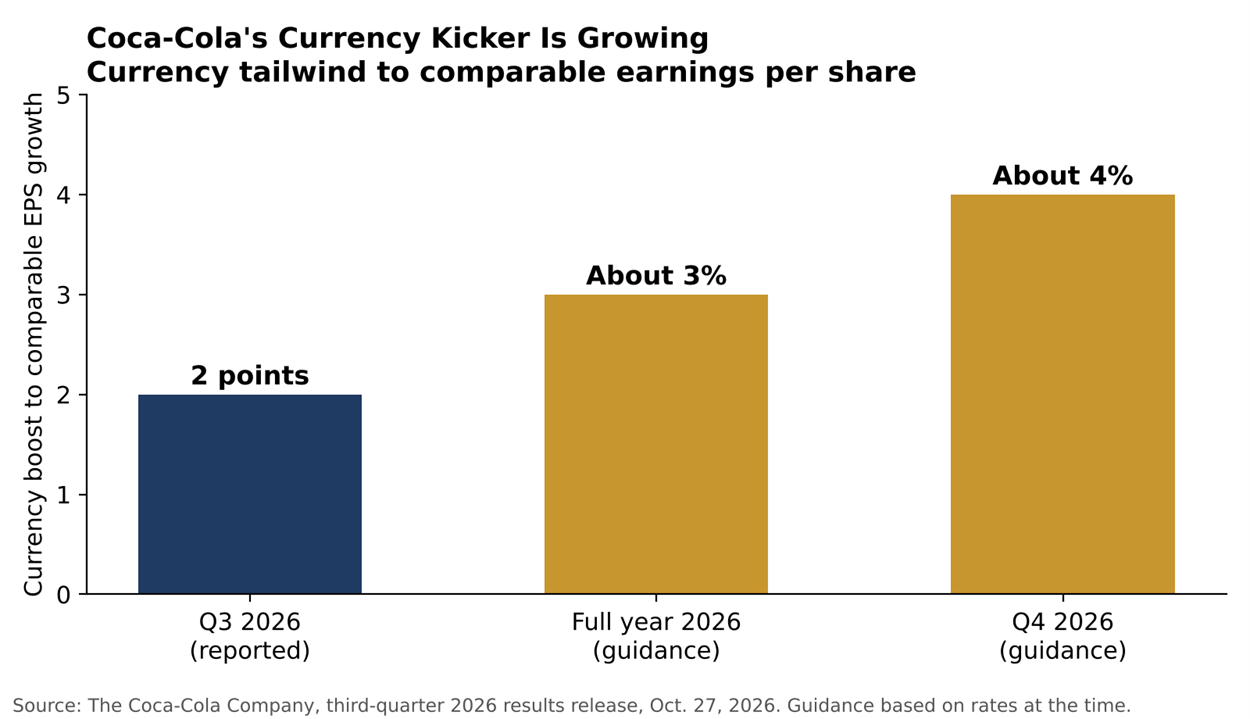
Currency added two points of that growth.
Management now expects comparable earnings growth of at least 11% for 2026.
It sees a currency tailwind of about 4% to fourth-quarter comparable earnings per share.
That outlook was set at exchange rates before Wednesday's slide.
A softer dollar from here would add to that cushion rather than erode it.
The stock closed Tuesday at $94.80.
Its regular quarterly dividend is 53 cents per share.
That works out to a yield of about 2.2% at Tuesday's close.
Coke is not a flashy stock.
It is a defensive name with a built-in currency kicker, just as the AI trade wobbles.
And our rating puts it well above the overseas funds the crowd is chasing.
What I'm Watching
The dollar index staying below its October high as markets digest a divided Congress.
Friday's October jobs report coming in soft enough to cool talk of a December Federal Reserve rate hike.
Coca-Cola's 2027 currency outlook improving when it reports fourth-quarter results early next year.
Bottom Line
A quiet shift after Tuesday's vote does matter to your portfolio.
The dollar slipped, and I see more slipping ahead under a divided Congress.
You do not need to go overseas to collect on it.
Consider buying Coca-Cola at market, with its Weiss rating of A-, a BUY, and its big overseas business.
If you own the Vanguard developed-markets fund, hold it, and steer clear of its emerging-markets sibling.
Cheers!
Gavin
P.S. A divided government may slow the spending, but protecting your dollars is up to all of us. Sign our Declaration of Dollar Independence HERE.