Wells Fargo's Consumer Engine Is Running. Why Did the Stock Slip?

 |
| By Gavin Magor |
Think about the last time you tapped a card at the gas pump or signed for a new car.
You were adding a data point to somebody's quarterly report.
This morning, one of the country's biggest consumer banks published its tally of those data points.
And the picture it paints of the American household is a lot healthier than the headlines suggest.
The market didn't seem to notice.
It marked the stock down anyway.
So today, I'm skipping the headline numbers and going straight to the customers behind them.
What they spent.
What they borrowed.
Whether they paid it back.
And why I'd buy the bank the market just put on sale.
Your Wallet, Seen from the Teller Window
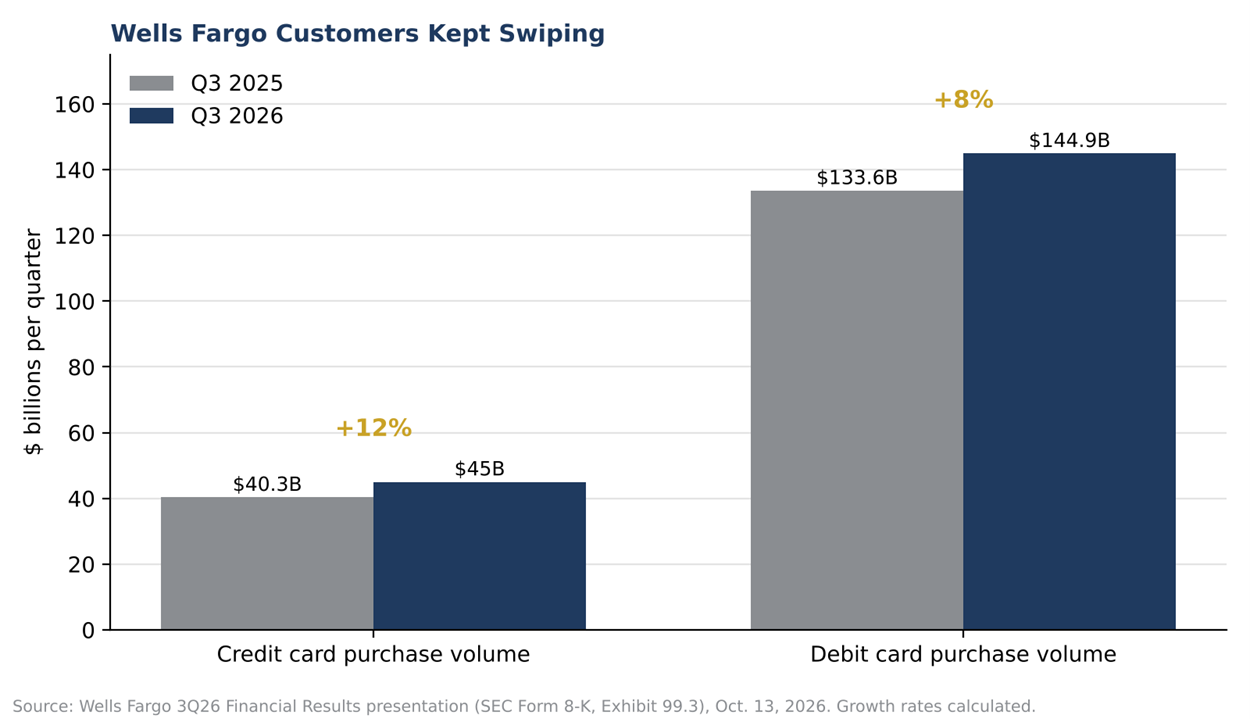
Wells Fargo (WFC) customers put $45 billion on their credit cards in the third quarter.
That's up from $40.3 billion a year earlier, a gain of nearly 12%.
Debit cards tell the same story.
Purchase volume climbed to $144.9 billion from $133.6 billion, up about 8%.
The bank also opened more than 660,000 new credit card accounts in the quarter.
People don't sign up for new cards when they're pulling back.
If you bought a car this year, there's a fair chance a bank like this one helped.
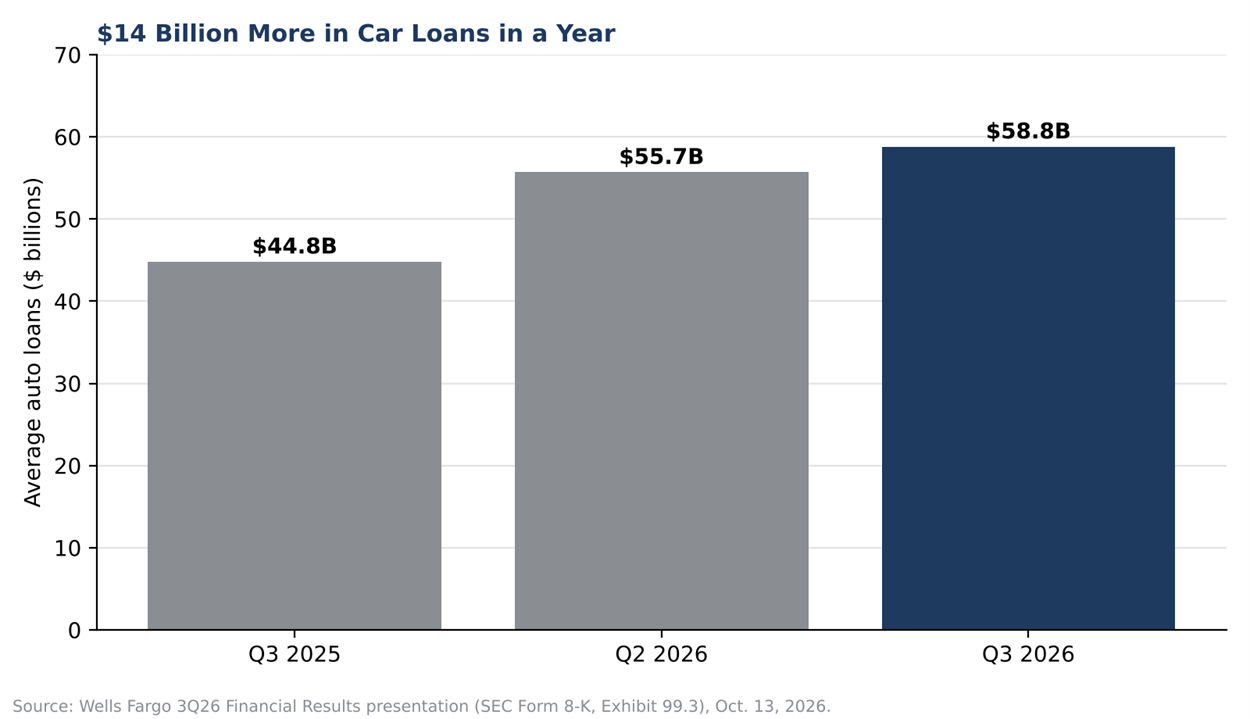
Wells Fargo's average auto loans reached $58.8 billion, up from $44.8 billion a year ago.
That's $14 billion more in car loans in 12 months.
Auto originations rose 15%, and revenue from the auto business jumped 33%.
And Yes, They're Paying It Back
Spending only matters if the bills get paid.
Wells Fargo's consumer net charge-off rate dipped to 0.7% of average loans, from the second quarter.
Chief Executive Charlie Scharf put it plainly in the release: "Consumers are spending more, loan delinquencies are low and deposit and investment balances have grown."
Consumer primary checking accounts have now grown year over year for 14 straight quarters.
That's the core relationship every bank wants, and it keeps expanding.
Tuesday Morning's Report Card
Wells Fargo reported third-quarter net income of $6 billion, or $1.87 per share, before Tuesday's open.
That's up from $5.6 billion, or $1.66 per share, a year ago.
Earnings per share rose 13%.
Total revenue came in at $21.9 billion, up 2%.
Lower trading gains, a smaller contribution from venture capital investments and the sale of its rail car leasing business held that number back.
Traders took the revenue line as the headline.
The stock went the other way when trading opened.
But is revenue really the number that matters here?
I don't think so.
The Parking Brake Came Off
For more than seven years, Wells Fargo drove with the parking brake on.
The Federal Reserve capped its total assets at $1.95 trillion in February 2018 and didn't lift the cap until June 3, 2025.
Now look where it is.
Average assets reached about $2.24 trillion in the third quarter.
Average loans and average deposits each grew 11% from a year earlier, to $1.03 trillion and $1.48 trillion.
That's what a bank looks like when it's finally allowed to grow.
Profit in Consumer Banking and Lending, the division that serves you, rose 21% to $2.76 billion.
Revenue in that division grew 5%, led by a 7% gain in everyday banking and the 33% jump in auto.
Expenses in the division fell 3%.
More revenue, lower costs and fatter profit are a combination you don't see often in banking.
Company-wide expenses slipped 1% from a year ago.
Headcount is down 8%, part of the bank's efficiency initiatives.
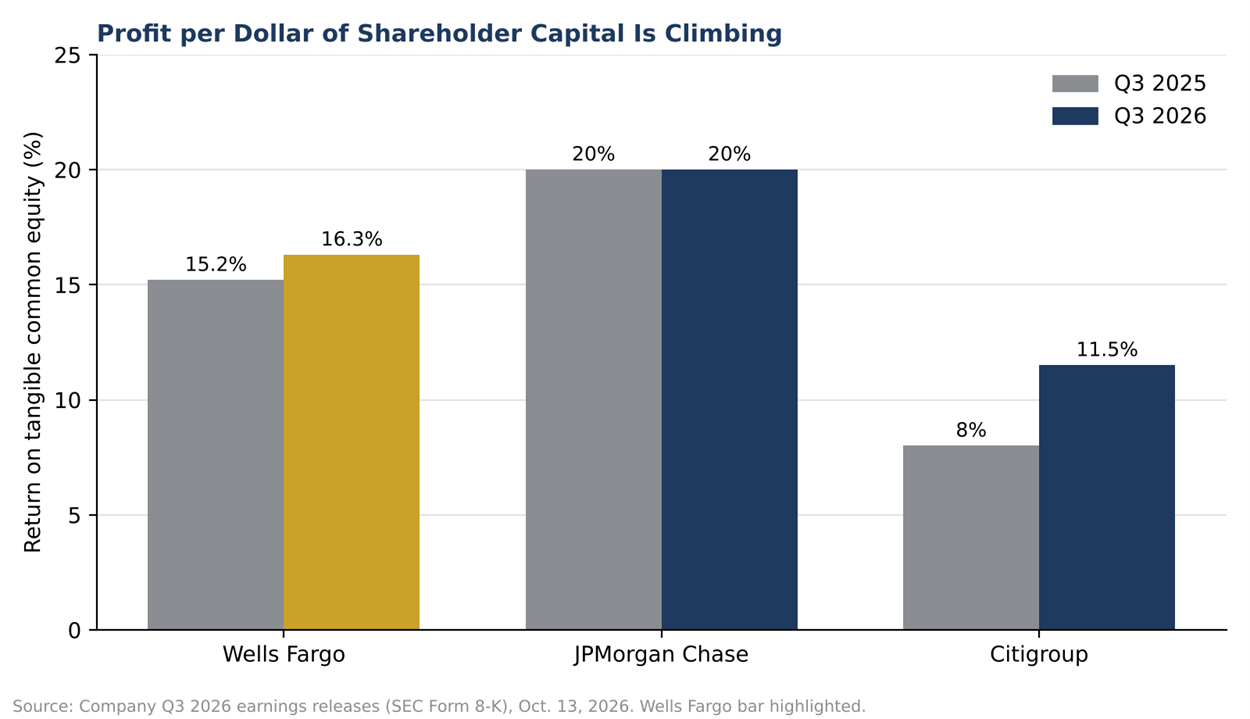
Return on tangible common equity, the profit the bank earns on each dollar of shareholder capital, rose to 16.3% from 15.2%.
And management is sharing the gains.
Wells Fargo bought back 28.6 million shares, or $2.5 billion of stock, in the quarter.
It also raised its quarterly dividend to 50 cents per share from 45 cents.
The Rest of the Class
Wells Fargo wasn't the only bank to report this morning, and the consumer story held up across the board.
JPMorgan Chase (JPM) said debit and credit card sales volume rose 10%.
Its card net charge-off rate fell to 2.91% from 3.15% a year earlier.
Net income rose 6% to $15.3 billion and return on tangible common equity held at 20%.
JPMorgan carries a Weiss rating of “B+,” a BUY.
It's the gold standard for scale, and the price reflects it at about 14x trailing earnings.
Citigroup (C) reported $175 billion of U.S. credit card spending, up 11%.
Net credit losses in its U.S. card business fell 4%.
Chief Executive Jane Fraser called it "the best third-quarter revenue in a decade."
Return on tangible common equity jumped to 11.5% from 8%.
Citigroup also carries a Weiss rating of “B+,” a BUY, and trades at about 14x trailing earnings.
It's the turnaround story with the most room left to run on returns.
Why I'd Buy the Bank With the Brake Off
Remember that parking brake?
It's off, and the engine underneath it is the American consumer.
Wells Fargo carries a Weiss rating of “B,” a BUY.
It trades at about 12x trailing earnings on the same basis, a discount to both JPMorgan and Citigroup.
At Monday's close of $83.32, the new 50-cent quarterly dividend works out to a yield of about 2.4%.
You're getting a bank whose consumer profit just grew 21%, whose returns are rising and whose share count keeps shrinking.
I'd use the dip to open a position, or add to one if you already own it.
What I'm Watching
- The September Consumer Price Index (CPI) comes out tomorrow, and a hot reading would keep the Fed leaning toward higher rates.
- Wells Fargo kept its full-year net interest income outlook at about $50 billion, with roughly $13 billion expected in the fourth quarter.
- Auto charge-offs ticked up in the quarter, and with balances growing this fast, that's the line I'll check first next time.
- How fast the buybacks continue now that the Common Equity Tier 1 (CET1) capital ratio sits at 10%.
Bottom Line
Every tap at the gas pump and every new car in the driveway shows up in a bank's quarterly report.
This quarter, those taps say the consumer is spending, borrowing and paying it back.
For my part, Wells Fargo is the cleanest way to own that story at a reasonable price, and the market just handed you a discount on it.
Cheers!
Gavin