What Do Central Banks Know About Gold That Traders Don’t?

 |
| By Sean Brodrick |
Gold tumbled down the stairs over the past week, though it’s showing signs of finding its feet now.
The yellow metal was slammed by the 1-2-3 combo of surging bond yields, a stronger dollar and trader expectations of more Fed rate hikes.
But while traders stare nervously at the Fed, some of the biggest, deepest-pocketed buyers on the planet are doing something very different.
They’re buying gold. Lots of it.
According to Goldman Sachs, they may be buying a heck of a lot more than they admit.
China’s Secret Gold Buying Spree
Goldman Sachs estimates global central banks bought 44 metric tonnes of gold in July.
That’s 158% above the pre-2022 monthly average of just 17 tonnes.
And the three-month, seasonally adjusted pace has surged to 91 tonnes per month.
But here’s where things get interesting.
Officially reported central bank purchases totaled only 23 tonnes in July.
So where did the other 21 tonnes go?
China appears to explain much of the mystery.
Goldman estimates China actually purchased 35 tonnes in July, versus roughly 20 tonnes disclosed officially — about 75% more than reported.
Take a look ...
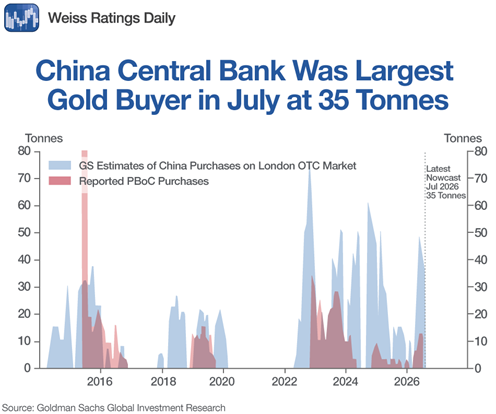
The red shows reported purchases by the People’s Bank of China.
The blue area is Goldman’s estimate of China’s actual purchases in the London over-the-counter market.
That’s a huge gap between what is reported and what might be happening.
This isn't some wild conspiracy theory.
Goldman tracks gold moving through London's enormous OTC market into domestic vaults and third-party custodians, allowing it to identify secret buying.
In fact, the World Gold Council says unreported central bank purchases have become a significant part of the gold market.
This Is Bigger Than China
The important thing isn't whether China bought precisely 20, 30 or 35 tonnes last month.
It's what central banks are telling us with their wallets.
They've accumulated an average of roughly 1,000 tonnes of gold annually over the past four years.
That's double the average of the preceding decade, according to the World Gold Council.
Why are central banks doing this?
Gold can't default. It can't go bankrupt.
And unlike dollars, euros or Treasuries, physical gold isn't someone else's liability.
The World Gold Council recently surveyed 76 central banks.
A whopping 89% expect global central-bank gold reserves to increase over the next 12 months.
And a record 45% say they expect their own institution to buy more.
Meanwhile, 74% expect the U.S. dollar's share of global reserves to decline over the next five years.
That's quite a vote of confidence in gold.
Thinking in the Long Term
This brings us back to today's sell-off.
Higher interest rates slam gold prices in the short term.
When Treasury yields rise, investors can earn more by holding bonds. A stronger dollar also makes gold more expensive for overseas buyers.
That's the bad news.
The good news is that central banks don't trade gold like hedge funds.
They're not worried about what the Fed might say next week.
They're restructuring reserves for a world that may look very different five or 10 years from now.
Goldman expects central banks to buy an average of 50 tonnes per month this year — nearly three times the pre-2022 pace.
Still, central bank buying doesn't mean gold prices can't fall from here.
In fact, Goldman's analysts warn that renewed expectations for Fed rate hikes could trigger another sharp correction.
But here's what I find fascinating.
Western traders are selling gold because they're worried about what interest rates will do over the next few months.
Meanwhile, central banks are buying gold because they're worried about what the global financial system will look like over the next decade.
Turn the Recent Sell-Off to Your Advantage
That's why I view this correction as an opportunity to watch for, not something to panic over.
And you don't have to buy a gold miner to participate.
One easy way to own physical bullion through the stock market is the SPDR Gold MiniShares Trust (GLDM).
GLDM holds physical gold in London vaults, has about $32 billion in assets, and charges an expense ratio of just 0.10%.
Better yet, it currently earns a Weiss Rating of "B-."
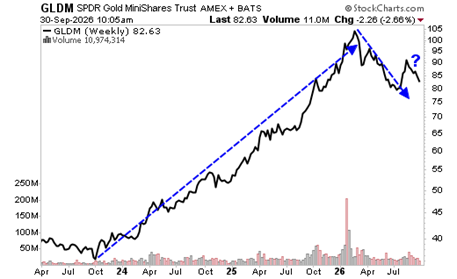
You can see that GLDM, along with gold, had a great run.
It’s spent most of this year consolidating. That worked off froth and left it positioned for its next big move.
A move I believe will be much, much higher.
Gold could remain volatile as the bond market wrestles with inflation and interest rates.
But underneath all that noise, something much bigger is happening.
The world's central banks are quietly loading up on gold.
And some of them apparently don't want us to know just how much they're buying.
All the best,
Sean
P.S. I’ll be in Orlando on October 6–7, speaking at the MoneyShow. In multiple sessions, I’ll be talking about my top picks in critical minerals, precious metals and The Great Space Race.
If you’re in the area, consider joining us for information-packed strategies and actionable recommendations. To learn more, click here.