What to Own as America Looks Increasingly Roman

 |
| By Sean Brodrick |
Some women complain that men think about the Roman Empire too much.
If you’re a man and DON’T think about the Roman Empire, don’t worry, I’m picking up the slack.
I think about Rome — a LOT!
Often, I’m wondering if America is on the same road to ruin as Rome.
But don’t worry, I have the same solution to it as smart Romans at the end of their heyday.
The traditional date for the fall of the Western Roman Empire is 476 AD.
But Rome's decline was a process that unfolded over centuries.
- Wealth became increasingly concentrated.
- The middle class weakened.
- The currency was debased.
- Political instability grew.
- And confidence in the institutions holding everything together slowly eroded.
Sound familiar?
There are some uncomfortable parallels between late Rome and America today. For example …
The Middle Gets Squeezed
One of Rome's great strengths was its class of independent landowning farmers. They were the middle class of the day.
Then wealth and land became increasingly concentrated among Rome's elite.
Huge slave-worked estates squeezed out smaller farmers, pushing many into poverty.
America’s trend of wealth concentration is unmistakable.
The Federal Reserve's most recent Survey of Consumer Finances found that families in the top 10% of the wealth distribution had a median net worth of about $3.8 million. Families in the bottom quarter had just $3,500.
If you own a home, stocks and other assets, rising asset prices can make you considerably wealthier.
If your primary asset is your paycheck, your wealth is getting chipped away.
A whopping 62% of employed Americans say their income failed to keep pace with inflation-driven increases in expenses.
Uncle Sam Can’t Balance His Books
Here's an even stronger Roman parallel.
Rome increasingly struggled to raise enough money to pay for the military, bureaucracy, infrastructure and other obligations of an enormous empire.
Now, the Congressional Budget Office projects a federal deficit of roughly $1.9 trillion in fiscal 2026 — about 5.8% of GDP.
That's an enormous deficit considering we're not in a major recession.
Federal debt held by the public is already around 101% of GDP. CBO projects it will reach 120% by 2036.
And then there's interest.
Net federal interest expense should reach roughly $1 trillion this year. CBO expects it to hit $2.1 trillion by 2036.
The problem is partly spending and increasing debt service.
But it’s also about huge tax cuts that billionaire donors demand from Washington.
Economist Steven Rattner recently posted a chart showing that without the Bush and Trump tax cuts, the U.S. debt-to-GDP ratio — now around 100% of GDP — would drop to a more manageable 48% to 55% of GDP.
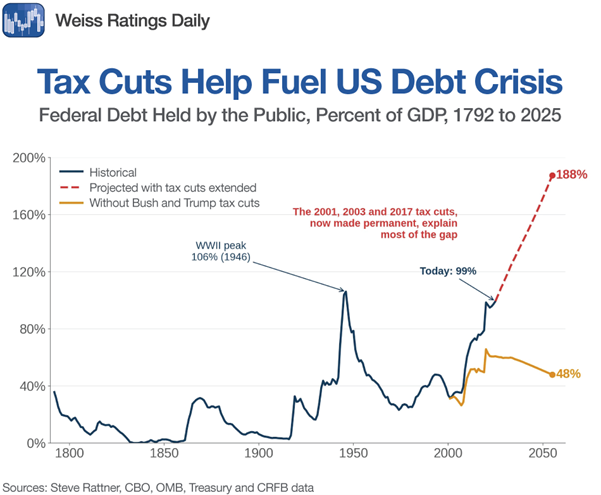
Again, the billionaires won’t allow Washington to fix this. So, the problem will worsen.
Rome learned where that road can lead.
Debasing the Currency
Rome tried to fix its fiscal problems by increasingly reducing the precious-metal content of its coins.
Today, we have a fiat currency and a central bank capable of creating money electronically.
That’s even more tempting, and potentially worse!
Inflation reduces the real value of debt.
I’m not saying the Treasury or Fed is like Emperor Diocletian clipping silver from denarii.
But when governments accumulate enormous debts, depreciating the currency can make those debts easier to bear.
The problem is that it’s the money in YOUR wallet they’re shrinking.
Trust Is Disappearing
Here’s the most disturbing similarity …
As Rome weakened, elites became increasingly detached from the broader society, political instability intensified and faith in the system deteriorated.
Today, only 17% of Americans say they trust the federal government to do what is right always or most of the time.
And America’s political system has become extraordinarily polarized. In Rome, that led to civil wars.
An Empire with a Lot to Defend
America isn't a territorial empire like Rome, but it has accumulated extraordinary security commitments around the world — in Europe, Asia and the Middle East.
So, it’s no surprise that President Trump wants to dramatically increase the U.S. defense budget.
It’s already the biggest in the world. Trump wants to increase it 50% to $1.5 trillion next year.
Interest costs, defense spending and entitlement spending are consuming an ever-larger portion of federal resources.
Meanwhile, threats from our enemies are growing.
Something eventually has to give.
The Roads Still Need Fixing
Infrastructure was one of the great accomplishments of Rome.
But maintaining roads, aqueducts, ports and public buildings became increasingly difficult as the empire weakened.
America has its own infrastructure problem.
The American Society of Civil Engineers estimates the U.S. needs to spend $9.1 TRILLION over the next decade across 18 major sectors to bring systems into a “state of good repair.”
That’s on top of all the other spending we’re already doing.
America Is NOT Rome — Yet
Countries CAN recognize their problems and fix them. And America remains enormously powerful.
The economy is still growing. The dollar accounts for roughly 57% of disclosed global foreign-exchange reserves. U.S. capital markets dominate global finance. And America remains a technological powerhouse.
Rome in its final decline wasn't leading the world into the next technological revolution.
So, I’m not predicting the United States will collapse anytime soon.
But any student of history would worry about the path we’re on.
Rome itself went through repeated crises and recoveries. Its decline wasn't a straight line.
That's precisely why I find the comparison useful.
When barbarians showed up at the gates, they found a Rome that had spent many decades undermining its own foundations.
Wealth concentrated. The middle class weakened. Government obligations grew. The currency deteriorated. Political legitimacy faded. Infrastructure became harder to maintain.
All this was compounded by constant wars, pandemics and economic shocks.
Eventually, the system ran out of resilience.
America is checking an uncomfortable number of those boxes.
Empires Fall. Gold Survives
So, what do you buy when you’re worried about your empire?
Here’s some gold jewelry I saw in the Roman city of Herculaneum when I visited it (and neighboring Pompeii) a couple of years ago.

Rome turned to dust … but gold survived.
I'm buying gold. Not because I expect America to collapse tomorrow, but because I don't know what will happen tomorrow.
Gold’s rise doesn't require the United States to fall.
It benefits from many of the trends we've just discussed — enormous government debt, persistent deficits, declining confidence in institutions and the long-term erosion of purchasing power.
And unlike fiat currency, gold isn't somebody else's liability.
Governments come and go. Political systems change. Currencies are created, debased and eventually replaced.
Gold keeps going.
That's the lesson I take from Rome.
You don't have to know whether the American Empire has another 20 years, 200 years or 2,000 years ahead of it.
You need to own some assets that can outlive it.
Of course, owning physical gold is one way to protect yourself. But there’s another way to actually profit from the yellow metal.
Here’s my full report on how to do just that.
All the best,
Sean Brodrick