 |
| By Sean Brodrick |
Sometimes bad news is good news.
And Friday morning, Wall Street got a good helping of bad news.
The U.S. economy added just 29,000 jobs in September, according to the Bureau of Labor Statistics. Wall Street expected 89,000.
Worse, August payroll growth was revised down to 133,000 from the originally reported 162,000. And July was revised lower by another 31,000 jobs.
That means the U.S. economy actually LOST 10,000 jobs in July.
Take a look at the trend ...
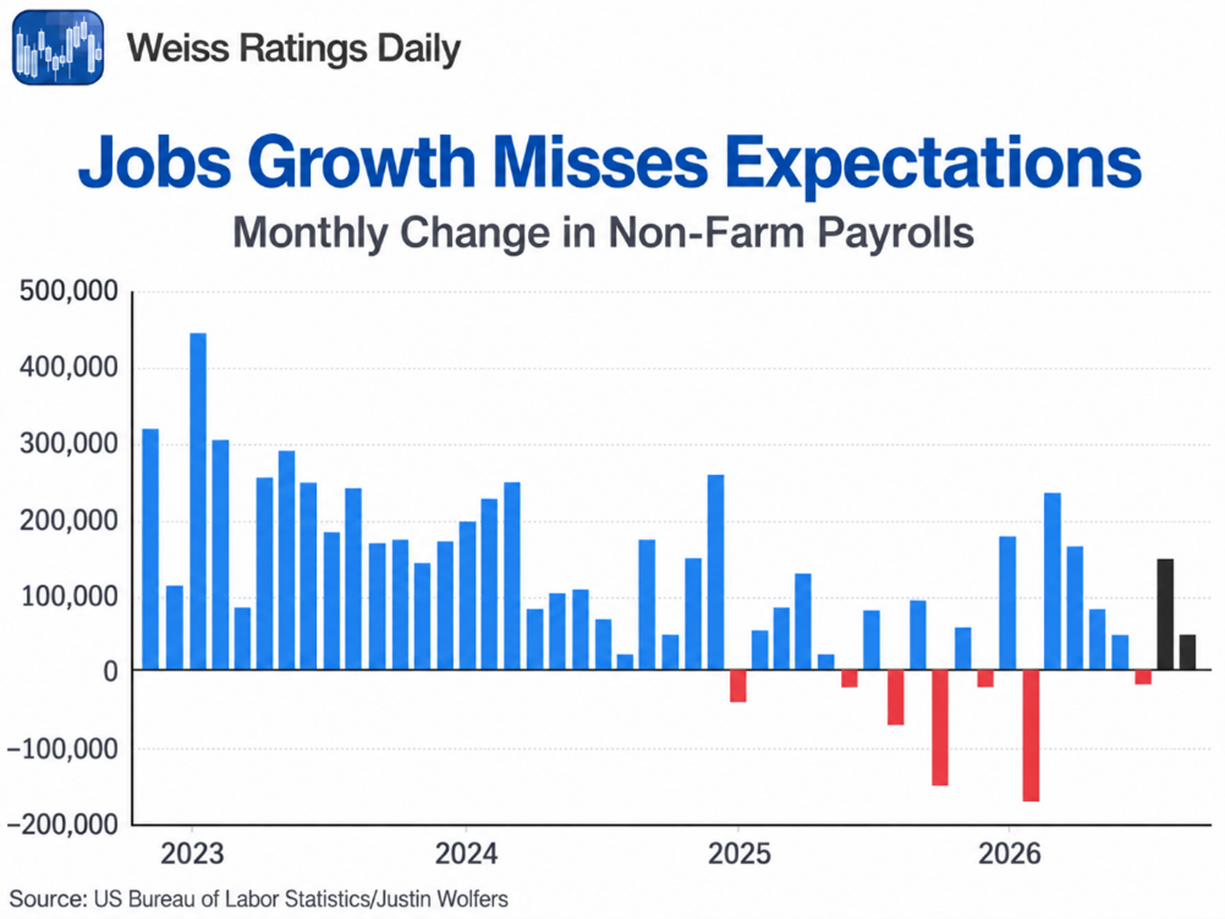
You can see nonfarm payroll growth rolling over right before our eyes.
I’ve put the August and September numbers in black (on the right). Those make the slowdown especially clear.
Normally, rapidly weakening job growth isn't something investors celebrate.
But these aren't normal times.
Bad News Just Became Good News
Remember what's been beating up stocks lately: interest rates.
Stubborn inflation had Wall Street increasingly convinced the Federal Reserve would have to hike rates again.
Earlier last week, traders were pricing in roughly a 70% chance of another hike in October or December.
Then Friday's jobs report hit.
Suddenly, those odds plunged to just 14% to 20%. And the odds of a hike by December dropped from 93% to roughly 75%.
This could be good news for some of the stocks that have been hit hardest by the recent surge in rates.
I'm particularly interested in smaller growth companies.
Why? Because higher interest rates hit them from both directions.
First, they increase the cost of borrowing.
That's especially painful for companies still burning cash and needing outside capital to finance growth.
Second, higher rates raise the discount rate investors apply to future earnings.
The further out those profits are, the harder the stock can get whacked.
Take away the threat of another couple of rate hikes — or even reduce it — and suddenly the math starts to look a whole lot better.
5 Ways to Avoid Small-Cap Money-Losers
Now, I'm not saying you should run out and buy every unprofitable company on the market.
What I am saying is to look for companies with:
A credible path to positive free cash flow. Preferably within roughly 12 to 24 months.
Plenty of cash, compared with their quarterly burn rate.
Revenue growth. Ideally strong enough to help the company survive a slowing economy.
No giant wall of debt that needs to be refinanced soon.
And, importantly, a catalyst of their own — rising orders, a growing backlog, accelerating adoption, regulatory approval, a production ramp or expanding margins.
In other words, falling rate expectations should be the tailwind, not the entire investment thesis.
A company that's burning cash, running low on liquidity, and piling up debt may pop when rates fall. But that's a trade, not an investment.
So, Who Wins?
The obvious answer might seem to be housing and real estate.
After all, the surge in rates has pounded those stocks to paste.
But I'm not convinced about that strategy.
Housing really needs longer-term Treasury yields and mortgage rates to come down.
So, a Fed pause by itself may not be enough.
That’s why I'm looking elsewhere — including small-cap growth stocks and domestic cyclicals.
And there's a simple way to buy a whole basket of them: the Vanguard Russell 2000 ETF (VTWO).
VTWO tracks the Russell 2000, giving you broad exposure to America's small-cap universe.
And it does it cheaply: Its expense ratio is just 0.06%, compared with 0.19% for the much better-known iShares Russell 2000 ETF (IWM).
Better yet, VTWO isn't secretly dependent on a handful of giant stocks. Its largest positions are tiny.
Just look at its top three holdings.
- JFrog (FROG) accounts for just 0.34% of assets.
- Moog (MOGA) and UMB Financial (UMBF) each account for about 0.33%.
VTWO has been sliding since August, along with much of the broader market.
But when Friday's weak jobs number suddenly made another Fed hike less likely, VTWO perked right up.
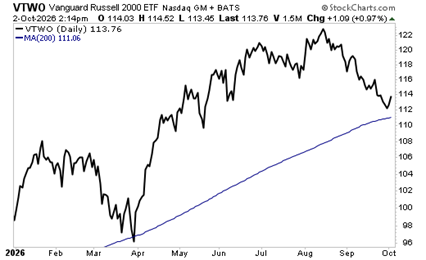
If the labor market continues to cool while inflation remains contained enough to keep the Fed on the sidelines …
One of the market's biggest recent headwinds could start to fade.
Small-Caps Have Something Else Going for Them
They've already taken a beating.
In other words, if you buy select small-cap stocks now, you’re not chasing them after a huge run.
We're looking at a broad basket of beaten-down stocks … just as one of the forces holding them down may be losing its grip.
That's the kind of setup I like.
- VTWO gives us hundreds of shots on goal,
- Charges almost nothing to own it, and
- Puts us right in the part of the market that could get an outsized boost if the Fed finally takes its foot off the brake.
And right now, those stocks are on sale.
You could do a whole lot worse than VTWO.
You could also do even better … potentially much better … when it comes to stocks that are new to the market.
For example, 7,245%, 4,178% and even 1,924%.
That figure in the middle was possible in just six months’ time!
And tomorrow, my colleague Chris Graebe is going live in a first-of-its-kind event here at Weiss Ratings to reveal …
How to Find Winning Small-Caps … When and Even BEFORE They’ve Even Gone Public
When a hot IPO hits the market, a lot of investors think the same thing ... this could be the next one.
But picking a good company is only half the battle. Even a solid IPO can burn you ... if you buy it at the wrong time.
That’s why, at 2 p.m. Eastern tomorrow – Tuesday, Oct. 6, my colleague Chris Graebe will unveil our first rating system built specifically for brand-new stocks.
This is the first event in Weiss Ratings' 55-year history of its kind.
The stocks this system flags have beaten the average new listing by 25-to-1.
With more than 1,600 companies, worth a combined $8.6 trillion, lining up to go public in the coming months …
This may be one of the most important things we've built for our members in years.
I’ll be watching. I hope you’ll join me.
Click here and we’ll save you a seat.
All the best,
Sean