Why 3 Wall Street Banks Just Tore Up Last Year’s Copper Forecast
 |
| By Sean Brodrick |
Wall Street thought it had copper figured out. Nope!
A year ago, analysts were debating how large the next surplus might be.
Mine production was set to outpace demand and inventories looked manageable.
Now those forecasts are being torn up.
The International Copper Study Group reversed its previous call for a surplus. It now expects a 150,000-metric-ton copper deficit in 2026.
It’s not the only big name that’s tempered its expectations for Doctor Copper.
- JPMorgan (JPM) forecasts a 330,000-ton shortfall.
- Morgan Stanley (MS) believes the deficit could reach 600,000 tonnes — the largest in more than 20 years.
- Goldman Sachs (GS) still expects a small surplus of approximately 160,000 tonnes, unlike its peers. It also sees limited downside for copper prices.
One thing they all agree on is inventories are falling, and supply is tight.
|
Institution |
2026 Forecast |
Notes |
|
ICSG |
-150,000 tonnes (deficit) |
Revised from earlier surplus forecast; first structural shortage since ~2009. |
|
JPMorgan |
-330,000 tonnes (deficit) |
Hyperscale AI data centers and mine closures will drive deficit. Data centers alone = ~475,000 tonnes of copper demand in 2026. |
|
Morgan Stanley |
-600,000 tonnes (deficit) |
Largest in over 20 years; most aggressive deficit view. |
|
Goldman Sachs |
Small surplus (~160,000 tonnes) |
More conservative: expects prices to ease somewhat in 2026 but remain supported longer-term. |
Forecasts can change again, of course. But those inventories keep shrinking.
That’s because copper demand is being pulled higher by three enormous investment cycles at once.
One, utilities need copper to rebuild aging power grids and connect new generating capacity.
Electric vehicles use far more copper than conventional vehicles. Renewable energy, battery storage, charging networks and building electrification add still more demand.
Two, Europe recently published an Electrification Action Plan.
This is aimed at making electricity the dominant energy carrier across roughly half of its economy by 2040.
Reaching that goal will require a much larger network of transmission lines, substations, renewable projects, electric heating systems and vehicle chargers.
Three,there’s AI.
JPMorgan estimates that data centers alone could consume approximately 475,000 tonnes of copper in 2026.
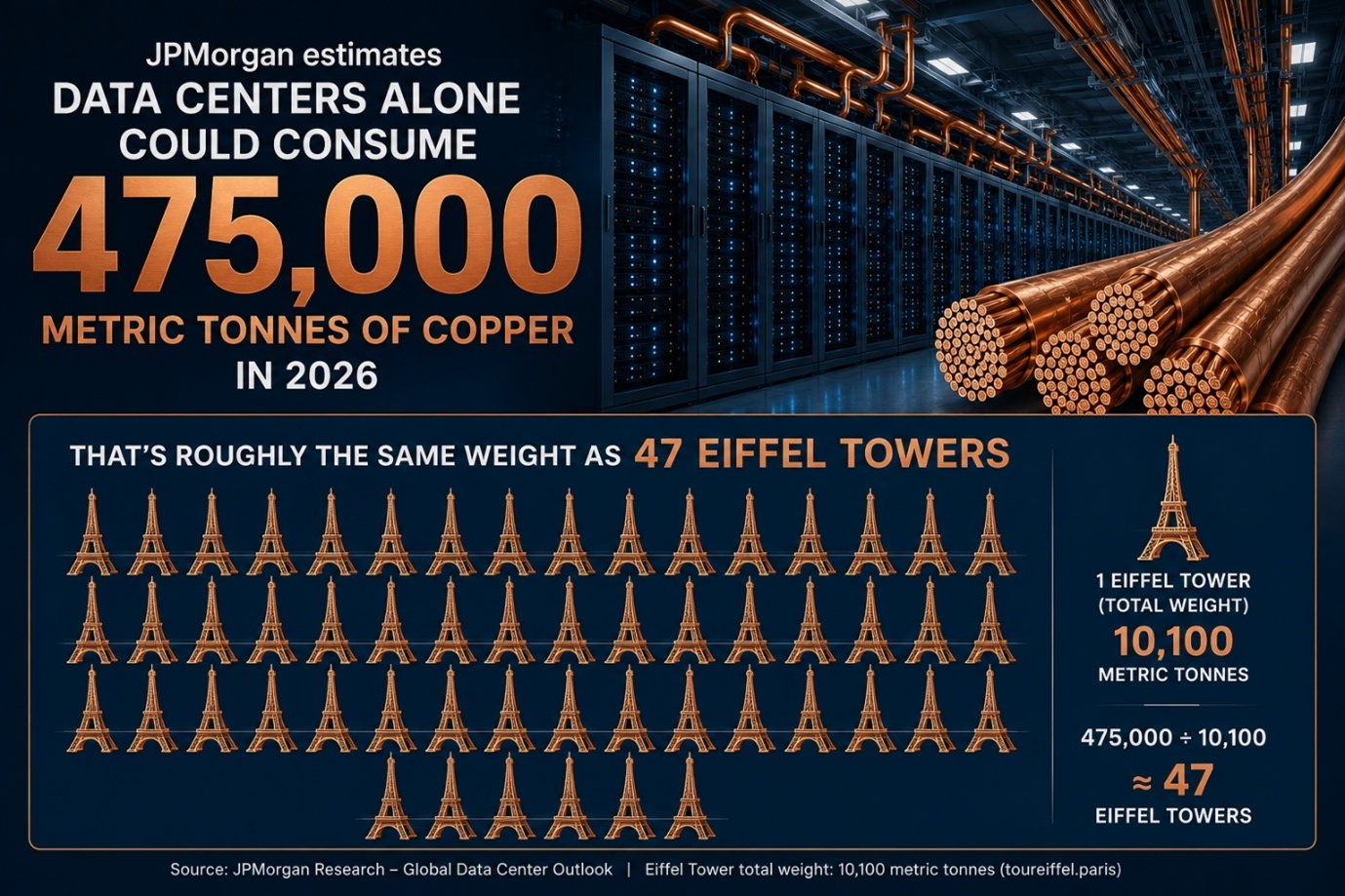
The copper goes into electrical wiring, transformers, cooling equipment and power infrastructure.
A gigawatt-scale data center also requires new generation and grid connections. That extends the copper demand well beyond the facility itself.
Doctor Copper’s Long Memory
They call the metal “Doctor Copper” because it takes the temperature of the global economy.
Now, one part of the global economy is heating up … faster than copper production can keep up.
A major technology company can approve a new data center and begin construction within a few years. A large copper mine may take 20 years or more to discover, permit, finance and build.
Along the way, miners face political opposition, environmental reviews, water constraints, labor disputes, inflation and the enormous cost of developing infrastructure in remote regions.
Ore quality is deteriorating, too. The long-term decline in copper grades means miners must dig, crush and process more rock to produce the same amount of metal.
Average operating costs have climbed from approximately $1,500 per tonne to $3,700 per tonne over the past 20 years.
That helps explain why the industry has failed to build enough new mines despite years of bullish demand forecasts.
Flooding, earthquakes, technical problems and lower-than-expected grades have hit major operations.
I’m not saying every mine will run into trouble. But there only need be enough disappointments to erase what little spare supply remains.
Hormuz, You Lose!
The freshly restarted war in the Middle East brings more trouble for copper miners who use sulfuric acid to extract copper from certain ores.
Roughly one-seventh of global copper output has exposure to sulfuric acid supplies moving through the Strait of Hormuz.
Then, recently, China halted exports of sulfuric acid.

Up to 15% to 20% of global copper capacity now faces some degree of risk. A mid-single-digit percentage of global output gets potentially affected if the disruption lasts.
Those small percentages can have a powerful effect, as many buyers must secure copper regardless of price.
Physical-market signals already point toward tightening conditions. Chinese copper inventories have fallen toward the bottom of their seasonal range.
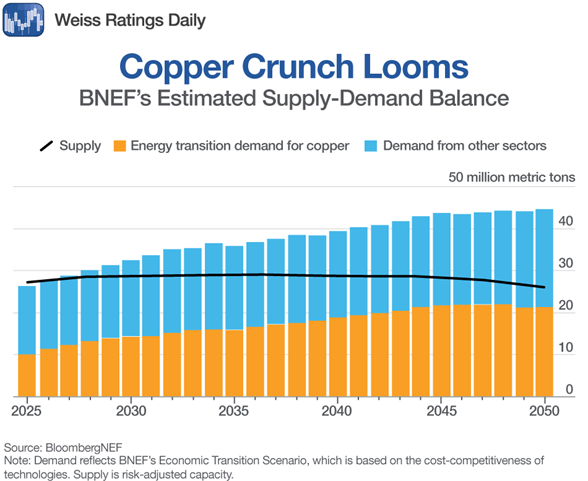
The chart shows that copper demand continues climbing while supply struggles to make meaningful progress.
The gap becomes wider as electrification demand expands.
Higher prices should eventually encourage more production and reduce some demand.
But that could take years. And therein lies your opportunity.
How You Should Play It
I last talked about copper on June 3. My recommendation then was the Global X Copper Miners ETF (COPX).
It has an expense ratio of 0.65% and holds a global basket of miners, including Freeport-McMoRan, BHP, Southern Copper and Zijin.
Since then, COPX has gone nowhere but sideways. That’s OK. I may have been early, but I’m not wrong.
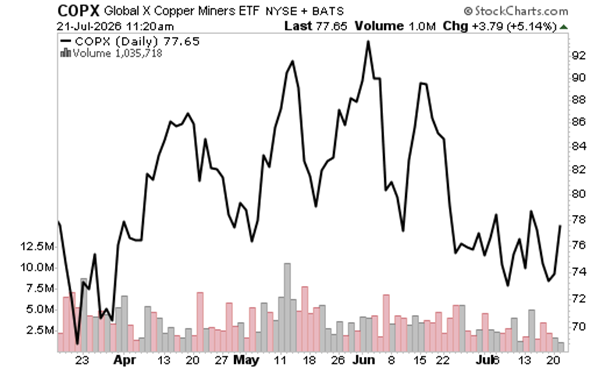
A look at a recent chart shows COPX is bumping along at the bottom of its recent range.
As fundamentals overwhelm the paper traders, I expect COPX to go much higher.
Wall Street has spent years pushing the expected copper shortage further into the future.
The latest forecasts suggest the wait may be over.
All the best,
Sean
P.S. You know where else copper is needed? Space!
Copper is useful in extreme temperatures. But the moon has even more valuable resources like helium, silicon and, ironically, rare earths.
Before we can mine them, we need the lunar infrastructure. And I’ve just identified FOUR small companies that can build it.
They even have U.S. government contracts for this very purpose. They also have revenue flowing. And tickers you can buy today.
I shared my research yesterday afternoon during a special broadcast event. You can watch the recording here.
1https://www.abc.net.au/news/rural/2026-05-17/china-turns-off-sulphuric-acid-supply/106682704