Why America's Diesel Pain Could Be Your Portfolio's Gain

 |
| By Sean Brodrick |
Pull into a truck stop anywhere in America, and the price at the pump tells a painful story.
Diesel averaged $6.29 a gallon nationwide in September, according to the Energy Information Administration.
And the EIA expects it to remain above $6 in October.
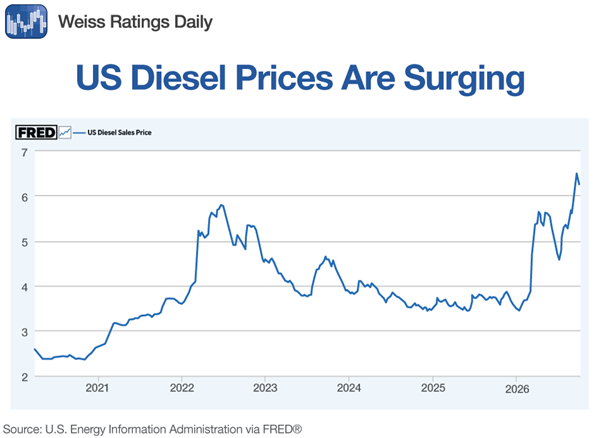
That hurts independent truckers hauling produce, steel and retail inventory.
It squeezes farmers and construction companies.
Eventually, those higher transportation costs get passed along to you through higher prices.
The Inflation Shock
And yes, it affects YOU!
The diesel price shock is adding between 0.4 and 0.7 percentage points to annual headline Consumer Price Index (CPI) readings.
September’s inflation report showed consumer prices rising 0.6% for the month.
Annual inflation climbed to 3.6%, higher than the 3.6% economists expected.
Everyone watches gasoline prices.
But diesel is quietly pushing inflation higher, accounting for an estimated quarter to a third of September’s monthly increase.
Bottom line: Higher diesel costs are helping drive inflation — and Americans are paying the price.
But there’s another side to this crisis.
Someone is making an absolute fortune.
And today, I’ll show you a way to get your share.
America Has Spare Diesel — And We're Shipping It Away
Drive south toward the giant refinery complexes along the Texas and Louisiana coasts, and you'll see a very different picture.
American refiners are running hard, turning domestic and imported crude into gasoline, jet fuel and — most importantly — diesel.
Then we're shipping enormous quantities of that fuel overseas.
In the week ending Oct. 2, the U.S. exported 1.76 million barrels of distillate fuel per day.
That's one of the highest weekly rates we've seen this year.
Meanwhile, U.S. distillate inventories stood at just 105.1 million barrels.
East Coast supplies are particularly tight — the EIA says they were 32% below their five-year seasonal average in September.
So why don't we keep more of that diesel here?
The refining industry answers that America isn't one giant, friction-free fuel market. And that's true.
Much of the East Coast's refining capacity has disappeared.
The Colonial Pipeline, which carries fuel north from the Gulf Coast, is constrained.
Shipping fuel between U.S. ports is expensive because the Jones Act requires domestic cargo to travel aboard costly U.S.-built, U.S.-crewed vessels.
Those are real problems. But there’s more to the story.
The Export Price Sets the Domestic Price
America has another gigantic transportation network: railroads.
During the Bakken oil boom, railroads moved huge quantities of crude because pipelines couldn't keep up.
The same basic system can move refined products.
Rail isn't cheap.
Transporting diesel by rail can cost significantly more than moving it through pipelines — potentially adding $12 to $18 per barrel.
Even with those higher transportation costs, moving more American diesel to undersupplied regions could help ease prices.
Also, I’m not saying rail replaces pipelines or ocean tankers overnight.
But it could help move incremental barrels out of the Gulf Coast and into undersupplied regions.
More importantly, the East Coast isn't the entire country.
Restricting some incremental exports would leave more fuel competing for buyers in Texas, the Southeast and the Midwest.
That would put downward pressure on domestic wholesale prices.
And that's exactly what refiners don't want because the global diesel shortage has created one of the greatest profit environments the refining industry has ever seen.
The Crack Spread Has Gone Crazy
What matters to refiners is the “crack spread” — the difference between what refiners pay for crude oil and what they receive for the gasoline, diesel, jet fuel and other products they produce from it.
Before the crisis, diesel crack spreads typically ranged from $25 to $35 per barrel.
That’s a measure of how much refiners can earn from turning crude oil into diesel, before accounting for operating costs.
When the war with Iran started, squeezing oil transit chokepoints, and then Ukrainian drone strikes “KA-BOOMED” Russian refining capacity, that created a worldwide scramble for diesel, and the crack spread soared.
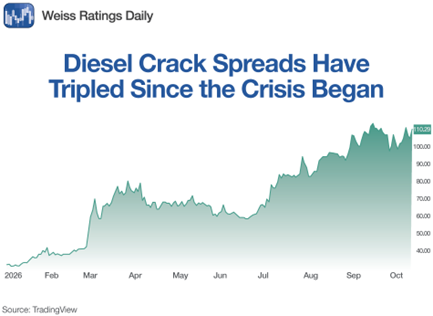
Diesel crack spreads rocketed past previous records, blowing straight through $100 per barrel as buyers scrambled for every uncommitted Gulf Coast cargo.
And because Gulf Coast refiners can put a tanker full of diesel on the water and sell it into the global market, American buyers must compete with desperate buyers in Europe and Latin America.
That's "export parity."
As a result, American truckers pay prices shaped by a global fuel emergency, even though the United States is one of the world's great refining powers.
The International Energy Agency reportedly expects the global diesel shortage to stretch into 2027.
And the EIA expects East Coast distillate inventories to remain well below normal through the winter.
This is bad for truckers and consumers, but fantastic for refiners.
Even a potential deal to secure additional Russian diesel is unlikely to offer much immediate relief.
Russia’s own refining capacity has been damaged by Ukrainian strikes, limiting how much supply it can provide.
American Refiners Are Printing Money
Wall Street is finally waking up to this.
Major refiners' market values have exploded this year as investors realize how much cash these companies can generate from today's extraordinary margins.
But refiners are also priced as if this boom will soon turn to bust.
I believe the IEA is not only correct, but that this crisis could drag on through 2027.
And that gives us an opportunity to turn America's diesel pain into portfolio gain.
The longer diesel supplies remain tight, the longer refiners could benefit from elevated margins.
And rather than betting on just one company, there is a way to invest in the industry as a whole.
Buy the Refiners
Rather than trying to pick which individual refiner will squeeze the most money out of this crisis, I recommend the VanEck Oil Refiners ETF (CRAK).
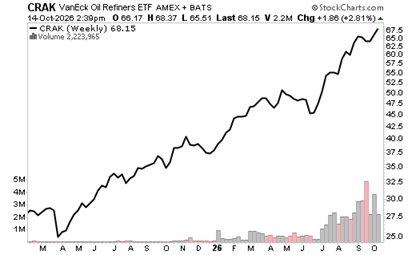
CRAK owns a basket of 30+ refiners around the world, including Marathon Petroleum (MPC), Valero (VLO), Phillips 66 (PSX) and HF Sinclair (DINO).
The fund charges 0.61% annually in expenses and currently yields about 1.19% in dividends.
CRAK gives us exposure to the companies sitting in the sweet spot between crude producers and fuel consumers.
Sure, a ceasefire or rapid recovery in damaged global refining capacity could hammer diesel crack spreads.
Washington could also intervene in fuel exports, which would be particularly painful for U.S. refiners.
But refiners have powerful friends in Washington.
If politicians haven’t already made the obvious fix before the midterm elections, they're unlikely to ever do so.
You may not like paying $6 or more a gallon when you see a diesel pump.
But with CRAK, at least you can own a piece of the companies making a fortune from it.
All the best,
Sean