 |
| By Sean Brodrick |
Earlier today, I told you why bombing Iran is going to end the one deflationary force that’s kept prices from getting even more out of control.
Now, let me walk you through what’s happening to the other major commodity I have my eye on …
The conflict between the U.S. and Iran that started this past weekend initially triggered a “safe-haven” spike in precious metals.
But this was quickly followed by a sharp “Bloody Tuesday” correction that saw gold, silver and mining stocks tumble.
It’s paradoxical, but high-quality assets often get punished the most in the early stages of a conflict.
When a crisis hits this hard, the narrative shifts from “What do I want to own?” to “What can I sell to survive the day?”
1. In a Crisis, Cash Is King
We saw a flight to safety out of most everything and into the U.S. dollar.
This creates a massive headwind for anything priced in it, including gold and silver.
For the mining stocks, this is a double whammy:
- Asset Value Compression: The value of the metal they have in the ground or are currently producing drops in dollar terms.
-
Operating Leverage: Because miners have fixed costs, a 5% drop in the metal price can lead to a 15% to 20% drop in their profit margins.
This leverage, which makes them so attractive on the way up, is exactly what causes them to tumble faster than the physical metal during a dollar-led rout.
2. The "ATM" Phenomenon
In a crisis, traders need to raise cash. They sell what they can, rather than what they want.
-
Raising Cash: When equity indices and bond markets are cratering simultaneously, hedge funds and large institutions face massive margin calls.
To cover those losses, they look for their winning positions with the most liquidity and the largest year-to-date gains.
-
Miners as Liquidity: Because mining stocks had been performing well leading up to the conflict, they were the perfect “ATM” for traders needing to raise cash quickly.
It isn't a reflection of the company’s value, but rather a reflection of the market’s desperation for liquidity.
Bottom line: Corrections in bull markets can be sharp and savage. And that’s just what we’re seeing in gold, silver and miners right now.
But the bull market isn’t over.
Here’s a chart from my friend Jeff Clark at Paydirt Prospector …
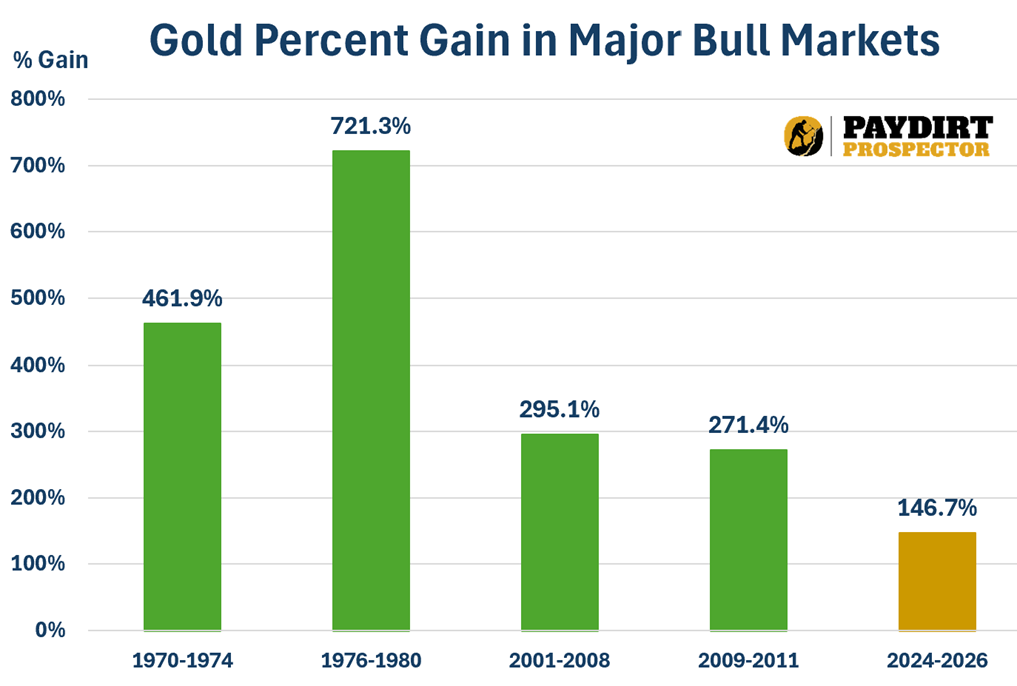
This is a chart of gold bull markets.
If the one we’re in now ended today, it would be the shortest on record.
It would also be the lowest percentage gain.
Jeff doesn’t believe that’s likely, and neither do I.
That doesn’t mean we can’t see more consolidation. Of course, we can.
As long as the U.S. dollar gets a global safe-haven bid, precious metals will likely remain under pressure.
But this war will likely be over in a matter of weeks — maybe sooner — and the big trends will reassert themselves.
And here’s a fun fact to take with you: There are about 500 grams of silver (~16 troy ounces) in every Tomahawk missile.
Over the weekend, the U.S. fired 400 Tomahawk missiles at Iran.
That’s 200,000 grams of silver vaporized.
This brings us to critical metals (silver is a critical metal).
The U.S. needs to rebuild its depleted arsenal, and it will need lots of critical minerals to do it.
China is a big source of critical minerals. And that country is kind of ticked off at Uncle Sam for pounding their major oil supplier.
So, beyond precious metals, expect more tightness in critical metals, too.
And that’s going to lead to higher prices.
I’ve already shared some easy ways to load up on metals.
Just last week, I told you to load up on the Global X Silver Miners ETF (SIL).
As for gold, I still like the iShares Gold Trust (IAU) and Van Eck Junior Gold Miners ETF (GDXJ). I last mentioned these three weeks ago.
But for an even better way to leverage gold’s bull rally resumption? Watch this in its entirety.
All the best,
Sean