Why Cybercrime Is the Top Problem for CEOs — And Your Profit Opportunity

 |
| By Sean Brodrick |
Corporate America has a new nightmare.
It isn't recession. It isn't tariffs. It isn't even the geopolitical turmoil rattling markets around the world.
It's cybercrime.
Fortunately, as you’ll see in a minute, you don’t have to become a cybercriminal to profit.
According to the latest survey data from The Conference Board and The Business Council, 71% of CEOs now rate cyberattacks as a "high" risk to their industry.
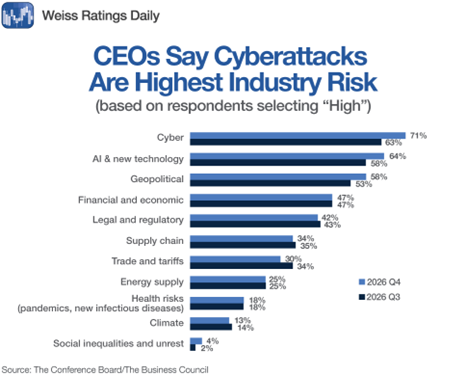
That's up from 63% just one quarter earlier — and puts cyber risk ahead of AI and new technology, geopolitical conflict and broader economic pressures.
CEOs have good reasons to be nervous.
- The average U.S. enterprise data breach now costs $10.22 million. And the damage doesn't stop with the ransom or the cost of repairing hacked systems.
- Attack volumes hit a new high in 2026 with organizations averaging 2,086 cyberattacks per week, an 18% jump from last year.
- Ransomware costs keep climbing despite fewer payouts with global damages projected at $74 billion in 2026, up 30% from 2025.
The scary part is that the threat is getting bigger, faster and smarter.
AI Is Arming Both Sides
Artificial intelligence is making companies more productive. Unfortunately, it's doing the same thing for hackers.
Cybercriminals can use generative AI to automate vulnerability searches, move through compromised networks and produce spear-phishing messages that are increasingly difficult to distinguish from legitimate communications.
AI can help attackers do more, do it faster and potentially operate at much greater scale.
Meanwhile, companies are rushing AI into their own operations, creating an entirely new attack surface that has to be defended.
That's one reason Gartner forecasts enterprise spending to secure AI applications will climb from $15.6 billion in 2025 to $37.6 billion by 2030 — an 18.5% compound annual growth rate.
And AI is only part of the problem.
Companies can spend fortunes securing their own networks and still get hacked through a software vendor, contractor or other supplier.
One compromised upstream provider can open the door to hundreds of corporate customers.
Then there are nation-state attackers.
With geopolitical risk rising, state-sponsored and proxy hacking groups increasingly have reason to target power grids, communications networks, transportation systems and financial infrastructure.
Cybersecurity Spending Is Nondiscretionary
This hands you an investment opportunity.
When the economy slows, companies can postpone a software upgrade, reduce hiring or delay buying new equipment.
Cybersecurity is much harder to cut.
The downside of getting it wrong is simply too large. Regulators are demanding faster disclosure. Cyber insurers are imposing tougher requirements. Executives face growing legal and reputational backlash when defenses fail.
Cloud security is another booming area.
As companies move workloads away from traditional on-premises systems, spending on cloud security and workload protection is growing at more than 27% annually.
In other words, cybersecurity has several growth engines running at once: more attacks, AI-powered threats, AI systems that themselves need protection, cloud migration, regulation and geopolitical conflict.
So, security budgets keep rising. Where that money goes is changing.
Companies are trying to reduce the jumble of specialized security tools they've accumulated over the years and consolidate around a smaller number of powerful platforms.
That favors the industry's giants — including CrowdStrike Holdings (CRWD), Fortinet (FTNT) and Palo Alto Networks (PANW).
My Pick to Play the Cybersecurity Boom
I know a fund that holds all those cyber heavyweights: The First Trust Nasdaq Cybersecurity ETF (CIBR).
Here’s a weekly chart …
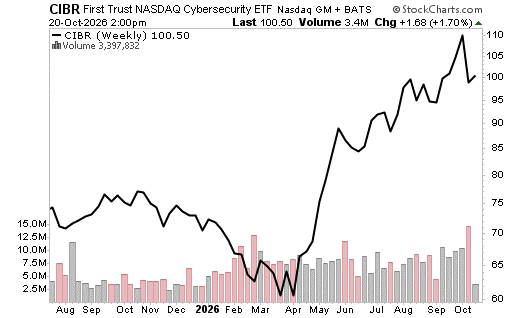
CIBR tracks the Nasdaq CTA Cybersecurity Index and owns roughly 46 to 47 cybersecurity-related companies.
It has about $18 billion in assets, trades roughly 2.2 million shares on an average day and charges a 0.58% annual expense ratio.
That gives us exposure to endpoint protection, threat intelligence, secure networking, firewalls, cloud defense and AI-driven security operations — without betting the farm on one company.
Cybercrime is an increasing threat.
AI is making the attackers more capable, corporate networks more complicated and the stakes much higher.
CEOs already understand that. That's why cyberattacks have shot to the top of their worry list.
And when corporate fear translates into billions of dollars of spending that businesses can't easily cut, I want to own the companies collecting those checks.
All the best,
Sean Brodrick
P.S. AI might make hacking easier. But in the right hands, it can also deliver short-term profit opportunities in volatile markets.
That’s why Gavin Magor just shared the latest research about his U-AI system and its ability to pinpoint major price movements leading up to elections.
With just two weeks left before the midterms, you’ll want to see it in action here.