Why Hospitals Can’t Treat Cybersecurity as an Afterthought in 2026

 |
| By Jim Nelson |
Cybersecurity threats in the healthcare industry are a huge problem.
Not just because personal medical information is at risk. But because it can put lives at risk. Some security breaches in the past have seen diagnostic tools go offline.
Others have caused hospitals to revert to paper charts overnight.
In many cases, it isn’t just one emergency room or hospital system that’s affected. These kinds of breaches can be multi-state affairs.
Unfortunately, data breaches in medicine keep climbing in number and scale. And old-school firewalls can't keep up anymore.
AI-powered attacks and slick medical scams have outgrown what most clinical networks still rely on.
In 2025, the Department of Health and Human Services’ Office of Inspector General joined a nationwide fraud takedown with federal and state partners.1
Investigators charged 324 defendants and flagged $14.6 billion in losses, the biggest DOJ fraud case yet and double the old record.
This isn’t an abstract IT headache. It shapes patient care, daily operations and whether hospitals stay open.
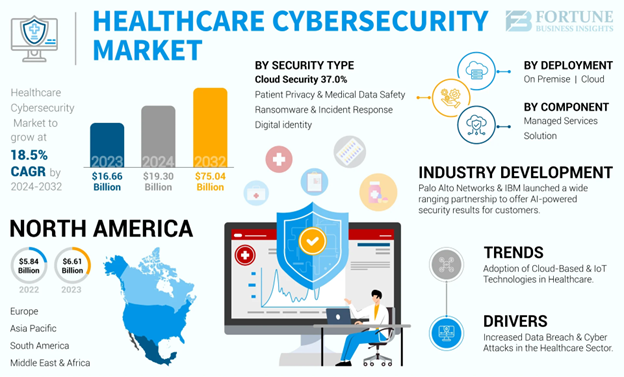
The healthcare cybersecurity market is set to more than quadruple this decade.
Fortune Business Insights puts it at $16.66 billion in 2023, climbing to $75.04 billion by 2032, an 18.5% growth rate every year.
Cloud security already eats up the biggest chunk of that spending, about 37%.
Ransomware defense, incident response and patient-data protection tools trail close behind.
North America leads the market by a wide margin, thanks to a problem hospitals feel every day: rising breaches.
The money is chasing the threat, not getting ahead of it.
Why This Isn’t Just an IT Problem
Attackers don’t stand still, especially with lives on the line.
They keep refining how to break into electronic health record systems, or ERH.
Fileless malware and multistage ransomware slip past old signature-based tools with ease.
Medical-device behavioral analytics and zero-trust architecture catch that weird lateral movement before it locks down an ICU.
Staying current buys your clinical engineering team something valuable: time. Time to patch vulnerable devices before someone else finds them first.
A publicized hack does more than cost money. It breaks community trust.
Patients switch providers and referral networks dry up. Hospitals cancel elective surgeries and lawsuits often follow.
Smart healthcare leaders stopped treating cybersecurity like a cost center. They treat it as core patient safety now.
Decentralized care hasn’t helped.
Radiologists read scans from home. Nurses update charts on personal tablets. And telehealth keeps growing.
The clinical attack surface has widened fast.
Phishing against tired nurses and shaky remote endpoints makes it easy for attackers to walk data out the door.
Money matters too. So does basic housekeeping hospitals still skip: patching medical devices.
Legacy infusion pumps, outdated MRI workstations and unpatched virtual appliances stay easy targets.
Tracking what attackers exploit right now helps IT teams fix the worst gaps before someone forces a shutdown.
5 Healthcare Cybersecurity Trends Worth Watching Right Now
1. Agentic AI targets clinical workflows.
Attackers use AI agents to scan hospital networks and map weak equipment without any human help.
Hospital security teams fight back with their own AI, isolating infected segments before ransomware reaches the EHR.
2. Deepfakes bypass medical identity and billing.
Attackers now use deepfake voice and video to impersonate hospital leaders and doctors, tricking staff into wire transfers or fake file requests.
Hospitals fight back with strict callback rules and multifactor checks for any request that looks off.
3. Cyber resilience keeps care running, not just prevention.
Hospitals now accept that a determined attacker will eventually get through.
Budgets are shifting from blocking every threat to simply keeping care running, with remediation time as the key metric.
4. Identity is the new clinical perimeter.
Medical teams log in from clinics, homes and ambulances now, so the old network wall doesn’t work anymore.
Zero trust systems check every login in real time by location, behavior and device health … and kill odd sessions instantly.
5. Quantum readiness starts now for old patient data.
Quantum computers can’t break today’s encryption yet, but attackers are already stealing encrypted records to crack open later.
Health systems are mapping their encryption now and planning a shift to quantum-resistant tools to protect decades of patient history.
The Bottom Line
None of these trends stand alone.
They all point to the same shift: Patient safety now needs strong cybersecurity, not just sterile equipment or fewer errors.
Hospitals that treat 2026’s threats as real and ongoing — not a yearly HIPAA checkbox — are the ones that stay open.
Their patients, and their data, stay safe too.
Sincerely,
Jim Nelson
P.S. There are plenty of cybersecurity companies out there already with some solutions.
But for future attacks from better technologies like quantum computing, you’ll need the companies working on those problems right now.
Chris Graebe just sat down to talk about one of those companies.
It’s on the cutting edge of cyber defense. And you can own shares before it even goes public. Watch his interview now.
1https://oig.hhs.gov/newsroom/media-materials/2025-national-health-care-fraud-takedown/
2https://evotek.vn/en/2025-healthcare-it-trends-key-focus-areas-for-tech-leaders/