Why Isn’t the Stock Market Rallying in Q4? 5 Headwinds to Watch

 |
| By Sean Brodrick |
Storm clouds are gathering over the market. As investors, we are torn between scurrying for cover and riding it out.
Let's work our way through what’s dragging on the market.
Why Isn't the Stock Market Rallying?
This is supposed to be the easy part.
We are in the fourth quarter — historically the strongest quarter of the year for stocks.
Better yet, we're in the fourth quarter of a midterm election year, which has historically been even stronger.
Since 1950, the S&P 500 has gained an average of 6.6% during the fourth quarter of midterm years.
Stocks finished higher in 16 of those 19 quarters.
In other words, history says the wind should be at our backs.
Instead, investors are getting hit from seemingly every direction.
The Neocloud Scare Is Spreading
I've written before about the cracks appearing in the "neocloud" business model.
Now those cracks are starting to make Wall Street nervous about the broader AI boom.
CoreWeave (CRWV) is the poster child.
The company grew at a blistering pace by borrowing enormous amounts of money to buy expensive Nvidia (NVDA) chips, leasing huge amounts of data-center capacity and then renting that computing power to AI customers.
The problem is the enormous amount of debt required to keep that machine running.
CoreWeave has roughly $50 billion in liabilities. Its capital-spending plans have ballooned. And one of its bonds recently traded at a yield above 16% — the kind of yield normally associated with distressed debt.
And investors aren't worried only about CoreWeave. They're starting to ask whether the entire AI infrastructure boom has become too dependent on borrowed money.
That's especially important because AI-related stocks have accounted for roughly 75% of the S&P 500's return since ChatGPT launched, according to JPMorgan data cited by Reuters.
Meanwhile, the estimated capital required for the AI buildout could reach $10.3 trillion by 2032.
If investors begin questioning the economics of that spending, the problem doesn't stay contained in neoclouds.
It can spread to chipmakers, data-center operators, power companies and ultimately the giant tech companies funding much of the boom.
That's one reason every new crack in CoreWeave gets so much attention.
War Is Pouring Fuel on the Inflation Fire
The continuing conflicts in the Middle East and Ukraine aren't just tragedies for the people who live there. They're increasingly a global economic problem.
This morning, Brent crude, the international benchmark, is back above $110. And West Texas Intermediate, the U.S. benchmark, is nearing $100.
This despite oil flowing through the Persian Gulf at near pre-war rates.
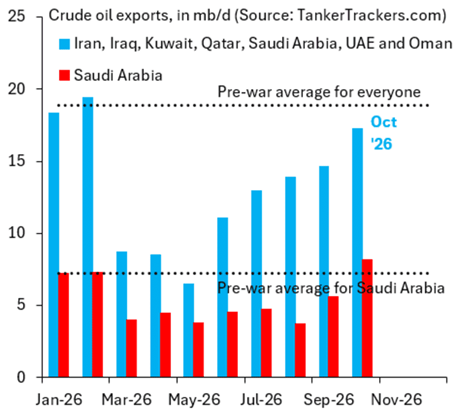
The global diesel market is even tighter, and the International Energy Agency warns shortages could persist well into 2027.
Diesel matters because trucking is the unseen nervous system of the economy. Higher diesel prices filter through the cost of almost everything.
And we're already seeing the consequences.
Inflation Is Heating Up Again
September's Consumer Price Index jumped 0.6% from August — a 7.4% annualized pace if that monthly rate persisted.
Headline inflation is now running at 3.7% year over year. Energy prices jumped 5.2% in September alone, while gasoline surged 9.1%.
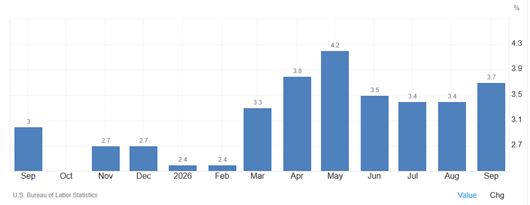
That's exactly what Wall Street didn't want to see.
Markets love cheap money. For much of the bull market, investors have been willing to pay premium valuations, assuming inflation would eventually cool and the Federal Reserve would bring interest rates down.
Instead, energy is pushing inflation in the opposite direction.
If inflation remains stubbornly above target — or accelerates further — the Fed has less room to ease monetary policy and may have to keep rates higher for longer.
To retain credibility, it may be forced to hike again sooner rather than later.
And that brings us to perhaps the biggest weight hanging around the market's neck.
The Bond Market Is Sending a Warning
The 10-year Treasury yield remains above 5%, recently around 5.1%. The 30-year is around 5.4%.
Remember, stocks don't exist in a vacuum. Investors constantly compare the potential return from equities with what they can earn elsewhere.
When lower-risk Treasury securities offer yields north of 5%, stocks, which are inherently riskier, have to compete with that.
Higher yields also reduce the present value of future corporate earnings.
That's especially painful for high-growth technology stocks, where investors are paying today for profits expected years into the future.
And all those high-flying tech companies like CoreWeave that are running losses? They’ll have to refinance debt at higher rates.
Businesses pay more to expand. Highly leveraged companies face higher interest expense.
For capital-intensive businesses — including those building the AI infrastructure boom — that can be brutal.
Indeed, the combination of the neocloud scare and rising yields is particularly toxic.
The AI buildout requires staggering amounts of capital at precisely the moment capital is becoming more expensive.
And not just corporations. Homebuyers pay more for mortgages. As a result, the real estate market has frozen solid.
And Now We Have Election Uncertainty
Finally, we have the Nov. 3 midterm elections.
Current polling suggests Democrats are favored to capture the House, while the Senate remains much more uncertain.
Markets hate uncertainty.
Also, a change in congressional control could alter expectations surrounding corporate taxes, regulation and federal spending.
Big Tech and AI could face greater scrutiny over antitrust issues, data privacy and the enormous amounts of electricity consumed by data centers.
Opposition to data-center construction has become a political issue in several states, and investors are starting to think the election could slow the AI infrastructure buildout.
Energy companies could face tougher oversight.
Pharmaceutical pricing could return to center stage.
Tax policy could become a battleground.
Markets can price good news. They can price bad news. Uncertainty is harder.
Depending on the election results, we could see a quick downside correction in the markets.
The Good News
Importantly, I'm not telling you to run for the hills.
A lot of bad news is hitting the market simultaneously, and yet, the broad market isn't collapsing.
That tells me investors still believe corporate earnings and the longer-term economic story remain strong enough to offset many of these pressures.
The election will happen. Once investors know who controls Congress, one major uncertainty disappears.
Treasury yields won't rise forever. Any convincing evidence that inflation is rolling over could send bond yields lower — and give growth stocks room to run.
The neocloud shakeout could also be healthy in the long run.
Bad business models should fail. Capital should flow toward businesses with real earnings, strong balance sheets and sustainable competitive advantages.
That's capitalism doing its job.
And remember that powerful seasonal tailwind.
The fourth quarter of a midterm year has historically produced some of the market's strongest returns.
History doesn't guarantee that happens this time. But the odds favor the cycles.
The market has many reasons to rally. Right now, those reasons are overwhelmed by inflation, war, high interest rates, fears of AI debt and political uncertainty.
If even two or three of those headwinds begin to ease, stocks could have plenty of room to run.
So I wouldn't abandon this market. I'd just be very selective about what I own while we wait for the storm clouds to clear.
All the best,
Sean