
 |
| By Jim Nelson |
On Saturday, we briefly looked at how small the average dividend has become in today’s tech-heavy market.
It’s at a 50-year low at just 1.09%. With inflation above 3%, dividends from your typical stocks clearly aren’t keeping up.
That said, there ARE companies out there that HAVE to pay you to own them.
In fact, there are three types of companies that — unlike mainstream stocks — are forced to pay shareholders an enormous dividend every year.
We checked into these before. But now, these three types of companies are even more important to anyone looking for investment income.
Let’s look at each one and what you should know before buying …
REITs
You’ve no doubt heard of Real Estate Investment Trusts.
Their premise is simple.
Instead of owning individual properties — and dealing with tenants, broken toilets and busted pipes — you can own a portfolio of real estate with just one investment.
Even better, REITs tend to offer large dividends. They are FORCED to pay out at least 90% of their taxable income to shareholders.
That allows them to avoid double taxation — taxed at the corporate level and taxed again on distributions.
One you might consider is Omega Healthcare Investors (OHI).
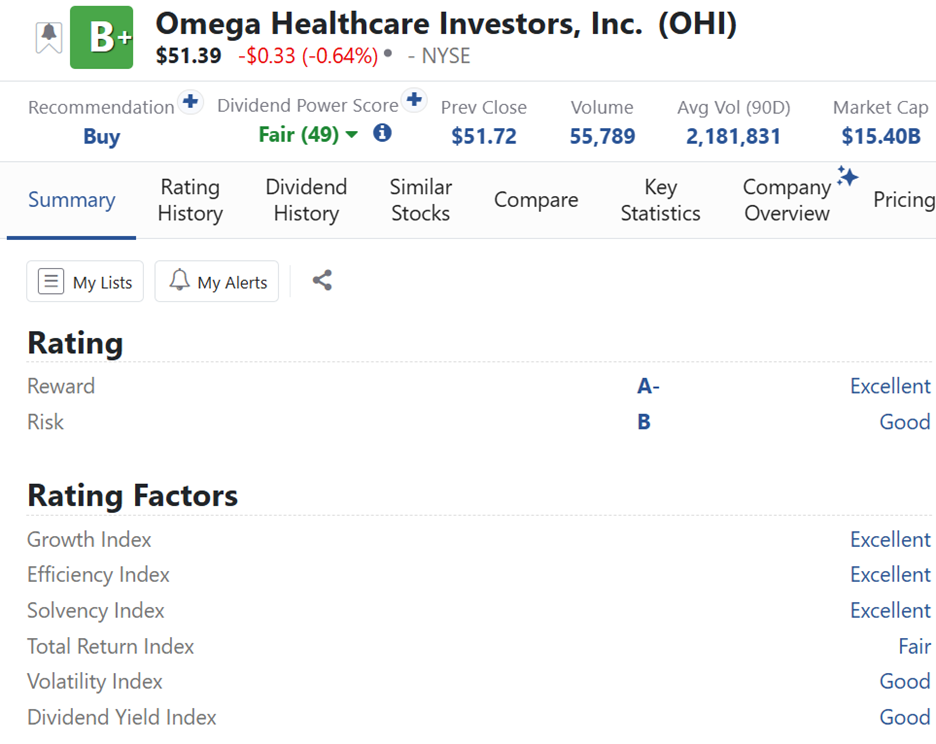
It owns long-term care facilities, which is a booming business with our aging population.
This REIT pays a 5.2% dividend yield.
One problem with REITs, though, is that they are sensitive to changes in interest rates. That can impact their ability to finance new properties with favorable terms.
But they aren’t the only big dividend game in town.
BDCs
Business Development Companies are exactly that: companies that finance developing businesses.
Often, the focus is on startups or other small businesses that need cash to expand.
BDCs will offer structured loans or equity stakes in exchange for that financing.
So, as long as they are picky when it comes to making these deals, BDCs earn incredibly high yields from their deals — often in the double digits.
They come from the “Small Business Investment Incentive Act of 1980.”1 So, they aren’t going anywhere.
And as part of their special tax structure, they, too, pass on at least 90% of their taxable income to shareholders.
One of the highest-rated BDCs is Capital Southwest (CSWC), currently rated a “B-.” It pays a whopping 10.9% dividend.
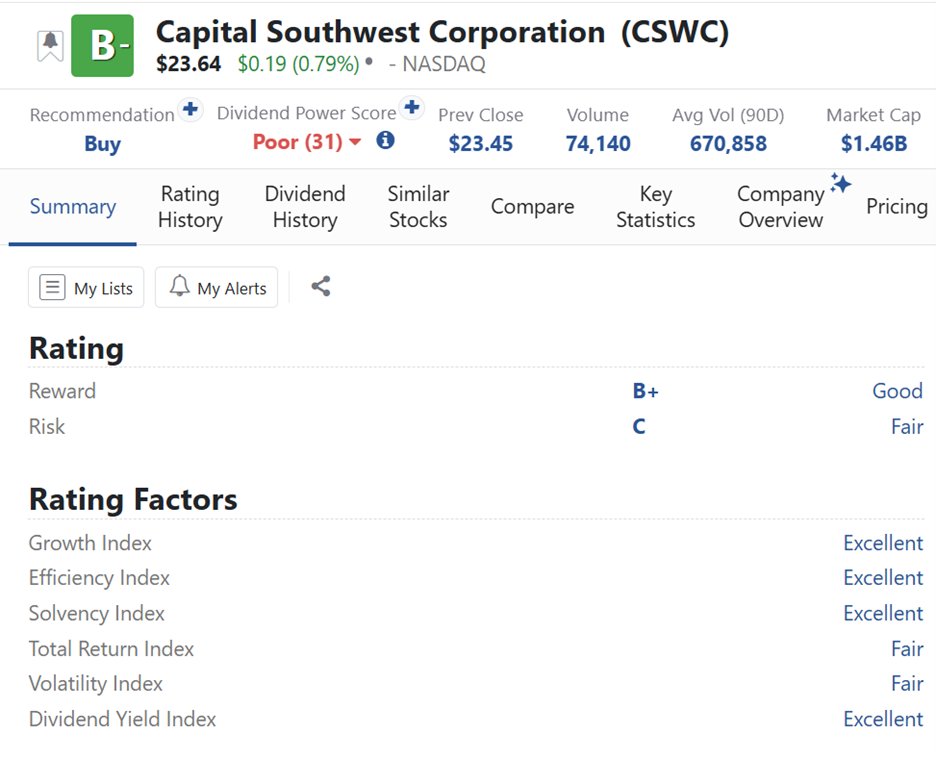
That fat dividend is attractive. But BDCs are often seen as risky because of the small size of the companies they finance.
If the market takes a downturn, these often go with it.
MLPs
Master Limited Partnerships offer a third category of high-income investment.
These were created in the years following the 1970s gasoline shortages and rationing.
They often pay large distributions to shareholders — called limited partners — because of the kinds of steady businesses they operate.
MLPs typically own assets related to the energy sector. Things like pipelines and storage facilities.
These assets let them lay out long-term contracts with producers.
And their services are always in need — whether the oil is flowing or held up at their facilities waiting for higher prices.
A great example of an MLP is MPLX (MPLX).
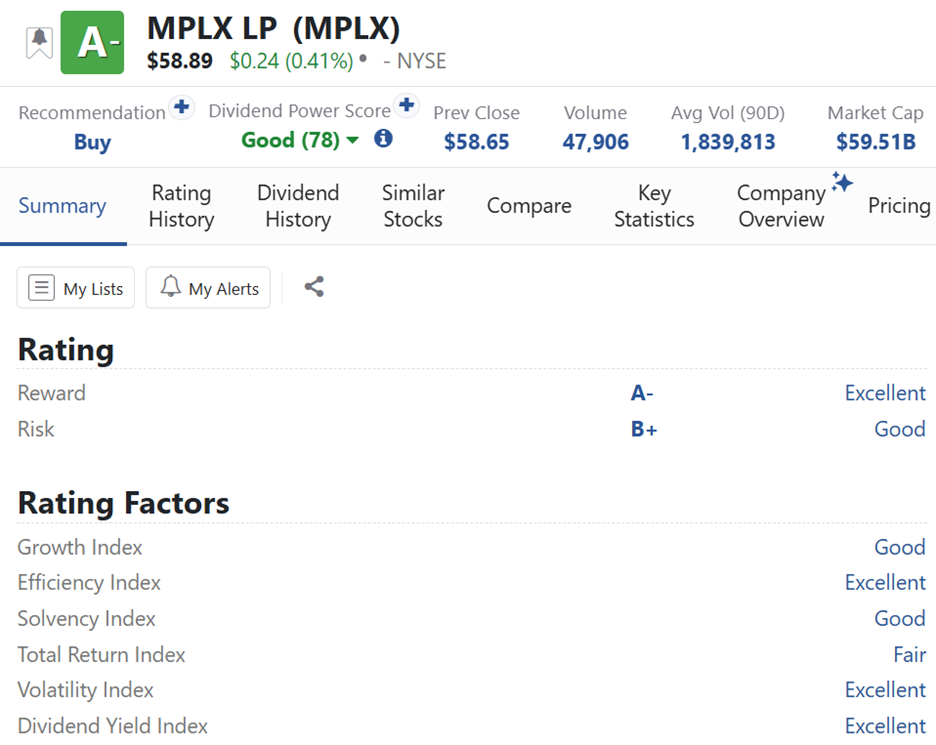
It has an enormous network of oil and gas pipelines and storage facilities across the U.S. and pays a solid 7.1% dividend yield.
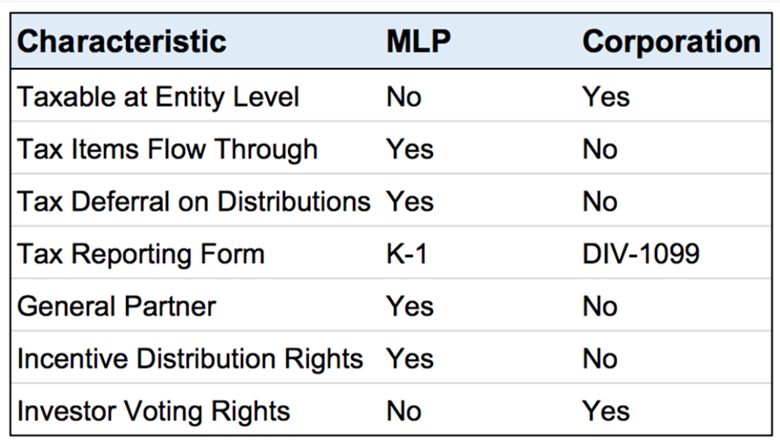
The downside? The IRS makes MLPs complicated to own.
That’s because partners (that could be you) receive payouts made up of “returns of capital.” Not just ordinary income.
On the one hand, that allows investors to lower their cost basis and delay taxes until they sell shares.
On the other, it complicates the tax process and can have an inverse effect if held within a tax-advantaged account.
So, if you’re worried about finding income in today’s market, you’re not completely out of luck.
These three types of companies — REITs, BDCs and MLPs — can give you a leg up.
But, as you can see, they all have their own problems — interest-rate sensitivity, market risk and tax issues.
You do have other options for investment income, however.
In fact, Dr. Martin Weiss and income expert Nilus Mattive are about to share a strategy they have been using for years to force income from regular stocks nearly every Friday.
All you have to do is click this link to see it for yourself. The event starts at 2 p.m. Eastern today.
Sincerely,
Jim Nelson
1https://www.congress.gov/bill/96th-congress/house-bill/8123
2https://www.dividend.com/how-to-invest/mlps-vs-dividend-stocks/