Why the Hot October Jobs Report Points Savers to the Two-Year Treasury Note

|
Key Takeaways
|
 |
| By Gavin Magor Reviewed by: Leo Tavolaro |
If you keep money in a savings account, a money fund or Treasury bills, Friday's jobs report was good news for you.
Employers added far more jobs in October than anyone expected.
That keeps the Federal Reserve (Fed) leaning toward another rate hike, and it keeps the interest on your cash higher for longer.
But Thursday showed how fast that can change.
So the question is how to lock in current rates before the next scare.
My answer is a plain government bond you can buy for $100.
Thursday's Scare, Friday's Relief
Thursday was a rough day for stocks and a strange one for savers.
The Nasdaq Composite fell more than 5% as investors dumped AI chip stocks.
Treasurys rallied, and the two-year Treasury yield fell to 4.46%.
For anyone living off interest, that looked like the start of smaller payouts.
It turned out to be a head-fake: a sharp move that quickly reversed.
Friday's jobs report pushed the two-year yield back up to about 4.53% by Friday morning.
If your cash earns interest, that bounce matters more to you than any headline about stocks.
The Report That Changed the Math
Employers added 165,000 jobs in October.
Economists had expected about 65,000.
The government also revised August and September higher, adding 84,000 jobs that weren't in the earlier count.
The unemployment rate dipped to 4.1%.
That's down a notch from September.
Hiring was broad, led by professional and business services and health care.
Paychecks grew, too.
Average hourly earnings rose 0.4% in October, a faster pace than economists forecast.
For you, that means a job market strong enough to let the Fed keep pushing rates higher.
A Fed With No Reason to Relax
The Fed raised its key rate in September, its first hike since 2023.
That put its target range at 3.75% to 4%.
It held steady in October, though two policymakers voted for another hike.
Inflation is the reason the Fed can't relax.
Consumer prices rose 3.7% in the year through September.
On Wednesday, traders saw more than an 80% chance of a December hike.
By Friday morning, after the jobs report, they put it at about 75%.
I expect the Fed to raise rates again when it meets on Dec. 8 and 9.
What the Numbers Say About Your Cash
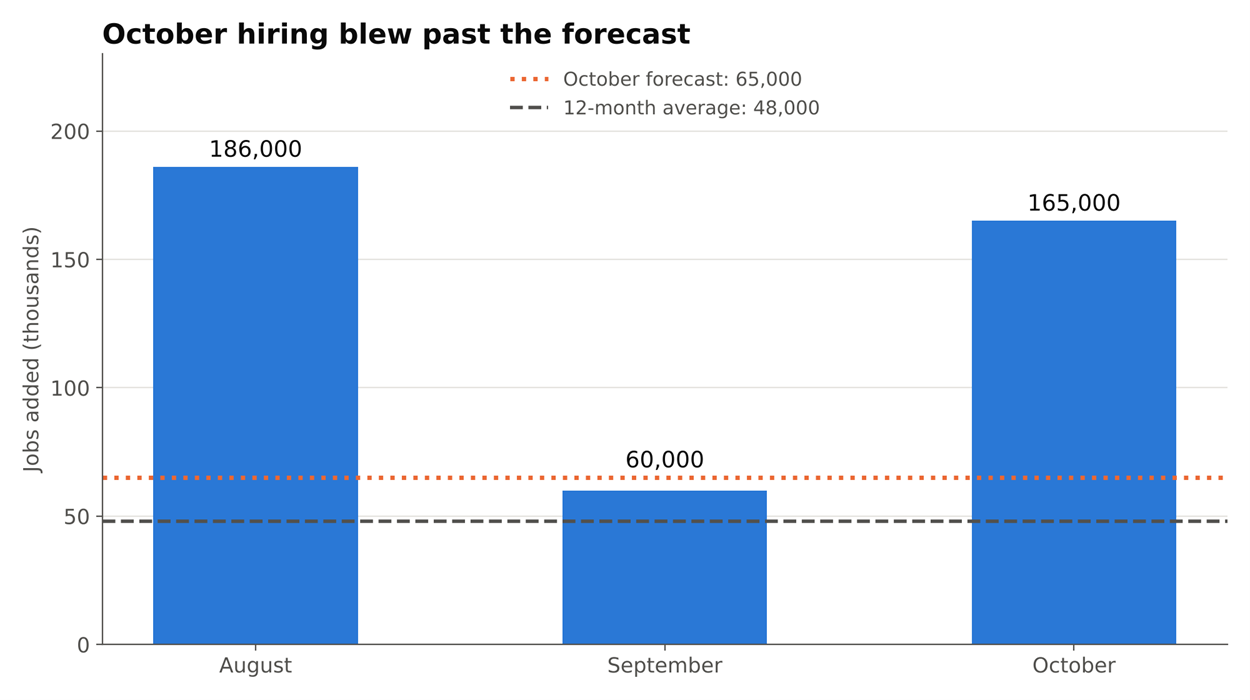
October's hiring ran at more than three times the average pace of the past year.
That's not a job market that needs the Fed's help.
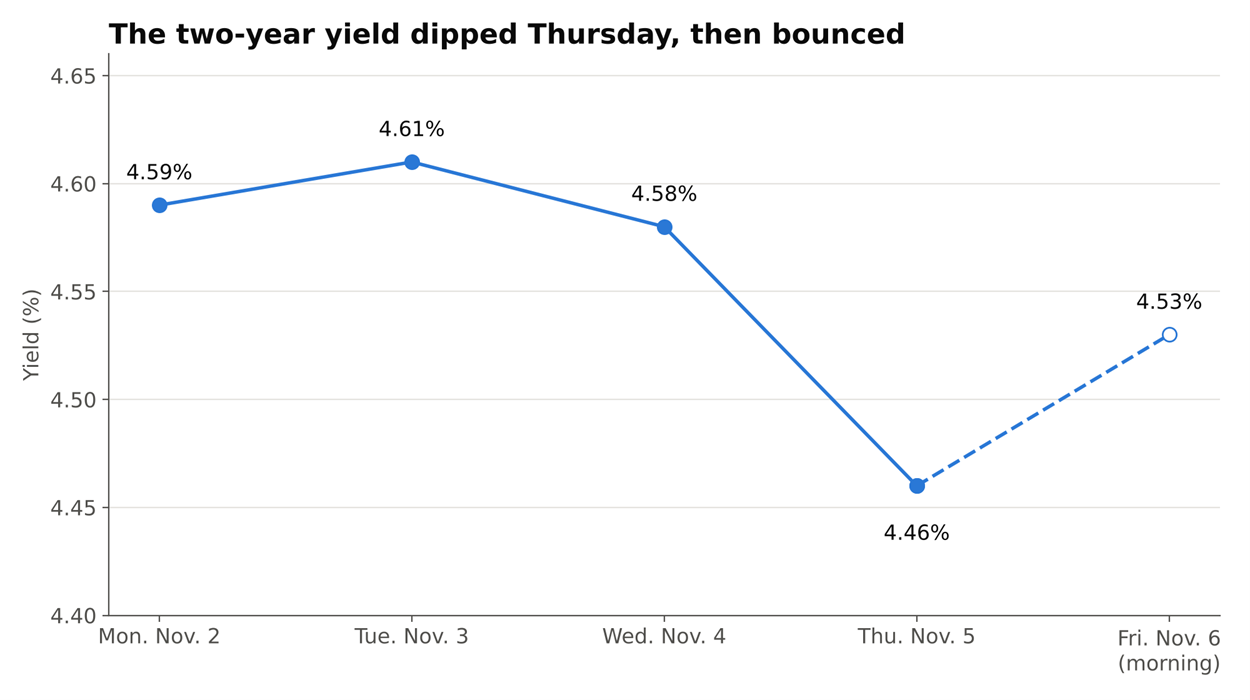
The two-year yield ended Tuesday at 4.61%.
By Thursday's close, it had fallen to 4.46%.
Then it rebounded on the jobs news.
That swing is a reminder that the rate on your cash can move a lot in a few days.
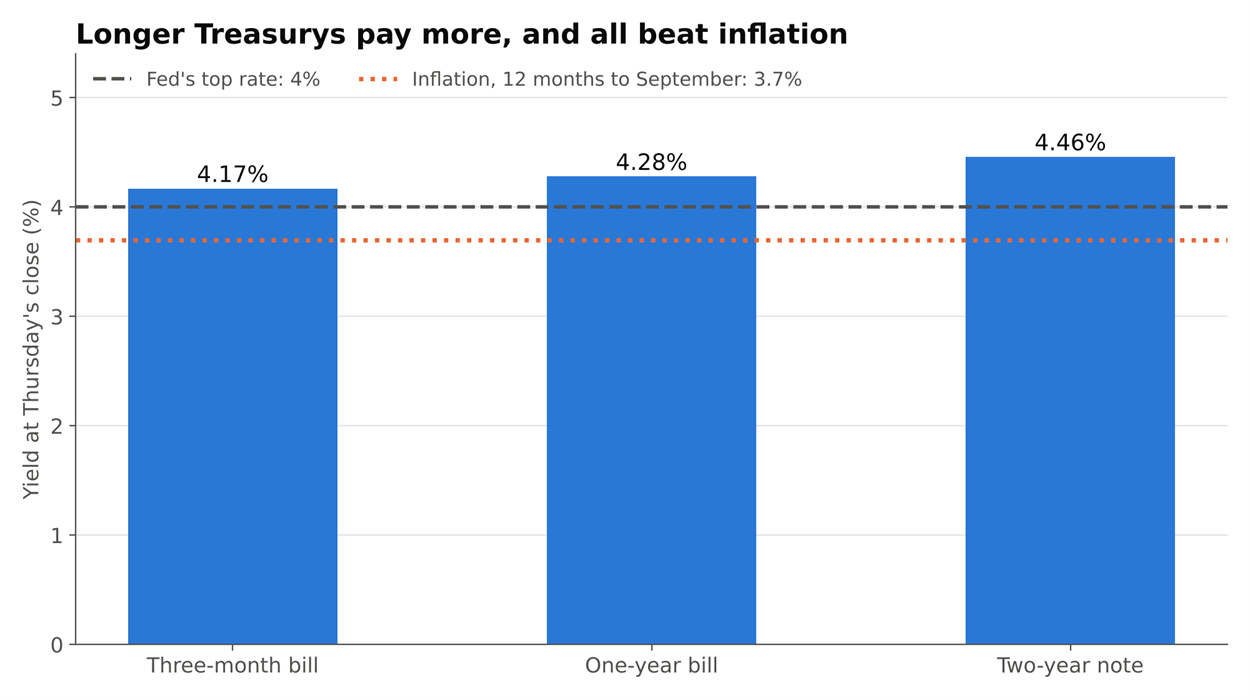
At Thursday's close, the two-year note yielded more than the Fed's top rate of 4%.
It also beat the latest inflation reading of 3.7%.
In plain English, the two-year note already pays you for a December hike before the Fed delivers it.
Treasury bill yields will likely rise if the Fed hikes.
But bills mature in a few months, and you'd be reinvesting at whatever rate the market offers next.
The two-year note locks in its yield for the full two years.
Why I'd Skip the Bond Funds
Many investors reach for a bond fund instead of a bond.
Our ratings say that's the weaker choice right now.
iShares 7-10 Year Treasury Bond ETF (IEF) carries a Weiss rating of D+, a SELL.
Longer bonds lose more value when rates rise, and that's the risk the jobs report just revived.
iShares 20+ Year Treasury Bond ETF (TLT) is rated D, a SELL.
It holds the longest bonds of the group, so it has the most to lose if the Fed keeps hiking.
Shorter funds score better, but not well enough for new money.
iShares 1-3 Year Treasury Bond ETF (SHY) is rated C-, a HOLD.
SPDR Bloomberg 1-3 Month T-Bill ETF (BIL) is rated C, a HOLD.
Vanguard Short-Term Treasury ETF (VGSH) is also rated C, a HOLD.
If you already own one of these short-term funds, there's no need to sell.
For fresh cash, I prefer owning the note itself.
A fund never matures, so it never promises to hand back your full principal on a set date.
A Treasury note held to maturity does.
In the Weiss Ultimate Portfolio, which I edit, we also hold an asset manager that earns more when savers keep their cash at work.
Let the Ratings Do the Sorting
Every fund rating in this report came straight from the live Weiss Ratings pages.
Weiss Ratings Plus puts that same work in front of you, with real-time ratings, instant alerts on upgrades and downgrades, and exclusive analysis.
It's how you'll know the day a long Treasury fund earns a better grade.
And it's how you'll see our next move on U.S. debt as soon as we make it.
Click here to see what Weiss Ratings Plus can do for you.
My Pick: The Two-Year Treasury Note
The bond I'd buy for fresh cash is the two-year Treasury note.
It yielded about 4.53% Friday morning.
You can buy it at a monthly auction through TreasuryDirect, the Treasury's own website, or through your brokerage account.
The minimum at TreasuryDirect is $100.
It pays interest every six months until it matures.
That interest is free of state and local income tax.
That's a real bonus if you live in a high-tax state.
The trade-off is simple.
If rates keep climbing, waiting could have earned you a little more.
I'd rather lock in a yield above inflation than gamble on squeezing out a few extra basis points.
What I'm Watching
- October's consumer price report on Tuesday, Nov. 10, to come in hot enough to make a December hike close to certain.
- The November jobs report on Friday, Dec. 4, to confirm that October wasn't a one-off.
- The Fed to raise its target range when its meeting ends on Wednesday, Dec. 9.
- The two-year yield to stay above the Fed's top rate, keeping the note's edge over cash intact.
Bottom Line
Friday's jobs report was good news for anyone holding cash, and the best way to keep that good news is to lock it in.
A strong job market keeps the Fed leaning toward higher rates.
But Thursday proved that one scare can pull yields down in a day.
So put the cash you won't need for two years into the two-year Treasury note.
Skip the SELL-rated bond funds, and let the government pay you every six months instead.
Cheers!
Gavin