 |
| By Sean Brodrick |
The White House doesn’t want to admit it, but food prices are soaring!
Average spot inflation for U.S. food and beverages surged 7.9% year-on-year. That’s a staggering jump from 4.2% the previous month.
This represents the biggest spike in roughly 12 months, according to a Bank of America Global Research report.
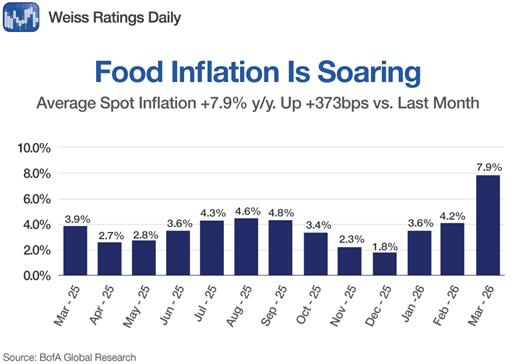
While retail CPI food still lags at +2.7%, the pass-through to grocery store shelves is imminent.
Consider these jaw-dropping spot price increases from the report:
- Tomatoes: +102%
- Vegetables: +90%
- Beef: +12.1%
- Vegetable oils: +13.2%
Yes, this is due to the war with Iran and that country’s blockade of the Strait of Hormuz.
That sent the prices of diesel and fertilizer — both food inputs — higher.
And worse is yet to come.
Government Complacency vs. Reality
The government appears remarkably complacent.
The USDA Economic Research Service (ERS) is currently projecting U.S. "all food" prices to rise only in the low- to mid-single digits in 2026, with a point estimate near 3%.
Even they admit to a "great deal of uncertainty," noting the upper end of their range could reach 6% to 8%.
Contrast that with data from AgFunderNews focusing on the Persian Gulf conflict spillovers.
It says global food prices could end up 12% to 18% above pre-crisis levels by the end of 2026, even with a quick resolution.
My take is that historically, such a rise would translate to roughly 4% to 8% U.S. food inflation over a year.
The Suez Risk
The official forecasts assume the war with Iran will be resolved soon.
If it doesn't, history offers a grim warning.
For example, a war between Israel and Egypt closed the Suez Canal for eight years starting on June 5, 1967.
I’m not saying the Strait of Hormuz will stay closed for that long.
What I am saying is the market is failing to price in the possibility of a prolonged closure.
If things do get worse, U.S. food inflation could approach 10% year-over-year.
Such a level would crush consumers and spell disaster for U.S. "congress-critters" heading into the midterm elections.
I believe the talk of 30% to 40% year-over-year food inflation I’ve seen is scare-mongering. But a more realistic 10% move would still send shocks through the system.
So, sensible investors might want to hedge against rising food prices.
The easiest way to do that is with the Invesco DB Agriculture Fund (DBA).
It holds a basket of futures on corn, soybeans, wheat, sugar, coffee, cocoa, cattle and hogs.
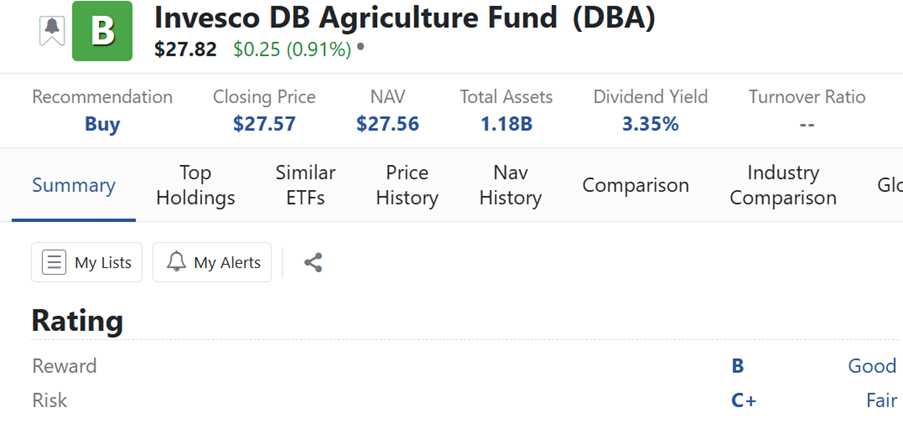
And what do you know? It’s already breaking out!
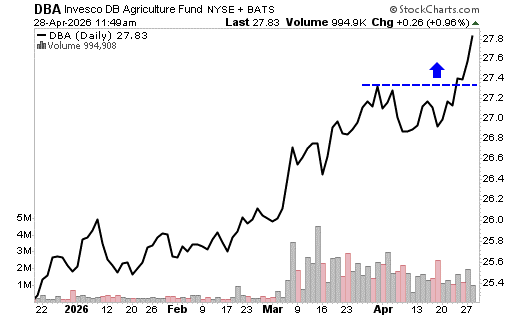
With a breakout like that, the DBA is headed to $35 a share, and probably higher.
The DBA has an expense ratio of 0.85%.
Higher food prices are coming. Wise investors will get ahead and hedge against a potential sticker shock on everything from hamburgers to apples.
All the best,
Sean
P.S. My colleague, Gavin Magor, just cracked the door for new members to gain access to his “Weiss 3.0” system. You can see what it’s all about here.