 |
| By Gavin Magor |
Monday was the kind of day that makes people feel they're missing out.
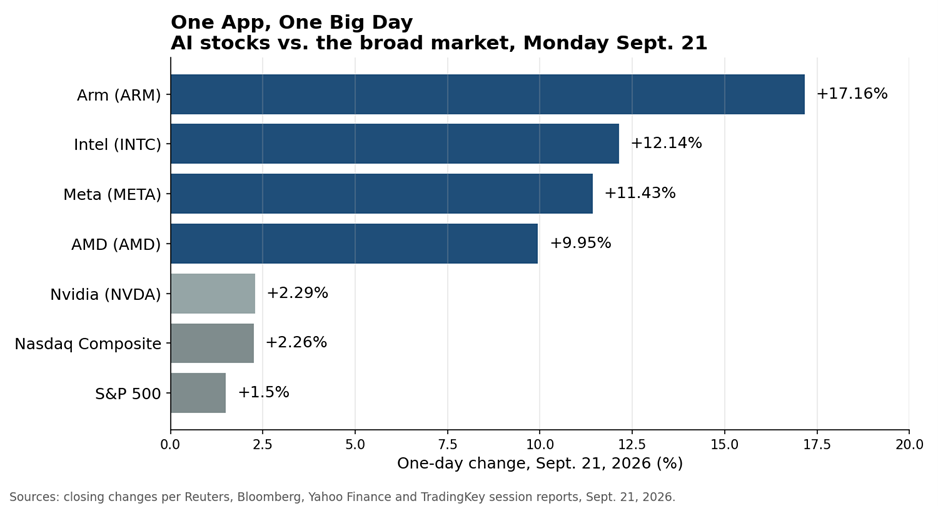
The S&P 500 rose 1.5%, its best day since early August. The Nasdaq Composite gained 2.26% for its first record close since June.
The spark? An app.
Meta Platforms (META) launched its Muse personal AI agent on Sept. 8.
In less than two weeks it became the No. 1 free iPhone app in the U.S., overtaking ChatGPT, according to Sensor Tower.
Meta shares jumped 11.43% to close at $741.25, their biggest one-day gain in more than a year.
That added roughly $190 billion in market value in a single session.
Then the chipmakers joined the party.
Advanced Micro Devices (AMD) rose 9.95% to close at $615.52, topping $1 trillion in market value for the first time.
Intel (INTC) climbed 12.14%, and Arm Holdings (ARM) jumped 17.16%.
So today, rather than asking whether to chase these names, I want to ask a more useful question: How much of this rally do you already own?
Why Chipmakers Care About an App
Muse doesn't just answer questions. It sends emails, books trips and fills out forms. And it keeps working after you close the app.
That takes a lot of ongoing computing.
Traders read Muse's popularity as a sign AI will need far more server processors, not just the graphics chips that made Nvidia (NVDA) famous.
Intel CEO Lip-Bu Tan said last week that CPU demand is so high his company can supply only half of its customers.
That's why Nvidia rose a comparatively sleepy 2.3%. Though at more than $5 trillion in value, that sleepy move still added roughly $120 billion. About a third of Arm's entire value!
You Already Own More of This Than You Think
Most individual investors don't own AMD or Meta directly.
They own an S&P 500 index fund, a target-date fund in their 401(k) … or both.
Those funds weight companies by market value. The bigger a company gets, the more of your money it takes up. Automatically.
At the end of 2015, the 10 largest companies made up about 19% of the S&P 500.
By the end of 2025, that share had reached a record 40.7%, according to RBC Wealth Management, using FactSet data.
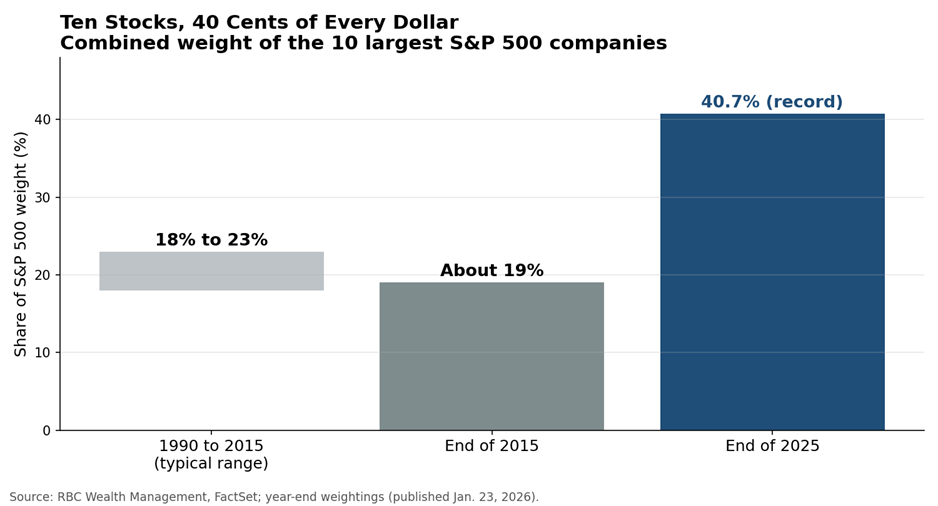
As RBC frames it, more than 40 cents of every dollar in an S&P 500 fund goes into just 10 companies.
Many of them are the same AI names that moved this week.
That has been wonderful on the way up.
RBC notes the market-value-weighted S&P 500 beat its equal-weighted version by roughly 32% over the three years to the end of 2025, one of the widest gaps on record.
But it cuts both ways.
When the AI trade stumbles, your "diversified" fund stumbles with it.
We had a preview earlier this month, when chip stocks sold off after Anthropic CEO Dario Amodei warned of a slowdown.
4 Steps to Take Right Now
1. Know what you actually own.
Pull up your 401(k) or IRA statement and look at the top 10 holdings of each fund.
If you hold an S&P 500 fund, a growth fund and a tech fund, you may own the same handful of companies three times over. That's not diversification. That's repetition.
2. Don't let one great day set your strategy.
Meta's jump came on an app ranking and an analyst note, not an earnings report.
Options traders piled in heavily, a sign of short-term speculation as much as long-term conviction.
AMD has gained about 25% in a week and more than 180% this year. But it fell yesterday and is down again today.
Wonderful if you bought early. But buying after a run like that means paying in advance for a lot of good news.
3. Rebalance, don't retreat.
If your winners have grown well beyond your target allocation, trimming back some lets you harvest profits without abandoning the growth story.
Whilst nobody enjoys selling a winner, that's how a sensible plan protects you from yourself.
Equal-weight index funds are another route.
They hold the same 500 companies in equal amounts, giving up some upside in a narrow rally in exchange for less dependence on a few giants.
A good example is the Invesco S&P 500 Equal Weight ETF (RSP).
It has a low expense ratio and a dividend yield slightly higher than a regular S&P 500 ETF.
4. Let quality do the filtering.
Enthusiasm is not a rating. Before adding to any position, check its Weiss Stock Rating via the links above.
We'd rather own a strong business at a sensible price than the most exciting business at any price.
Bottom Line
The AI boom is real, and so are the profits behind some of it.
But the most important question for individual investors isn't whether to buy Meta or AMD after a day like Monday.
It's whether you already own too much of them without meaning to.
Take 15 minutes this week to look under the hood of your funds.
Favor quality. Rebalance to plan. And let other people chase the headlines.
Muse can apparently book your travel. It still can't rebalance your 401(k). That part is on you.
Cheers!
Gavin