AbbVie: Why This Homegrown Drugmaker Can Shrug Off a Strong Dollar

|
Key Takeaways
|
 |
| By Al Qureiyeh Reviewed by: Leo Tavolaro |
If you own an S&P 500 index fund, the past month showed how much a handful of giants can cost you.
The past month showed how much a handful of giants can drag down the S&P 500. From Oct. 12 to Thursday the index lost about 2.7%.
Nvidia (NVDA) alone caused about 80% of that loss.
Over the same month, the Invesco S&P 500 Equal Weight ETF (RSP), which gives every company the same weight, gained about 3.5%.
Two forces moved your money in that month, and the newer one changes what we'd buy.
We'd own a steady, home-grown healthcare leader that can weather the second one.
An AI Sell-Off, Then a Jump in Real Yields
The first force was a sell-off in AI stocks.
It began when big tech reports disappointed in late October, and it deepened after the Nov. 3 elections.
From Oct. 12 through Nov. 5, the equal-weight fund beat the index by about 7.5 percentage points.
During that stretch, real Treasury yields, the return on bonds after inflation, were falling.
The second force is a jump in those real yields.
By Thursday, the 10-year real yield had climbed to 2.86%, up from its Nov. 5 low.
On Oct. 5, it reached 2.95%, its highest since 2008.
The two-year Treasury yield just had its biggest one-week rise in a year.
On Thursday, the dollar closed at its highest level in a year, and gold settled at its lowest.
Gold pays no interest, so rising real yields add to the pressure on it.
Since real yields bottomed on Nov. 5, the equal-weight fund has trailed the index.
On Friday, the government said wholesale prices rose 0.3% in October, a bit less than forecast.
It also revised September's rise higher, to 1.4%.
Still, those prices were up 6.5% from a year earlier, so the Federal Reserve has little room to relax.
The Average Stock Has Usually Lagged After Real Yields Jump
The crowd is gloomy: more than half of those polled by the American Association of Individual Investors (AAII) call themselves bearish.
The worriers have a point about rates: higher yields make every future dollar of profit worth less now.
Our own back-tests check how investments did after similar moves in the past.
We found 22 times since 2015 when the 10-year real yield jumped sharply within a month.
Each of those jumps was at least 0.4 percentage point.
The rise since Nov. 5 is smaller so far, so treat this as a guide, not a forecast.
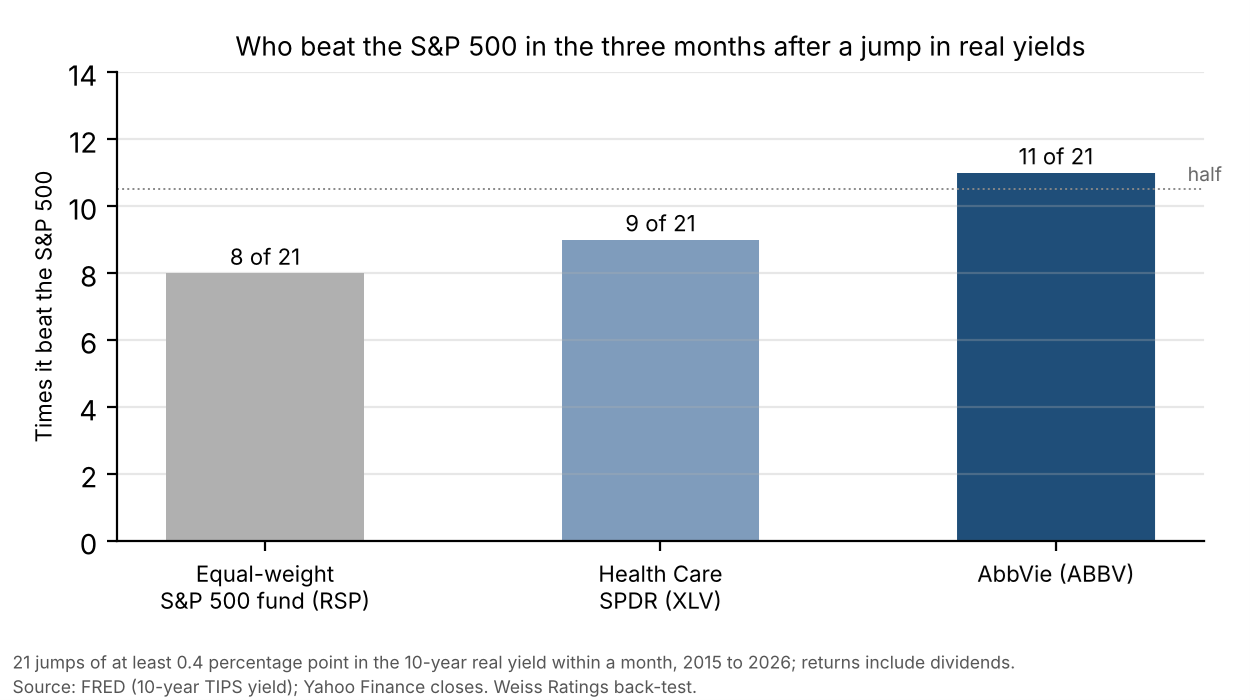
Over the following quarter, the equal-weight fund beat the S&P 500 after only eight of the 21 jumps old enough to measure.
The Healthcare SPDR (XLV) beat the index after only nine of them.
So, we would not chase the average stock, or the whole healthcare group, from here.
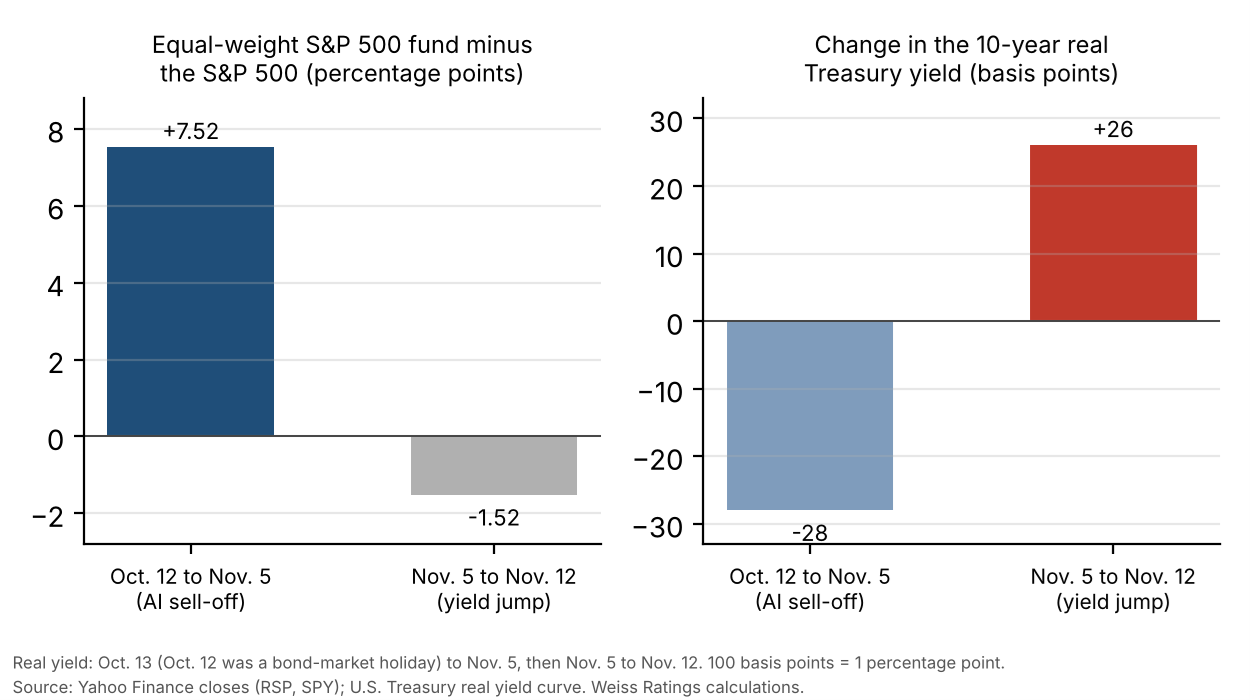
The chart shows the equal-weight fund's lead built while real yields fell, then slipped as they jumped.
Our Ratings Favor One Drugmaker Over the Whole Group
Weiss rates the equal-weight fund C+, a HOLD, and the Healthcare SPDR C+, a HOLD.
Nvidia, the stock behind most of the index's loss, is still rated B, a BUY.
Weiss rates AbbVie (ABBV) B, a BUY.
Its Reward grade is A+, and its Risk grade is C, a reminder that the stock can still swing.
The Nov. 7 Weiss piece "These Sectors Can Keep Your Portfolio Afloat Even When AI Fails" called it too early to name a turning point.
We agree, and with yields jumping, we'd add a steady earner rather than chase the groups that already ran.
Related story: These Sectors Can Keep Your Portfolio Afloat Even When AI Fails
A Strong Dollar Hurts AbbVie Less Than the Giants
AbbVie, which makes the immune-disease drugs Skyrizi and Rinvoq, earned about 77% of its third-quarter sales in the U.S.
That matters when the dollar is strong, because sales earned abroad shrink when they are turned back into dollars.
By contrast, tech companies in the S&P 500 earn about half of their sales outside North America, FactSet data show.
Skyrizi and Rinvoq are shielded from cheaper U.S. copies until at least 2033.
Skyrizi's sales rose about 23% in the third quarter from a year earlier.
In our backtest, AbbVie beat the S&P 500 after about half of the real-yield jumps.
That is a coin flip, so this call rests on the business, not on what rates did in the past.
Buy AbbVie, a Steady Earner at Home
Buy AbbVie (ABBV), rated B, a BUY, at the next close; it closed Thursday at $294.45.
Investors pay about 19 times the profits analysts expect over the next year.
What could work against it: Medicare's negotiated prices cut two of its older drugs, Vraylar and Linzess, starting in 2027.
Medicare must also publish a negotiated price for Botox by Nov. 30.
AbbVie also trailed the equal-weight fund while the AI sell-off ran, so it is a steady earner, not a high flier.
Our target is the average Wall Street price target, $311.81 as of Nov. 4.
Thursday's close is about $17 below that target.
That is a potential gain of about 6%.
AbbVie raised its quarterly dividend to $1.82 a share, starting with the Feb. 16 payment.
At Thursday's close, that is a yield of about 2.5% a year, which pays you to wait.
Our time frame is within a year, with the first check when Medicare publishes the Botox price by Nov. 30.
What We're Watching
First, Botox. If Medicare's cut to its price is deeper than the cuts to Vraylar and Linzess, we would review the call and tell you.
Second, the Fed's meeting that ends Dec. 9. One Fed governor has said a half-point hike should be considered; if the Fed goes that far, we would review the call and tell you.
Third, the dollar. If it keeps climbing and AbbVie still falls behind the S&P 500, we would review the call and say so.
Bottom Line
The AI sell-off made the average stock look like the winner, but it has trailed the index since real yields began jumping on Nov. 5.
So, if a handful of giants cost you in the past month, a steady, home-grown earner is where we see the opportunity.
Buy AbbVie (ABBV), rated B, a BUY, which closed Thursday at $294.45, at the next close.
Take care,
AL Qureiyeh