CoreWeave's 15% Bond Yield Sell-Off: The Contrarian Case for CRWV
 |
| By Gavin Magor Reviewed by: Leo Tavolaro |
Your portfolio just learned what one word can cost.
On Tuesday, Elon Musk replied "Yikes" to a chart of CoreWeave (CRWV) borrowing costs climbing toward 15%.
By Wednesday's close, CoreWeave had shed about $6.6 billion of stock market value.
The post didn't do that on its own.
The real story is that the bond market is now pricing the artificial intelligence (AI) build-out like a credit risk, and your stocks are next in line for that repricing.
Today: why borrowed AI is suddenly expensive AI, the numbers the sell-off skipped, which names to own, and the one I'd buy precisely because everyone is running from it.
Why Your Index Fund Felt It
September's consumer prices rose 3.7% from a year earlier, and core prices rose 2.6%, both hotter than forecast.
The 10-year Treasury yield climbed toward 5.3% after the report.
The Nasdaq Composite fell 1.88%, and the S&P 500 lost 1.11%.
If you own a broad index fund, you own the AI build-out, whether you meant to or not.
Borrowers Feel It First
When a safe government bond pays more than 5%, every company borrowing to grow has to offer a lot more.
The companies that paid for AI with cash shrug that off.
The ones that paid with debt are being repriced, fast.
And no stock is more closely tied to that borrowing than CoreWeave.
The Chart That Started It
On Tuesday, venture capitalist Chamath Palihapitiya posted a chart of CoreWeave's 2032 notes.
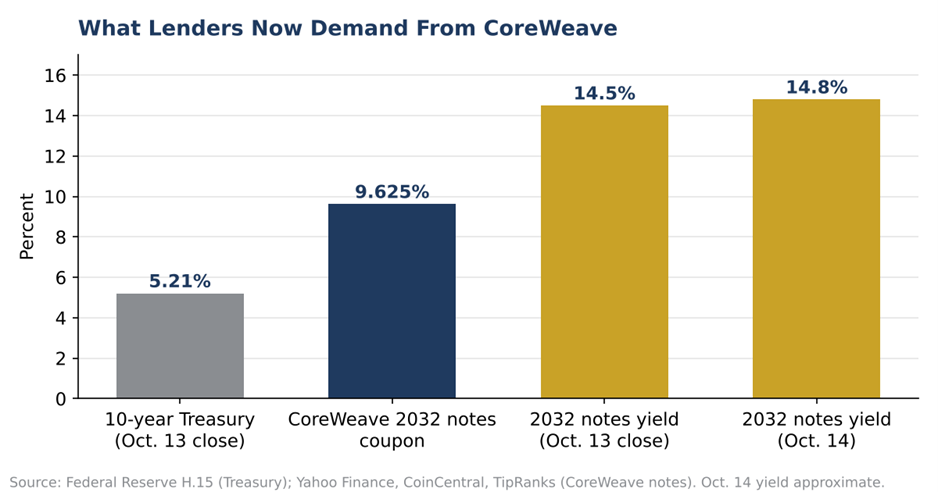
Their yield touched 15% before closing at a record 14.5%.
Those notes carry a 9.625% coupon, and by Wednesday they yielded about 14.8%.
Musk replied with his one word.
The Stock Followed The Bonds
CoreWeave stock fell 15.46% on Wednesday to $65.78.
That was its lowest close since July 29.
It now sits about 56% below last October's high near $150.
Chief Executive Mike Intrator told staff in a memo that the market was acting "irrationally," and that the company's backlog more than covers its debt.
The selling didn't stop there.
In a report published Wednesday, research firm Gartner (IT) predicted that 80% of neocloud providers, the companies renting out AI computing power, will stop operating independently by the end of the decade if AI spending keeps its current pace.
This morning, Bernstein, the research arm of AllianceBernstein (AB), kept its Underperform rating, with a $74 price target.
The shares were down another 5% in early trading.
The Numbers the Sell-Off Skipped
CoreWeave's second-quarter revenue rose 112% to $2.575 billion.
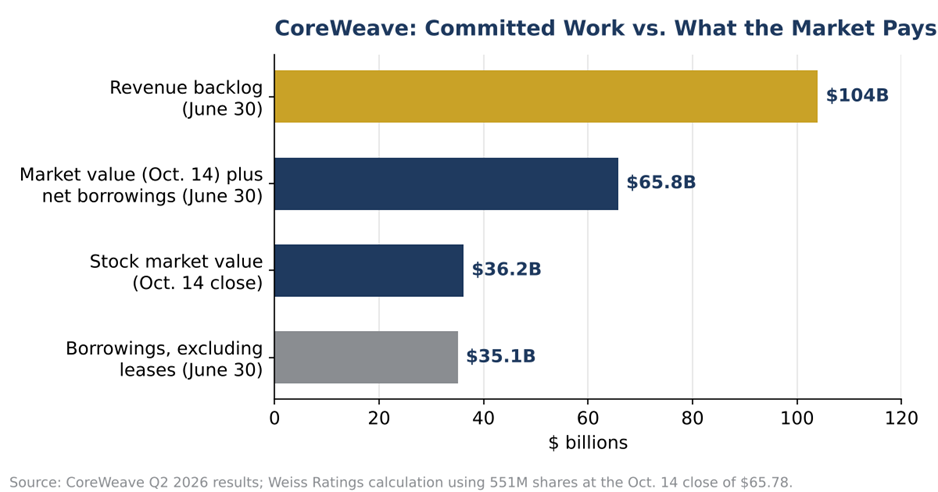
Its revenue backlog, work customers have committed to, reached $104 billion at June 30.
That figure leaves out more than $25 billion of new commitments added early in the third quarter.
Management guided third-quarter revenue to $3.4 billion to $3.6 billion, and full-year 2026 revenue to $12.4 billion to $13.2 billion.
The Market is Paying a Third of Face Value
At Wednesday's close, the whole company was worth about $36.2 billion on the stock market.
Add the $35.1 billion it had borrowed as of June 30, subtract its $5.5 billion of cash, and you get roughly $65.8 billion.
That's less than two-thirds of the backlog already on the books.
The Interest Bill is Real, But So is The Cash
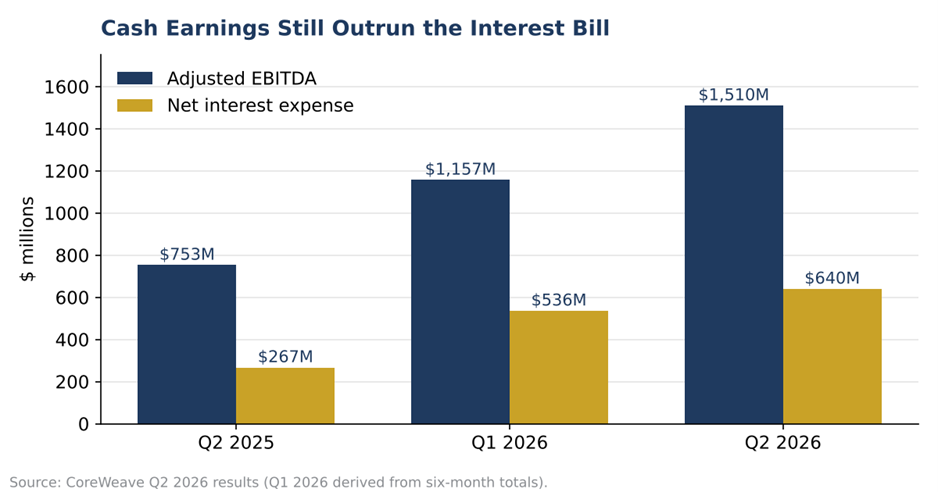
Here's the bear case in one line: CoreWeave lost $626 million in the second quarter, and $640 million of interest did it.
Now look one line higher.
Adjusted earnings before interest, taxes, depreciation and amortization (EBITDA) were $1.51 billion, a 59% margin.
That covers the interest bill about 2.4x.
Operating cash flow for the first half was $3.66 billion.
The 15% yield doesn't change the coupon on the bonds CoreWeave has already sold.
It's a toll on the next dollar it borrows.
That matters, because this company has raised more than $35 billion this year alone.
But it's a funding problem, not a demand problem.
And funding problems get solved by cash flow, partners and time.
Who Borrowed, Who Gets Paid
Nebius Group (NBIS) fell about 10% on Wednesday alongside CoreWeave.
Weiss rates it C-, a HOLD.
It runs the same borrowed-money playbook on a fraction of CoreWeave's revenue, so I'd be cautious and not buy more.
Oracle (ORCL) carries $169.1 billion of total debt as it builds out its own AI cloud.
Weiss rates it C, a HOLD.
It has the profits to carry that load, but it isn't cheap insurance against more rate pain.
Nvidia (NVDA) earns a B+, a BUY.
Its $134.4 billion of operating cash flow over the past year dwarfs its $38.9 billion of debt.
Much of what CoreWeave borrows ends up buying Nvidia's chips.
ASML Holding (ASML) earns a B, a BUY.
On Wednesday it reported third-quarter sales of 11.7 billion euros and a 57.5% gross margin.
It guided fourth-quarter sales to 14.2 billion to 15.2 billion euros, and it ended the quarter with 12.7 billion euros of cash and short-term investments.
That's what a fortress balance sheet looks like in a rate scare.
If you want one AI name to hold through this, it's ASML.
Let the Ratings Do the Sorting
Every rating in this report moved through the same filter: who can pay for growth, and who has to borrow for it.
Weiss Ratings Plus runs that filter for you, with real-time ratings, instant alerts and exclusive analysis.
When a rating changes on a name like CoreWeave, you'll know before the next "Yikes" does.
Click here to see what Weiss Ratings Plus can do for you.
Why I'd Buy the Stock Everyone is Fleeing
Remember "Yikes"?
That's the sound of a crowded exit, and crowded exits are where contrarians shop.
CoreWeave carries a Weiss rating of D-, a SELL.
I'm not going to pretend otherwise.
That grade tells you exactly what kind of bet this is.
It is not a core holding.
It is a speculation on one question: can CoreWeave keep funding a business that more than doubled its revenue in a year?
I think it can.
The backlog is signed.
The cash earnings already cover the interest more than twice over.
The company has partners with deep pockets, including Jane Street, which made a $1 billion strategic investment this year.
And the stock market now values the whole company at about what it owes its lenders.
What Would Make Me Right
Intrator said he looks forward to putting the facts in front of the market on the next earnings call.
That call is expected the week of Nov. 9, though CoreWeave hasn't set the date yet.
If third-quarter revenue lands in the guided range and the backlog grows again, the bonds can rally.
And when the bonds rally, the stock follows them back up.
Wall Street's average target is $143.96, more than double Wednesday's close.
I don't need that.
A return to where the stock traded a month ago would do nicely.
How I'd Play It
We recommend buying CoreWeave at market, as a speculative position.
Keep it to money you'd be comfortable seeing fall by half, because this stock can do that.
Pair it with ASML, so the steady half of your AI exposure pays for the patience the risky half needs.
What I'm Watching
- Every day: the yield on CoreWeave's 2032 notes; a move back toward 12% would tell me the credit market is calming down.
- Oct. 27 and 28: the Federal Reserve (Fed) meets, and another rate hike would raise the cost of every borrowed AI dollar.
- Any new funding deal: CoreWeave has reportedly been talking to insurance companies about fresh capital.
- The week of Nov. 9: CoreWeave's expected third-quarter report, where management gets its chance to answer the bond market.
Bottom Line
The bond market is right that borrowed AI just got more expensive.
It's wrong to price a company with $104 billion of committed work as if that work won't get done.
Own ASML for safety, keep Nvidia, hold Oracle and avoid Nebius.
And if you have a stomach for risk, buy a small slice of CoreWeave while it's on sale.
Musk said "Yikes."
I'd say "thank you."
One word cost CoreWeave's shareholders $6.6 billion, and that same word just put the stock on sale.
Cheers!
Gavin