CoreWeave Soars After Earnings, but Our Rating Says Sell; Nvidia Stays a Buy

|
Key Takeaways
|
 |
| By Gavin Magor Reviewed by: Leo Tavolaro |
You already own the AI trade, so last week's sell-off landed in your account too.
Now AI stocks are bouncing, led by a stock our ratings say to sell.
So is this the bottom, and did the smart money see it first?
The answer is in the flow data, the ratings and one very large debt pile.
From Sell-Off to Bounce: What Happened
On Thursday, Nov. 5, the S&P 500 fell 4.4%, its worst day since April 2025.
The trigger was fear that newly elected state leaders could slow data center construction.
Then Nvidia (NVDA) faced a problem of its own: a board investigation into CEO Jensen Huang's personal conduct.
Its slide on Monday and Tuesday erased more than $430 billion in market value.
Tuesday's inflation report then came in hotter than expected.
The 10-year Treasury yield closed Tuesday at 5%.
For you, higher yields make future AI profits worth less in today's money.
What Happened Next
Wednesday brought the bounce.
CoreWeave (CRWV) led the charge after reporting its quarterly results following Tuesday's close.
It jumped as much as 17% in premarket trading Wednesday.
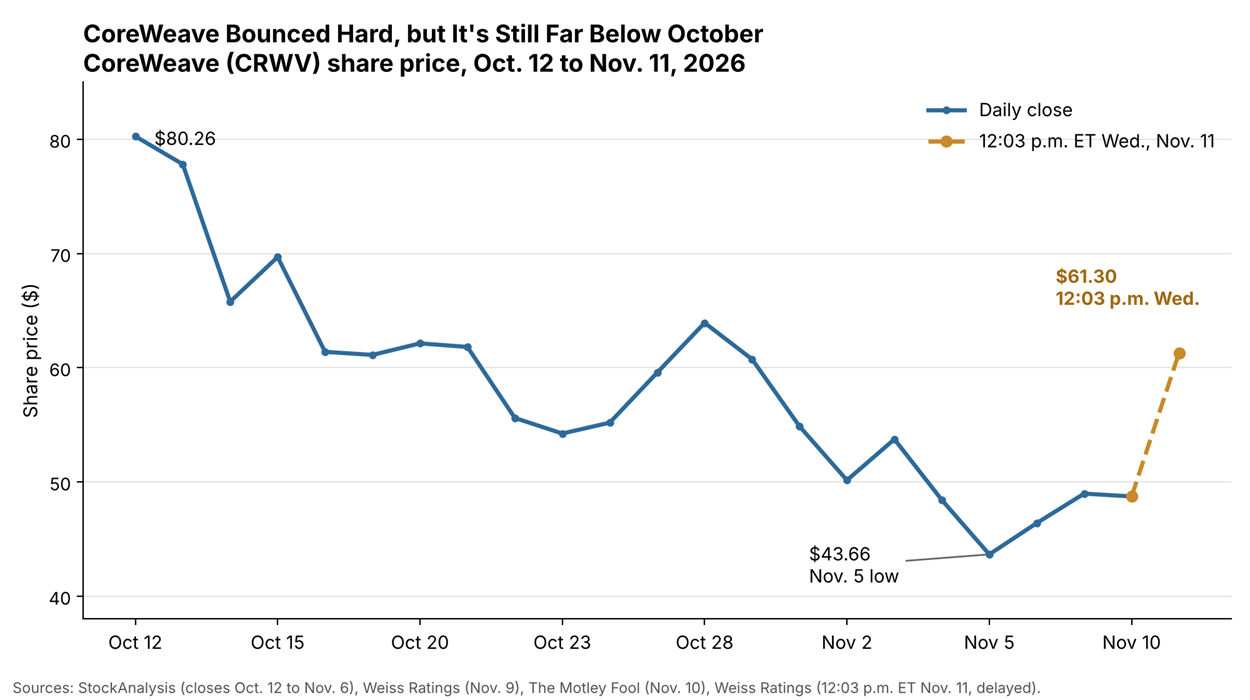
At 12:03 p.m. ET Wednesday, it was up about 26%.
That put the stock at $61.30.
That is about 40% above its Nov. 5 close.
Did the Smart Money Swoop In?
Not yet, and not in the way the headlines will tell you.
Hedge funds sold first.
The best near-real-time read comes from Goldman Sachs' prime brokerage desk, which lends to and trades for hedge funds.
Its data through Friday, Nov. 6, showed hedge funds selling tech at close to the fastest pace since 2016.
Funds also cut their leverage, or borrowed bets, by the most since March 2020.
JPMorgan's strategist called the pullback largely a "deleveraging event."
That means funds cut risk, rather than gave up on AI.
By that Friday, funds had turned net buyers.
But most of that buying covered bets against index and exchange-traded funds (ETFs), rather than fresh purchases of AI stocks.
Small Investors Bought the Drop
On Thursday, Nov. 5, small investors on Fidelity's platform leaned into Nvidia and the Invesco QQQ Trust (QQQ).
That fund took in $2.8 billion that day.
It did so while falling 6.5%.
On Friday, Vanda Research found Nvidia was the top retail buy at the open.
Vanda strategist Viraj Patel called it "some modest net buying, not gangbusters."
Small traders also favored Direxion Daily Semiconductor Bull 3X Shares (SOXL) and ProShares UltraPro QQQ (TQQQ).
Both funds are built to move three times as much as their index each day.
SOXL carries a Weiss rating of C, a HOLD, and TQQQ a C-, also a HOLD.
British investors piled in too.
Nvidia was the most-bought stock on the AJ Bell and Dodl platforms from Nov. 5 to Nov. 9.
Freetrade said Monday was its "biggest ever day of Nvidia buys."
For you, the picture is clear: The smart money sold the drop, and small investors bought it.
Our ratings back the small investors on Nvidia, but not on the leveraged funds.
Chip Fund Investors Cashed Out
Investors in the biggest chip fund went the other way.
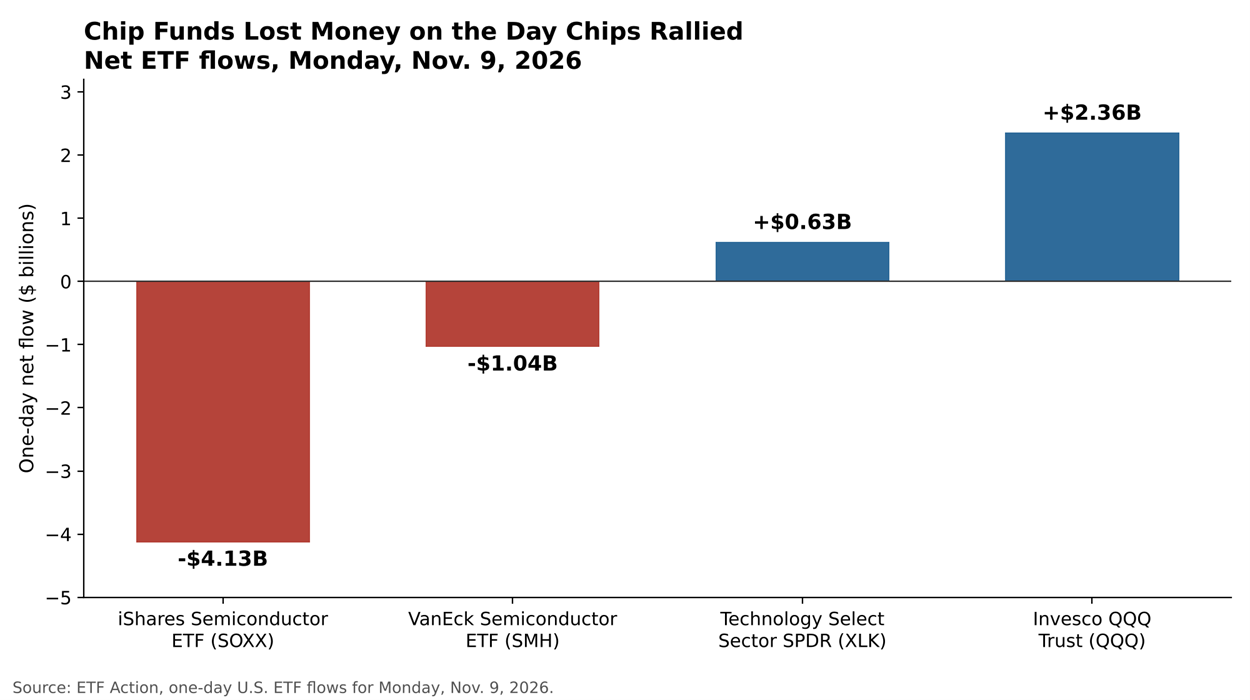
On Monday, investors pulled $4.1 billion from the iShares Semiconductor ETF (SOXX).
That happened on a day the fund rose 7.5%.
The same day, investors added $2.4 billion to the broader Invesco QQQ Trust.
Investors still want AI, but spread across a wider basket.
The 13F Trap
Big investment managers must report their holdings on Form 13F by Monday, Nov. 16.
Those filings show what funds owned on Sept. 30, five weeks before the sell-off.
Expect headlines next week about famous investors "buying the dip."
They will be describing September, not November.
Nvidia reports its quarterly results after the close on Tuesday, Nov. 17.
So Did AI Stocks Bottom?
Two signs say the worst of the forced selling is likely behind us.
First, hedge funds have already cut risk hard, so there is less left to dump.
Second, the spending behind AI hasn't stopped.
CoreWeave's revenue rose 168% from a year earlier.
That took its quarterly sales to $3.7 billion.
Its order backlog reached $132.5 billion at the end of September.
The bigger risk to AI stocks now is interest rates.
Rising rates hurt most where AI growth runs on borrowed money.
That gives you a simple test: Is the company paying for AI from profits, or from loans?
Buy the Profits, Not the Promise
Nvidia earns a Weiss rating of B, a BUY.
It closed Tuesday at $168.89.
At 12:19 p.m. ET Wednesday, it traded at $176.56.
That was a gain of about 4.5% on the day.
Baird downgraded the stock Wednesday, and Morgan Stanley dropped it as a top pick.
Our rating weighs the business behind the headlines, and Nvidia's business still earns high marks.
You can buy it at market ahead of the Nov. 17 results, if you can live with sharp swings.
The Quieter Chip Winner
Broadcom (AVGO) also earns a Weiss rating of B, a BUY.
It closed Tuesday at $331.98.
That was a gain of 3.9% on a day Nvidia fell.
It's a buy at market.
The Whole Supply Chain
If you'd rather not pick one company, the VanEck Semiconductor ETF (SMH) earns a B-, a BUY.
It traded at $514.48 at 12:03 p.m. ET Wednesday.
That was a gain of about 6% on the day.
It was still up about 35% this year at Monday's close, even after last month's drop.
For a steadier route, the Technology Select Sector SPDR ETF (XLK) also earns a B-, a BUY.
It spreads your money across the biggest tech companies, not just the chipmakers.
By comparison, the iShares Semiconductor ETF and the Invesco QQQ Trust both carry a C+, a HOLD.
If you own them, there's no rush to sell, but our higher-rated choices are above.
Let the Ratings Do the Sorting
Every fund rating in this report came straight from the live Weiss Ratings pages.
Weiss Ratings Plus puts that same work in front of you, with real-time ratings, instant alerts on upgrades and downgrades, and exclusive analysis.
It's how you'll know the day a long Treasury fund earns a better grade.
And it's how you'll see our next move on U.S. debt as soon as we make it.
Click here to see what Weiss Ratings Plus can do for you.
Remember That 40% Bounce?
CoreWeave earns a Weiss rating of D-, a SELL.
The rating reflects how its growth is paid for, not the growth itself.
CoreWeave's debt reached $46.9 billion at the end of September.
Of that, $10.6 billion is due within a year.
Even after Wednesday's jump, that debt is larger than the market value of all its shares.
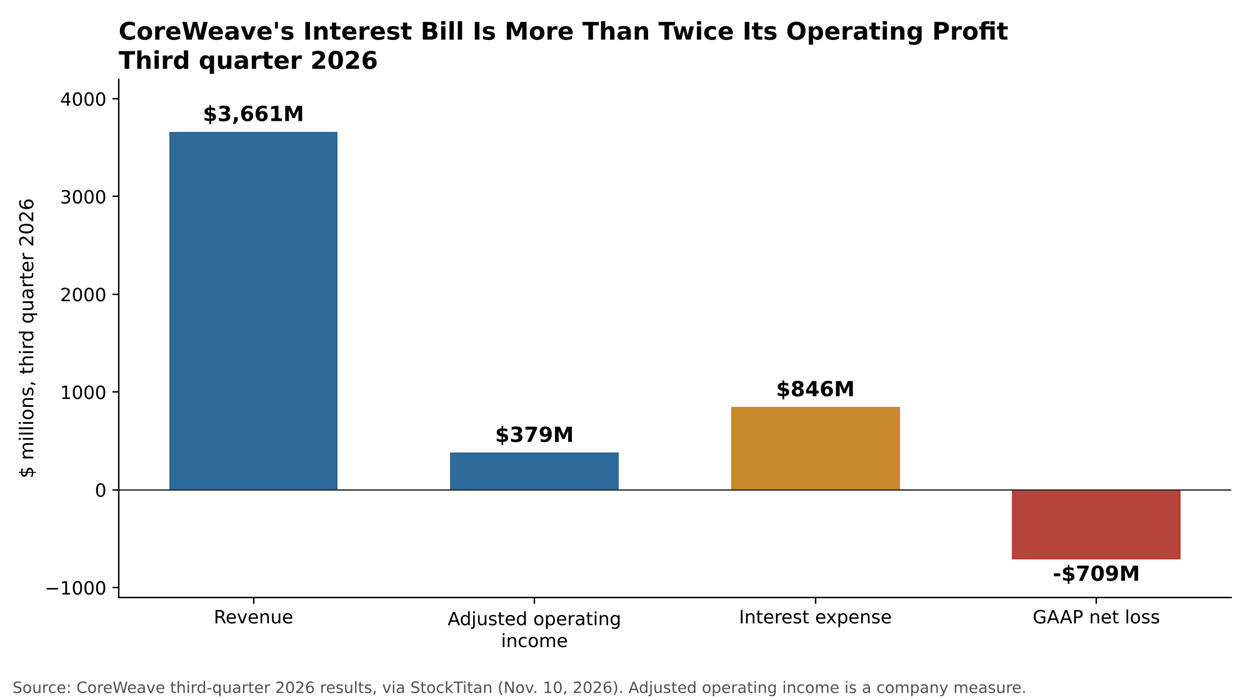
Its interest bill for the quarter came to $846 million.
That was more than twice its adjusted operating income.
And it still lost $709 million in the quarter.
With rates rising, every dollar of that debt gets more expensive to carry.
Why the Bounce Doesn't Change Our View
Even at Wednesday's midday price, the stock sits about 56% below its 52-week high.
One strong quarter and one strong morning don't change that balance sheet.
If you own CoreWeave, Wednesday's jump is a chance to sell into strength.
If you don't, there are better-rated ways to own the AI build-out.
What I'm Watching
- Headlines on Monday's 13F filings that mistake September's holdings for November's buying.
- Nvidia's outlook for data center demand when it reports on Tuesday, Nov. 17.
- A Federal Reserve rate hike at its December meeting, which Governor Christopher Waller now supports.
- A formal pause on data center permits in Texas once the new governor takes office.
- Whether CoreWeave can hold Wednesday's gains through the rest of the week.
Bottom Line
You already own the AI trade, so make sure you own the right part of it.
The smart money sold the drop, and small investors bought it.
Our ratings say they got Nvidia right.
Consider buying Nvidia, Broadcom or the VanEck Semiconductor ETF at market.
And use CoreWeave's bounce to step aside.
Cheers!
Gavin