Gold Stalls Near $4,100 as Treasuries Pay 5%: Which Is Really Safe Now?

 |
| By Gavin Magor Reviewed by: Leo Tavolaro |
If you bought gold to sleep better at night, this year it has mostly kept you awake.
Gold ended Tuesday more than a fifth below its January record, and it has barely moved this month.
Meanwhile, the bond market is offering you 5% to lend the government money for 10 years.
So the obvious move looks like swapping the coin for the coupon.
I don't think it's that simple.
Gold has stalled for reasons that can change, and not every Treasury is the safe harbor it's sold as.
Here's why gold stopped, what restarts it, and which Treasury actually deserves the word "safe."
The Coin in Your Drawer
Gold futures settled at $4,143 an ounce on Oct. 20, 22.1% below the record close of $5,318 set on Jan. 29.
They're down 6.4% in the past month alone.
September was the worst of it, with gold down 8.5% for the month, according to the World Gold Council (WGC).
If you own gold, you're down about 4.5% this year, before you've paid anyone to store it.
The Buyers Didn't Leave
The people who buy gold kept buying.
Gold exchange-traded funds (ETFs) took in a record $31 billion in the third quarter, and their holdings ended September at a record 4,256 tonnes.
Central banks bought 289 tonnes in the second quarter, a record for that quarter and about five times what they bought in the first.
So this isn't a story about gold falling out of favor.
It's a story about gold getting more expensive to hold.
Why Gold Pressed Pause
Gold has one weakness, and it's a big one.
It doesn't pay you anything to own it.
That didn't matter much when cash and bonds paid next to nothing.
It matters now.
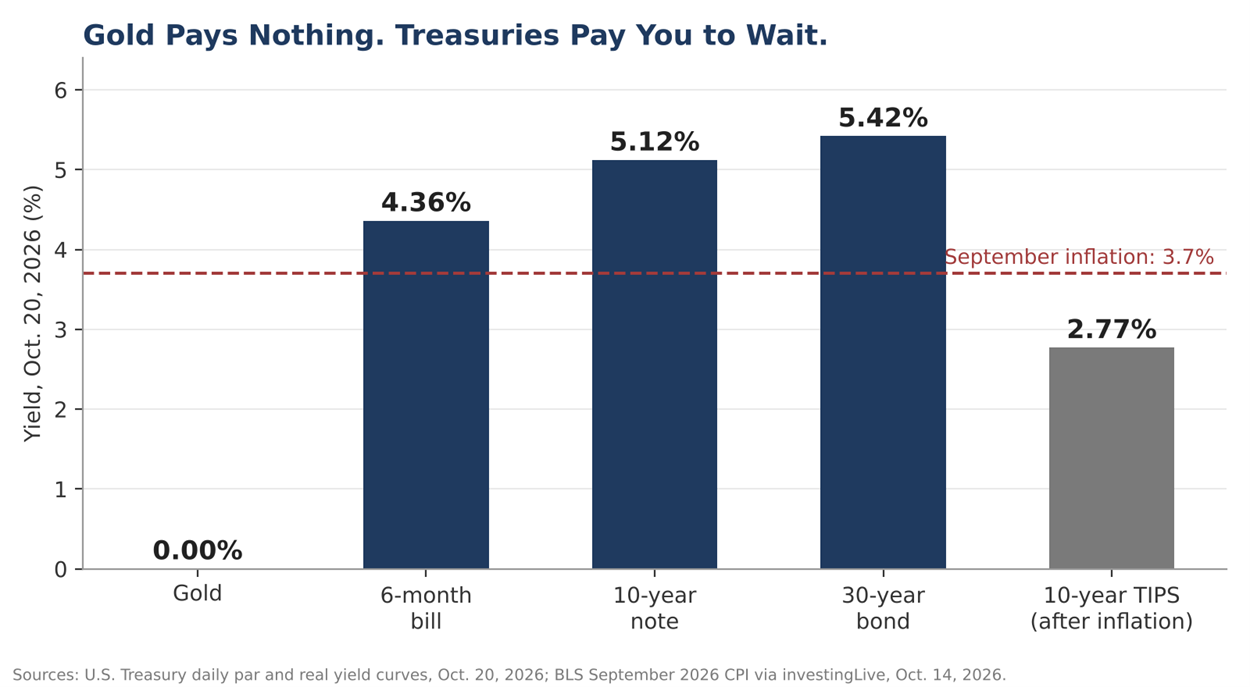
On Oct. 20, a six-month Treasury bill yielded 4.36% and the 10-year Treasury note yielded 5.12%.
Even after inflation, the 10-year Treasury Inflation-Protected Securities (TIPS) yield was 2.77%.
That's the guaranteed return over inflation you give up every year you hold gold instead.
And it's close to the highest on record, which is 3.15% from November 2008.
When gold made its weekly high in late February, that same real yield was 1.72%.
It has risen by more than a full percentage point since, and gold has given back more than a fifth.
The Fed Turned the Screw
The Federal Reserve (Fed) raised rates a quarter point on Sept. 16, to a range of 3.75% to 4%, its first hike since July 2023.
Most officials said another hike would probably be appropriate by year end.
In September alone, the 10-year yield jumped more than half a percentage point and the dollar rose 2%, which the WGC named as major reasons for gold's decline.
Speculators added to the pressure, as money managers cut their bets on gold futures by $12 billion.
Inflation Hasn't Let Go
Consumer prices rose 3.7% in the year to September, faster than the 3.4% pace in August.
That keeps the Fed alert, which keeps yields high, which keeps gold on hold.
It's a loop, and gold is stuck inside it.
So Are Treasuries the Safe Bet?
A Treasury will pay you back.
What it won't promise is that it'll be worth what you paid for it in the meantime.
If rates rise, the price of a bond you already own falls, and the longer the bond, the harder the fall.
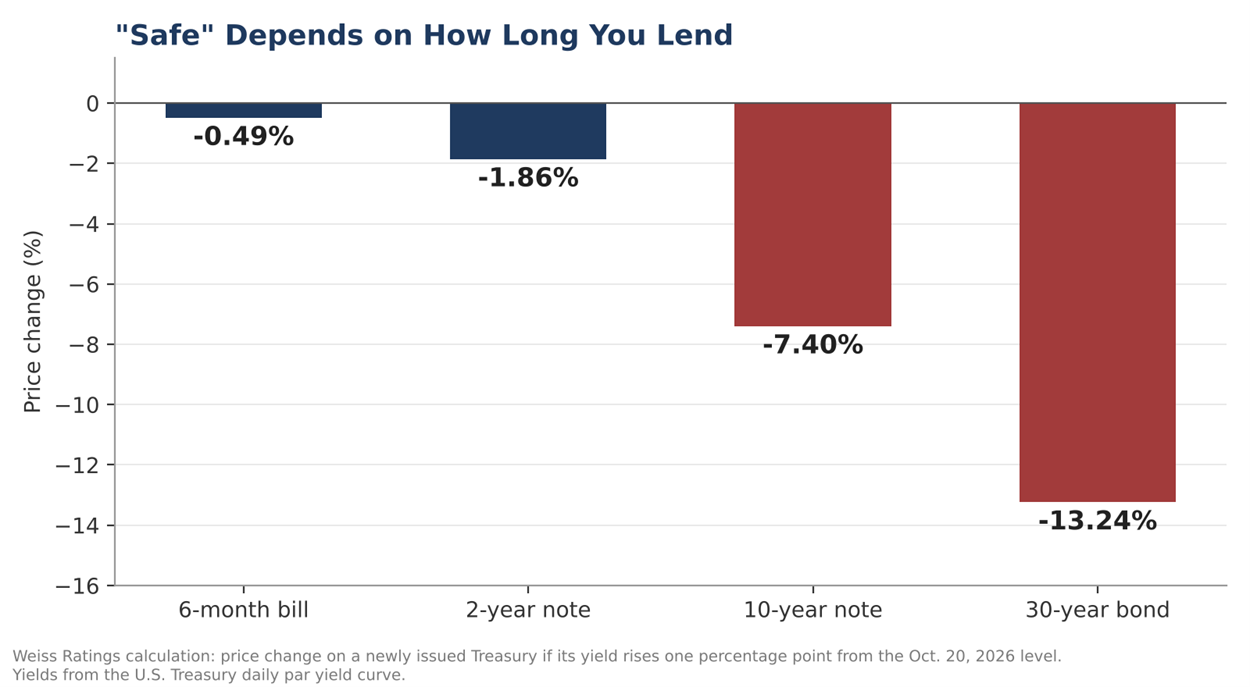
I ran the numbers on what a one-point rise in yields from Tuesday's levels does to a newly issued Treasury.
A six-month bill loses about half a percent.
A 10-year note loses about 7.4%, roughly a year and a half of its interest.
A 30-year bond loses about 13.2%, close to two and a half years of interest.
The Supply Problem
The Treasury expects to borrow a further $628 billion in the final three months of this year alone.
The national debt passed $40 trillion for the first time in August.
Every one of those dollars has to find a buyer, and buyers of long-dated debt are asking to be paid more for the risk.
That's why the long end of the market has been the bumpiest place to stand.
What the Ratings Say
The iShares 20+ Year Treasury Bond ETF (TLT) is a common way to own long Treasuries.
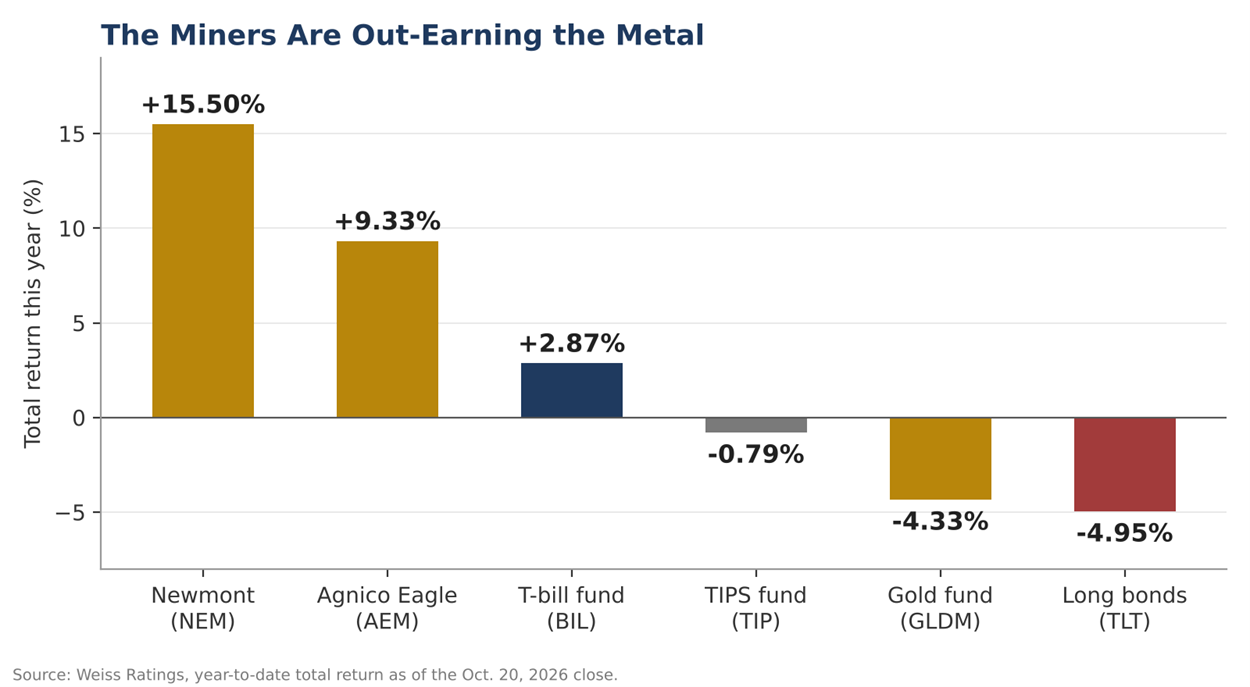
It earns a Weiss rating of D, a SELL, and it's lost 8.87% over the past year, including interest.
Even inflation protection hasn't helped much.
The iShares TIPS Bond ETF (TIP) rates a D+, a SELL.
At the short end, the SPDR Bloomberg 1-3 Month T-Bill ETF (BIL) rates a C, a HOLD, and is up 2.87% this year with almost no swings.
So my answer is yes, Treasuries are safe, but only the short ones.
The long ones aren't a safe haven this time.
They're a bet on where rates go next, and right now the Fed is still leaning the wrong way for that bet.
What Restarts Gold
The biggest change would be a Fed that signals it's done.
Traders now give a hike at the Oct. 27-28 meeting only about a 12% chance, but they still put the odds of one more hike before 2027 at 82%.
The day the Fed says its next move could be its last, real yields have room to come down from near-record levels.
And gold, which pays nothing, gets cheaper to hold overnight.
Bond Buyers Lose Their Nerve
The WGC has floated a second trigger.
If yields stay high even as hike odds fade, it suggests investors are worried about government borrowing itself, and that tends to send money toward gold.
That's already happening in Britain, where gold ETFs took in far more than the WGC's own model predicted in the third quarter.
With $628 billion of new borrowing on the way, I wouldn't bet against the same thing happening here.
The Big Buyers Keep Coming
Record ETF inflows and record second-quarter central bank buying didn't lift the price this year.
But they are a floor under it.
In the WGC's latest survey of central banks, a record 45% said they expected to add to their own gold reserves.
For my part, I expect gold to hold around today's levels into the Fed meeting, then move higher once the market believes rate hikes are close to done.
The Miners Are Doing the Heavy Lifting
The metal is down this year, but the best miners are up.
Newmont (NEM) earns a B, a BUY, and has returned 15.50% this year.
Agnico Eagle (AEM) also rates a B, a BUY, and has returned 9.33%.
Those returns tell you the market thinks a well-run mine still makes good money with gold above $4,000 an ounce.
And when gold moves, the miners usually move further.
The Big Gold Funds Hold Their Grades
The SPDR Gold Shares (GLD) and the iShares Gold Trust (IAU) both earn a B-, a BUY.
That tells you the ratings haven't given up on gold, even after a rough few months.
Let the Ratings Do the Sorting
Every rating in this report came straight from the live Weiss Ratings pages this morning.
Weiss Ratings Plus puts that same work in front of you, with real-time ratings, instant alerts on upgrades and downgrades, and exclusive analysis.
It's how you'd have seen that the most popular long-bond fund carries a SELL while most investors still call it safe.
And it's how you'll know the day the ratings on long Treasuries finally turn.
Click here to see what Weiss Ratings Plus can do for you.
Back to the Coin in the Drawer
So do you swap your gold for Treasuries?
No.
You keep the gold, you add a little more at today's prices, and you put your safe money where it really is safe.
My pick for new money in gold is the SPDR Gold MiniShares Trust (GLDM).
It earns a B-, a BUY.
It holds physical gold, just like its bigger sister fund.
But it costs 0.10% a year, against 0.40% for SPDR Gold Shares.
When an asset pays you nothing, the fee is the only thing you can control.
The MiniShares closed Tuesday at $81.48.
The Safe Money
For cash you can't afford to see shrink, I'd buy the six-month Treasury bill.
It yielded 4.36% on Oct. 20, ahead of inflation, and you get all your money back in six months, whatever the Fed does.
If rates rise further, you simply roll into the higher rate when it matures.
That's the one Treasury that truly earns the word "safe" right now.
What I'm Watching
- The Fed's decision on Oct. 28, and any hint that December's hike could be the last.
- The September personal consumption expenditures (PCE) inflation report on Oct. 29.
- The 10-year TIPS yield, currently 2.77%; a sustained move back below 2.5% would be gold's green light.
- The WGC's third-quarter Gold Demand Trends report, to see whether central bank buying held up.
- The Treasury's next quarterly borrowing estimate, for any jump in long-dated supply.
Bottom Line
Gold hasn't stopped working as a safe haven.
It has just become expensive to hold while Treasuries pay 5%.
When the Fed signals it's done, that changes, and the money that never left gold will have company.
Until then, keep the gold, add the Gold MiniShares, and park your safe money in six-month bills rather than long bonds.
That way, you can get back to sleeping at night.
Cheers!
Gavin