Johnson & Johnson Is the Health Care Bargain the Rotation Skipped
 |
| By Gavin Magor Reviewed by: Leo Tavolaro |
When the market gets nervous, it goes to the doctor.
That's what happened on Thursday.
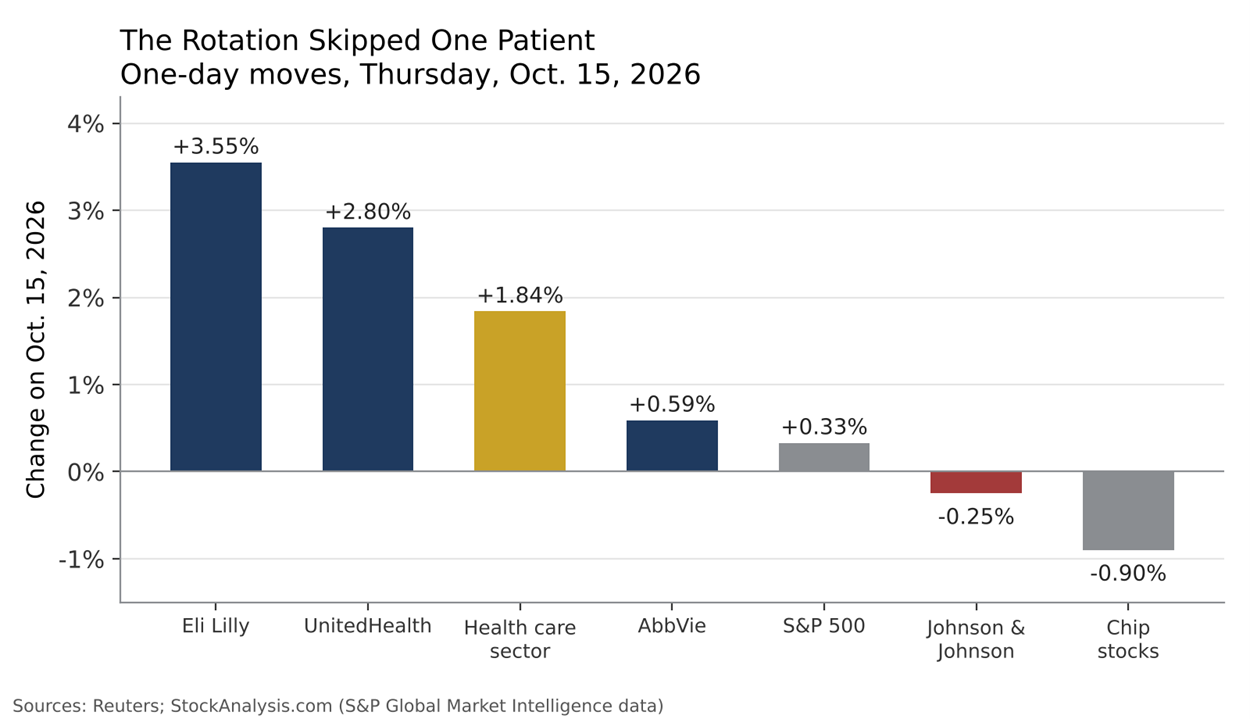
Health care was the best of the 11 sectors in the S&P 500, up 1.84%, as investors backed away from AI stocks.
But here's what the headlines missed.
The rotation picked up almost everyone in the waiting room except one of the healthiest patients.
Today I'll show you where the money went, why it's likely to stay a while, and the high-rated name it walked right past.
Short version: the safe room has a discount rack.
Why This Rotation Lands in Your Account
If you own an S&P 500 index fund, you've spent most of 2026 riding a handful of AI stocks.
The index is up about 13% this year, with most of that gain coming from AI-related names.
That works beautifully until money gets more expensive.
And it has.
Producer prices rose in September by the most in four and a half years, a day after a hot consumer inflation report.
Traders expect the Federal Reserve (Fed) to hold rates at this month's meeting, but they still see a 67% chance of a hike by December.
Jed Ellerbroek of Argent Capital Management summed up Thursday in one line: "The best performing stocks today are the non-cyclical, defensive businesses."
Health care is that kind of business.
Nobody postpones cancer treatment because the 10-year Treasury yield is above 5%.
So when borrowed growth gets expensive, earned growth gets a premium.
The Exit From Tech
The fund data shows this isn't one jumpy afternoon.
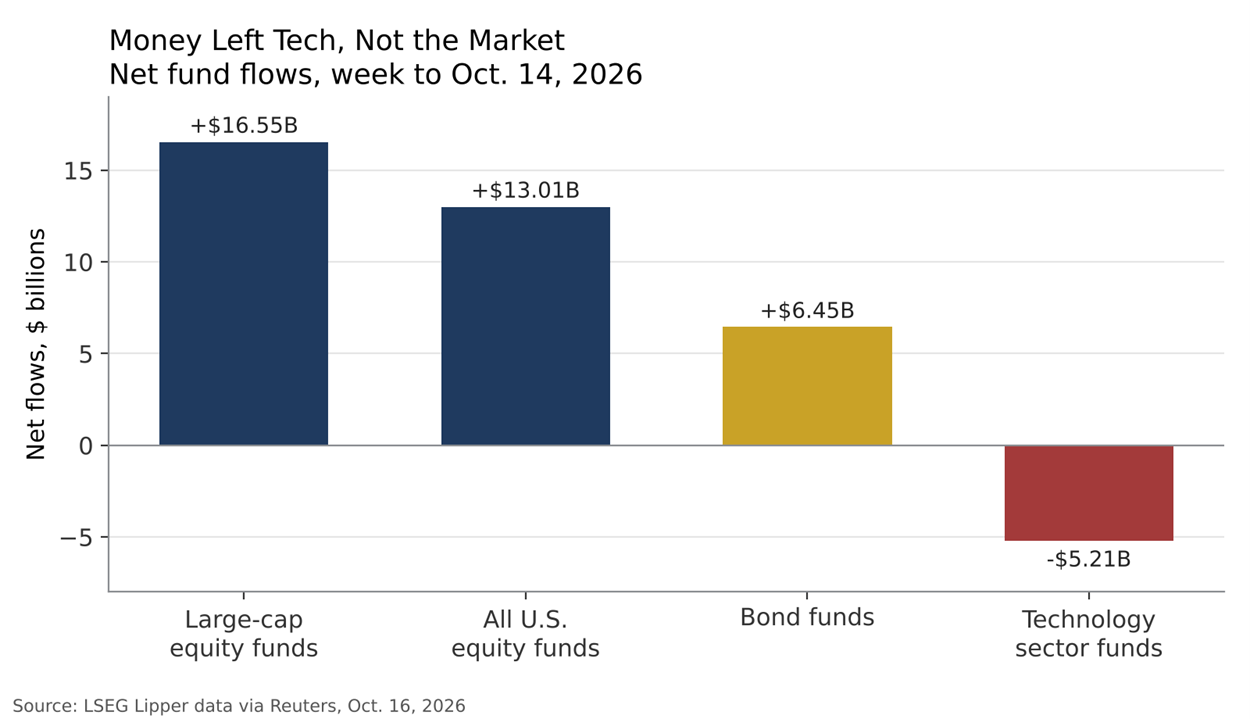
In the week to Oct. 14, investors pulled a net $5.21 billion out of technology funds, the biggest weekly exit since June 24.
They didn't take the money home.
U.S. equity funds took in a net $13.01 billion, and large-cap funds alone drew $16.55 billion.
Bond funds added $6.45 billion, their 26th straight week of inflows.
Who Caught It
On Thursday, the buyers went straight to the biggest names in medicine.
Eli Lilly (LLY) rose 3.55%.
UnitedHealth (UNH) added 2.8%.
Reuters said both moved after rating upgrades from Deutsche Bank and were among the heaviest contributors to the S&P 500's gain.
AbbVie (ABBV) traded as high as $291.40 during the session, a new 52-week high.
And then there's Johnson & Johnson (JNJ).
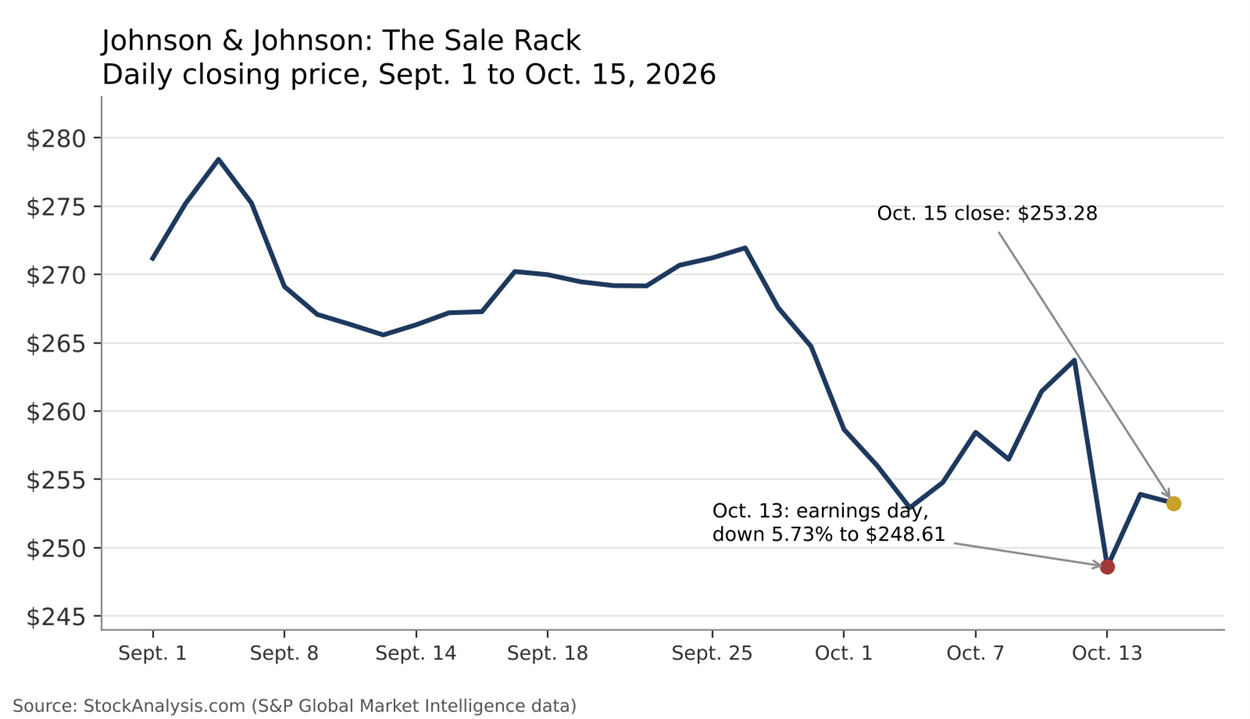
It closed down 0.25% at $253.28.
The Patient Everyone Walked Past
Johnson & Johnson reported third-quarter results on Tuesday.
The headline number looked ugly: earnings of 9 cents per share, down from $2.12 a year ago.
The stock fell 5.73% that day.
But read past the headline.
Those 9 cents reflect a one-time charge for the proposed talc settlement, plus the purchase of Firefly Bio and a new partnership with Sail Biomedicines.
Adjusted earnings, which exclude special items and amortization but still carry the cost of the two deals, came to $2.59 per share.
The talc deal is the one investors have waited 15 years for.
In July, the company agreed to pay at least $5.5 billion to resolve about 76,000 ovarian cancer claims, provided enough plaintiffs sign on.
That's an ending, not a new problem.
What The Business Actually Did
Sales rose 5.9% to $25.4 billion.
U.S. sales grew 9.1%.
The drug business, Innovative Medicine, grew 7.7% to $16.8 billion, even with older immunology drug Stelara trimming about 6.9 percentage points from its growth.
Free cash flow for the first nine months came to about $15.1 billion.
And management raised its full-year outlook.
It now expects about $101.2 billion in sales and adjusted earnings of $11.10 per share at the midpoints, up from $101.1 billion and $11.04 in July.
Companies in trouble don't raise guidance in the same week they book a big legal charge.
How We Rate the Rest of the Ward
Lilly carries a Weiss rating of B+, a BUY.
Thursday's jump left it a little more than 3% below its 52-week high of $1,292.65, set on Aug. 19.
Its third-quarter report lands on Oct. 29.
If you don't own it, it belongs in a core health care position.
AbbVie: Already At The Top of The Chart
AbbVie carries a Weiss rating of B, a BUY.
It yields about 2.4% and closed less than 3% below the 52-week high it set on Thursday.
It's the income-plus-momentum pick of the group.
UnitedHealth: The Repair Job
UnitedHealth carries a Weiss rating of C, a HOLD.
On Tuesday it beat expectations, with adjusted earnings of $4.69 per share against a consensus of $4.12.
It also raised its 2026 outlook to at least $20.50 per share in adjusted earnings.
Its medical care ratio improved to 88.4% from 89.9% a year ago.
The repair is real, but the rating hasn't caught up yet, so I'd hold rather than add.
Merck: Nothing to Chase
Merck (MRK) carries a Weiss rating of C, a HOLD.
Keep it if you own it, and let the rating lead before you add.
The Sector Fund: The Easy Button
If you'd rather own the whole sector through one exchange-traded fund (ETF), the obvious choice is the State Street Health Care Select Sector SPDR ETF (XLV).
It carries a Weiss rating of C+, a HOLD.
It costs just 0.08% a year.
But owning everything means owning the C-rated names too.
That's exactly why picking beats the basket right now.
Let the Ratings Do the Sorting
Thursday's rotation sorted stocks by one thing: who earns their growth, and who borrows for it.
Weiss Ratings Plus does that sorting every day, with real-time ratings, instant alerts and exclusive analysis.
When a rating moves on a name like UnitedHealth, you'll know before the crowd does.
Click here to see what Weiss Ratings Plus can do for you.
Why I'd Buy Johnson & Johnson Now
Remember the patient everyone walked past?
Johnson & Johnson carries a Weiss rating of B+, a BUY.
That ties it with Lilly for the best rating in this report.
Yet in the 30 days through Thursday, it lost about 9%, while Lilly gained about 8% and AbbVie about 10%.
It has raised its dividend for 64 straight years, most recently by 3.1% to $1.34 a quarter.
At Thursday's close, that works out to a yield of about 2.1%.
Its beta is close to zero, which means it barely moves with the broader market.
That's exactly what you want when the AI trade gets jumpy.
Wall Street is already coming around: this morning Wells Fargo raised its price target to $287 from $275.
That's about 13% above Thursday's close.
I expect the rotation to find this one as the talc settlement closes and the charge fades from view.
How I'd Play It
We recommend buying Johnson & Johnson at market.
Treat it as a core defensive holding, the kind you buy for the next five years, not the next five days.
If you want more growth in the mix, pair it with Lilly.
What I'm Watching
- Oct. 27 and 28: the Fed meets, and a pause would keep defensive stocks in favor.
- Oct. 29: Lilly's third-quarter report, the biggest single test of the sector's leadership.
- The talc sign-up: Johnson & Johnson's settlement needs lead plaintiff firms representing at least 95% of claims.
- Weekly fund flows: another large tech outflow would confirm the rotation still has legs.
Bottom Line
When the market got nervous this week, it went to the doctor.
It found Lilly, UnitedHealth and AbbVie right away.
It hasn't found Johnson & Johnson yet.
Buy Johnson & Johnson, own Lilly and AbbVie, and hold UnitedHealth, Merck and the sector fund.
The best seat in the waiting room is the one nobody's sitting in.
Cheers!
Gavin