REPORT: Nvidia Expects $130 Billion in Sales, Yet Its Stock Fell 27% in a Month on Doubts About Trust and Payback. Here's Why We'd Buy the Chipmakers Getting

|
Key Takeaways
|
 |
| By Al Qureiyeh Reviewed by: Leo Tavolaro |
If you own an S&P 500 index fund, the past month has probably felt worse than the headlines suggest.
Your fund fell, while a version of the same index that weights every stock equally edged higher.
On Tuesday, Nvidia (NVDA, “B”) said it expects about $130 billion in sales this quarter, more than Wall Street expected.
Yet the chipmaker's stock closed Tuesday 27% below where it stood a month earlier.
Over that month, Wall Street's estimates of Nvidia's earnings went up far more often than down.
The artificial intelligence (AI) sell-off is about trust and payback, not demand. We'd own the chipmakers getting paid, such as Nvidia and Broadcom, through one fund.
What Happened
Two shocks shook AI stocks in quick succession in late October and November.
First, Alphabet (GOOGL, “B”) reported on Oct. 28 that its spending on AI data centers left it with negative free cash flow.
Free cash flow is the cash left after paying for new buildings and equipment, and Alphabet's was negative $9.1 billion for the quarter.
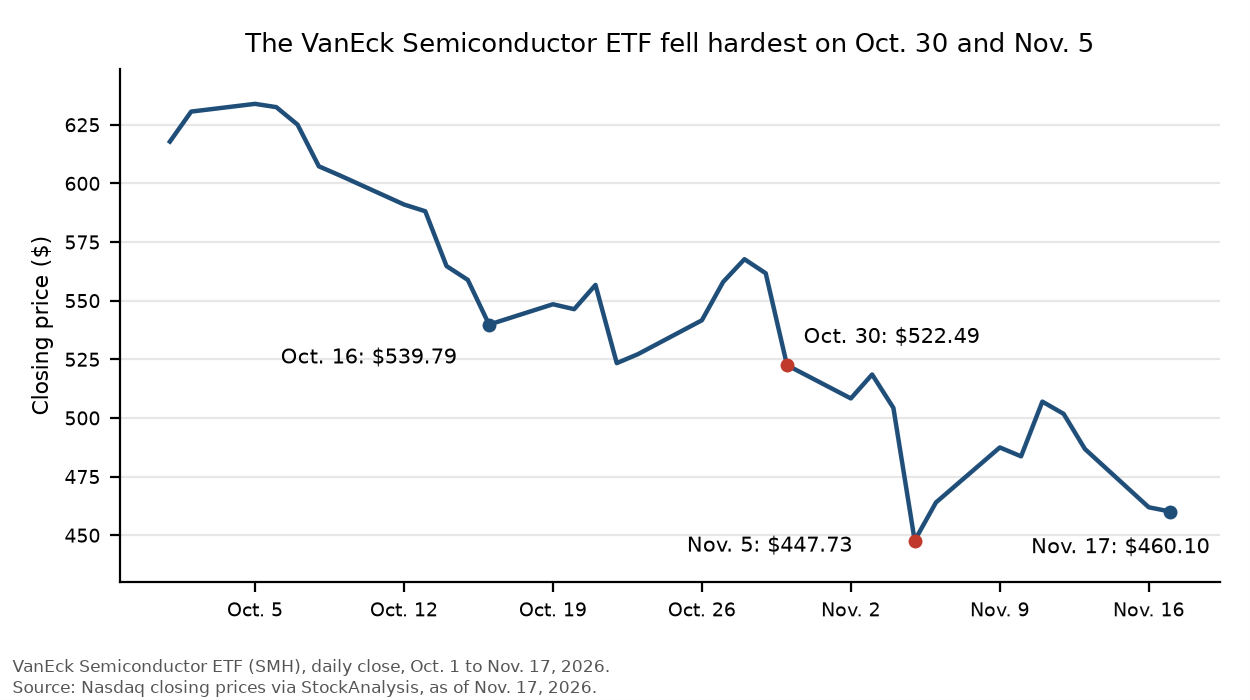
Its stock fell sharply the next day, and chip stocks followed on Oct. 30.
Second, Nvidia's longtime chief executive, Jensen Huang, stepped down Nov. 12, and an independent board committee is investigating.
Then came Tuesday's report, and traders bought it: Nvidia rose about 3% in Wednesday's pre-market trading.
Futures on the wider market gave back most of their early gains.
Some AI Worries Are Fair, but Not the One About Demand
The crowd is split.
In the American Association of Individual Investors (AAII) survey for the week ending Nov. 11, more than half expected stocks to fall.
First, many worry that the Federal Reserve (Fed) will keep raising rates, and futures traders see a December hike as nearly certain.
Some of the biggest AI spenders, Alphabet and Amazon among them, now spend more than their businesses bring in.
That makes higher borrowing costs a fair worry for them.
Second, many worry that Nvidia is investing in its own customers and backing their deals, which flatters its sales.
That worry is real for Nvidia itself, which is one reason we'd own a basket of chipmakers instead.
What the data does not support is the idea that AI demand is fading.
Nvidia's outlook says the orders are still coming in.
Weiss Rates the Chipmakers a BUY
Weiss Ratings rates the VanEck Semiconductor ETF (SMH) B-, a BUY.
All but one of its 11 largest U.S.-listed holdings carry a Weiss BUY rating.
Nvidia, its largest holding, is rated B, a BUY.
Taiwan Semiconductor Manufacturing (TSM) and Broadcom (AVGO), the next two, are each rated B-, a BUY.
The exception is Advanced Micro Devices (AMD), rated C, a HOLD.
Alphabet, the spender whose report deepened the slide, is rated B, a BUY.
On Nov. 16, Weiss Ratings Daily called Nvidia's report "a trust test," and we agree.
On Nov. 17, Weiss Ratings Daily published "After Jensen Huang: Who Can You Trust in the AI Boom?"
It questions the profit and financing claims behind the AI buildout.
We agree that trust is the open question, especially at Nvidia.
Where we read things differently is Nvidia's own earnings estimates, which keep rising.
Related story: After Jensen Huang: Who Can You Trust in the AI Boom?
Other Weiss Ratings Daily pieces on Nov. 12 and Nov. 15 named Advanced Micro Devices as a possible winner if Nvidia's grip loosens.
With its HOLD rating, it is a name we would not buy on its own, and the fund already holds it.
The Fed Did Not Start This Sell-Off
Many investors blame the Fed for the drop in AI stocks.
The timing says otherwise.
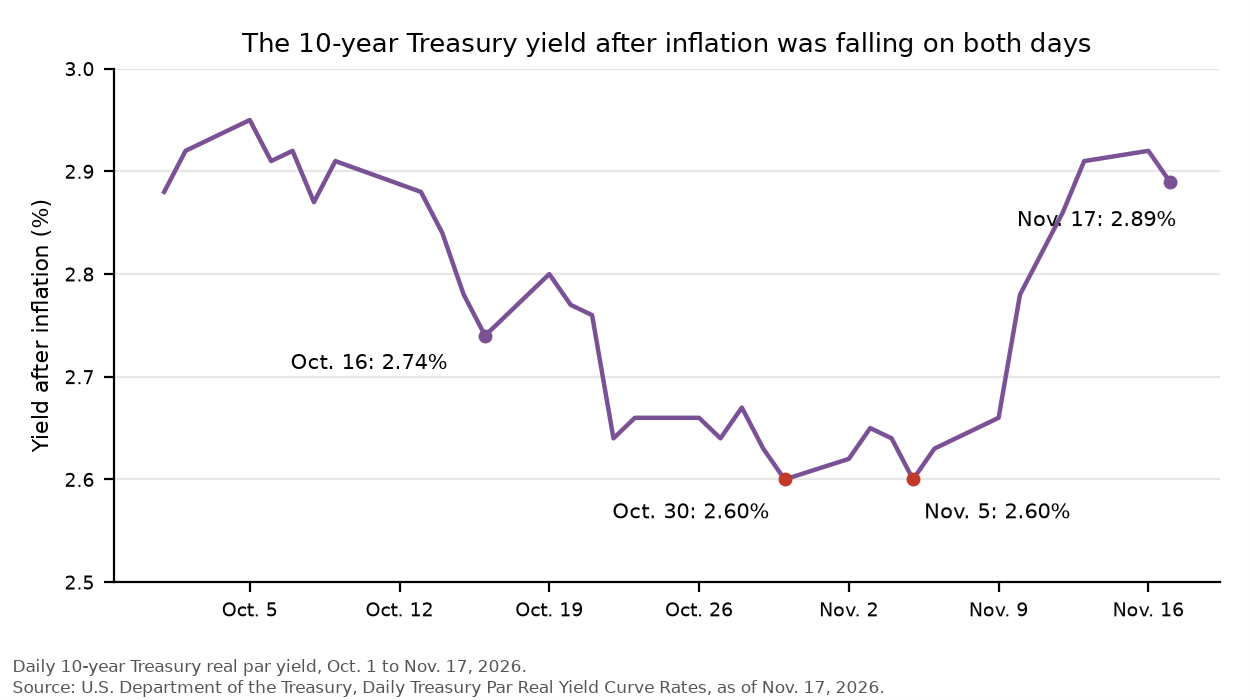
On Oct. 30 and Nov. 5, the two worst days for chip stocks since September, the 10-year Treasury yield after inflation was falling.
That yield, which measures what lenders earn above rising prices, only climbed later in November.
In each of the four jumps in that yield that our own back-tests covered, the chip fund beat the S&P 500.
Over the same month, an equal-weight S&P 500 fund, which gives banks, factories and stores the same weight as the AI giants, edged higher.
Why We'd Own the Chipmakers Now
Buy the VanEck Semiconductor ETF (SMH), rated B-, a BUY, at the next close; it closed Tuesday at $460.10.
When Alphabet, Amazon and Microsoft spend on AI data centers, much of that money lands with the chipmakers this fund holds.
The fund spreads your bet, so Nvidia's leadership question is a slice of it, not the whole.
Tuesday's close is about $80 below the fund's Oct. 16 close, before Alphabet's report and Nvidia's leadership change.
Regaining that level would mean a gain of about 17%.
The fund pays you a little to wait, about 0.2% of its price, so most of the return has to come from the chipmakers' growth.
We'd give it a year, with the first check at the Nov. 25 government report on economic growth.
What could work against it: Weiss grades the fund's risk D+, a sign its price swings hard.
A cut in any big spender's 2027 budget would also reach every chipmaker it holds.
What We're Watching
First, the spenders.
Alphabet promised details of its 2027 spending on its next report, and a cut there or at another giant would make us sell.
Second, business investment.
The Nov. 25 government report on economic growth shows whether companies kept spending heavily on computers and data centers.
Third, Nvidia itself.
If Nvidia's sales for this quarter fall below $126.1 billion, the low end of its outlook, we would sell the fund and say so.
Nvidia is rated B, a BUY, and if its board names a permanent chief executive and closes its investigation cleanly, we would buy it.
Bottom Line
The AI sell-off is a fight over trust and payback, while the chipmakers keep getting paid.
If your index fund has lagged lately, buy the VanEck Semiconductor ETF (SMH) at the next close; it closed Tuesday at $460.10.
Take care,
AL Qureiyeh