Social Security's 3.6% COLA Trails Inflation: Chevron and TIPS Fill the Gap
 |
| By Gavin Magor Reviewed by: Leo Tavolaro |
That Social Security raise is already spent.
The Social Security Administration announced this morning that benefits will rise 3.6% in January.
For the average retired worker, that's $75 more a month, taking the typical check from $2,095 to $2,170.
It is the biggest increase since 2023, and it still isn't enough.
The government's inflation report, released the same morning, shows the price index behind the raise is up 3.9% over the past 12 months.
So the bigger check starts January already behind the bills it is supposed to cover.
Whether that check goes to you, your spouse or a parent who leans on you, the shortfall lands on the household.
Today: where the $75 actually goes, the "inflation-protected" fund that lost money during an inflation, and the company collecting what you pay at the pump.
The Raise That Shows Up Late
The cost-of-living adjustment (COLA) does not use today's prices.
It compares the average of July, August and September in the Consumer Price Index for Urban Wage Earners and Clerical Workers (CPI-W) with the same three months a year earlier.
That average rose 3.6%, from 317.265 to 328.746.
But prices sped up as the quarter went on.
By September, the CPI-W stood 3.9% above a year earlier.
In plain English, the formula set the 2027 raise using prices that were already out of date.
Last Year's Raise Came Up Short Too
This year's COLA was 2.8%.
Beneficiaries have been living on that 2.8% while the index meant to track their costs climbed 3.9% over the 12 months through September.3That gap doesn't get refunded.
It just becomes the new starting line.
The Pump, the Tank and the Plane Ticket
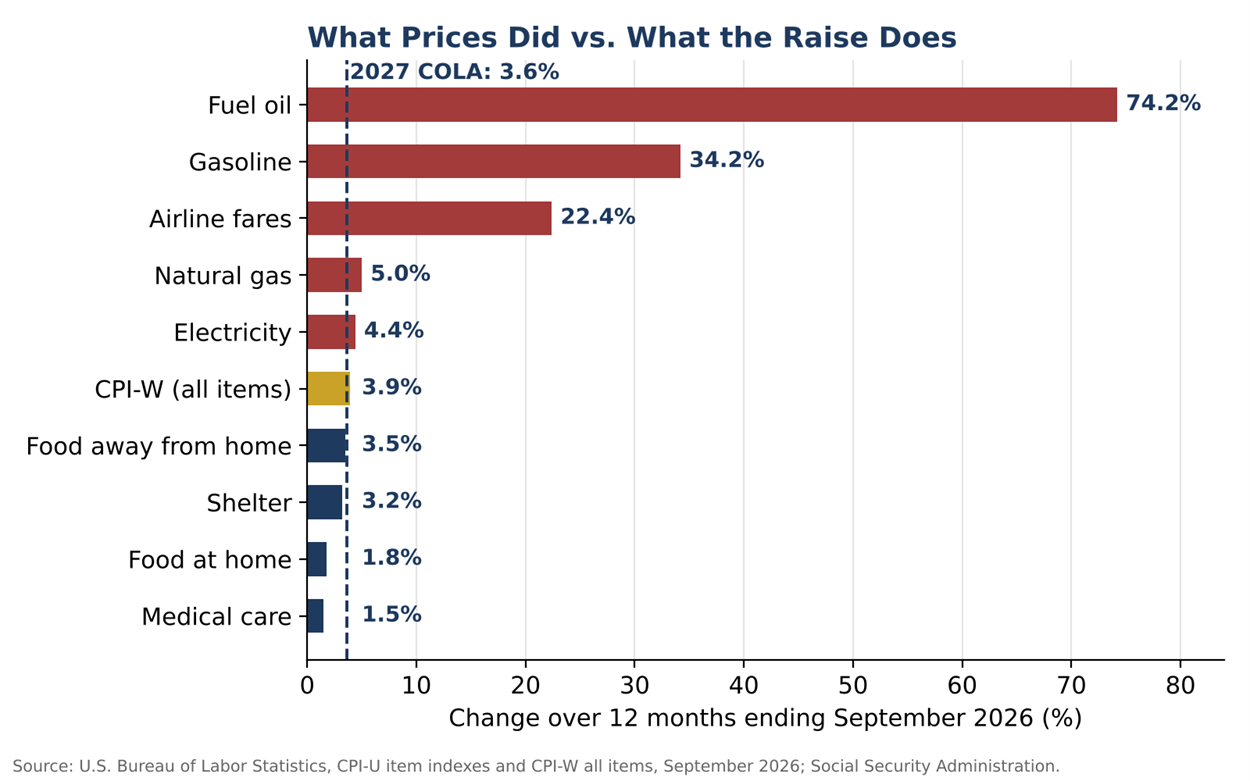
The Consumer Price Index for All Urban Consumers (CPI-U), the headline inflation measure, rose 0.6% in September and 3.7% over the past year, up from 3.4% in August.
Gasoline alone drove more than half of September's monthly increase.
Over the past year, gasoline is up 34.2%.
Fuel oil is up 74.2%.
If you heat with oil, that is not a rounding error.
Airline fares are up 22.4%, which matters if the grandchildren live far away.
There is some relief at the grocery store, where food-at-home prices are up just 1.8%, and medical care is up 1.5%.
But energy is the line item doing the damage, up 20.4% in a year.
Bond traders read the same report and didn't like it.
The 10-year Treasury yield closed Tuesday at 5.21%, and the two-year at 4.79%.
The report pushed both higher this morning, with short-term yields leading the way.
Traders added to bets that the Federal Reserve (Fed) will raise rates again.
Higher yields pay new money more.
They also knock down the price of bond funds you already own.
Follow The $75
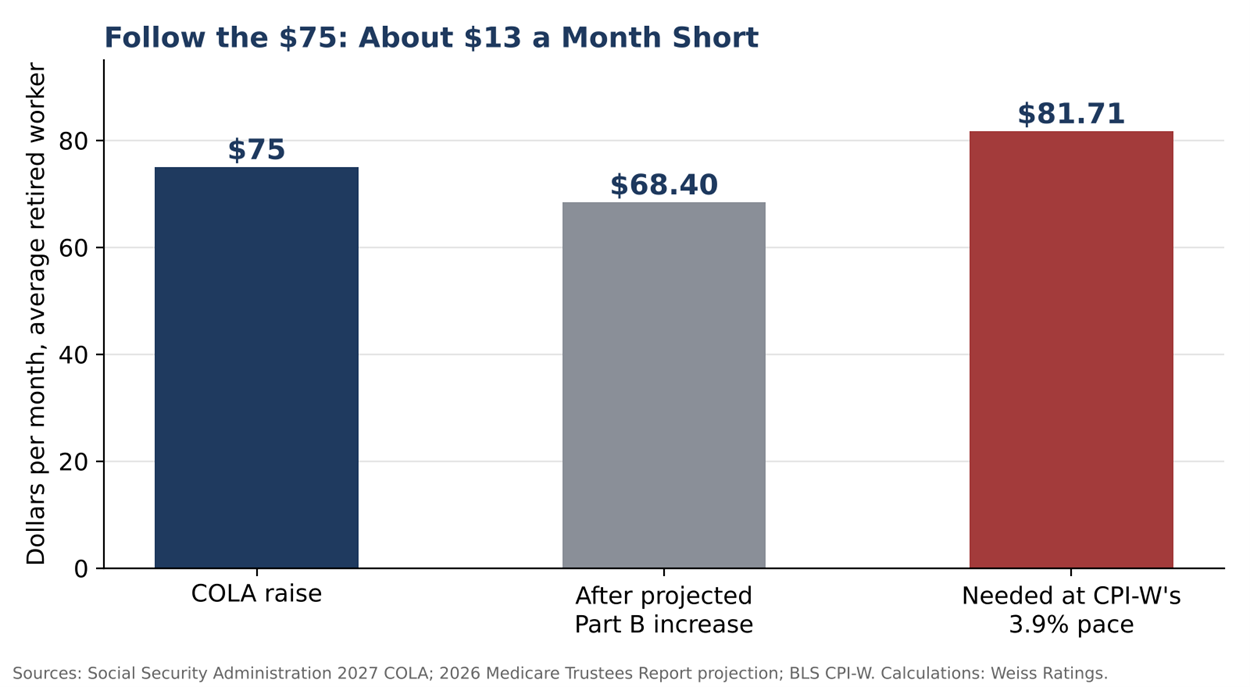
Start with the average raise of $75.
Medicare's trustees project the standard Part B premium will rise $6.60 next year, to $209.50 a month.
For many retirees, that premium comes straight out of the Social Security check.
That leaves about $68.40.
Now apply the 3.9% pace the CPI-W just posted.
At that pace, the average retiree needs about $81.71 more a month just to stand still.
That's a shortfall of roughly $13 a month, or about $160 a year, before anyone buys an extra tank of gas.
And the final Part B number doesn't arrive until later this fall, from trustees whose projections have been right only three times in the past 10 years.
Social Security can't close that gap.
Your portfolio can, whether the gap shows up in your budget or a parent's.
The Inflation Fund That Lost Money in an Inflation
The obvious move is a fund that holds Treasury Inflation-Protected Securities (TIPS).
Take the iShares TIPS Bond ETF (TIP).
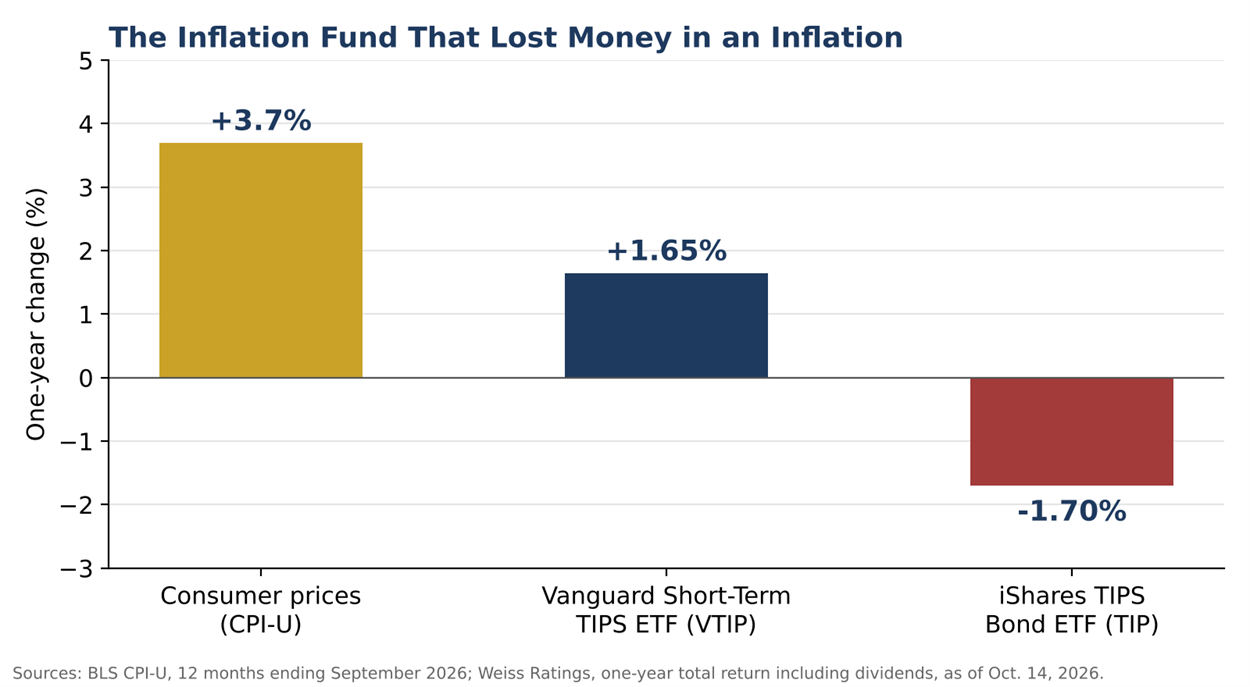
Over the past year, consumer prices rose 3.7%.
The fund lost 1.70%, even after counting its payouts.
Weiss rates it D+, a SELL.
The Schwab U.S. TIPS ETF (SCHP) carries the same D+, also a SELL.
The inflation protection inside these funds works fine.
The problem is the wrapper.
The real yield on 10-year TIPS climbed from 1.73% to 2.88% over the past year.
A fund never matures, so it has to mark its bonds down when real yields climb, and that markdown swallowed the inflation adjustment.
If you already own a TIPS fund, the Vanguard Short-Term Inflation-Protected Securities ETF (VTIP) has held up far better, returning 1.65% over the past year on its shorter maturities.
Weiss rates it C, a HOLD.
The Fix: Buy the Bond, Not the Fund
The Treasury sells a brand-new five-year TIPS at auction on Oct. 22.
It's a $26 billion issu that settles Oct. 30.
Hold it to maturity and the price swings stop mattering.
The principal adjusts with inflation, and you collect a fixed real yield on top of it.
The five-year real yield closed Tuesday at 2.67%.
The last five-year TIPS auction, in June, cleared at 1.955%.
If the Oct. 22 sale prices anywhere near today's market, buyers lock in roughly 0.7 percentage point more real return than June's buyers got.
You can bid through TreasuryDirect or most brokerage accounts, in $100 increments.
A noncompetitive bid simply accepts whatever yield the auction sets.
That makes the five-year TIPS our pick for cash you, or a parent, can't afford to see inflation eat.
The Other Side of The Pump
Someone is collecting that 34.2% jump at the gas station.
ExxonMobil (XOM) earns a B, a BUY.
It pays $1.03 a share each quarter, a 2.37% yield at Tuesday's close of $174.08.
It's a solid way to own the same trade, but our lead pick pays more.
Let the Ratings Do the Sorting
I checked every rating in this report by hand, and the "inflation-protected" label turned out to be the worst guide of the lot.
Weiss Ratings Plus does that sorting for you, with real-time ratings, instant alerts and exclusive analysis.
It also unlocks the full dividend history for the stocks we rate, so you can see which companies have raised their payouts faster than Social Security.
Click here to see what Weiss Ratings Plus can do for you.
Own the Pump
Remember that gasoline line, up 34.2%?
Chevron (CVX) is the company I'd want collecting it on my behalf.
It earns a B, a BUY.
It pays $1.78 a share every quarter, or $7.12 a year.
At Tuesday's close of $217.73, that's a 3.27% yield.
Social Security gave beneficiaries 2.8% this year.
Chevron lifted its quarterly dividend from $1.71 to $1.78 at the start of 2026, an increase of about 4.1%.
It has raised its payout for 39 straight years.
That streak ran straight through 2008 and 2020, when oil companies had nowhere to hide.
Put $25,000 in Chevron and the dividend pays about $818 a year at today's yield.
That's nearly the entire $821 the average retiree nets from the 2027 COLA after the projected Part B increase.
For a family helping a parent make ends meet, that's the gap covered without touching the principal.
Oil prices swing, and Chevron's shares will swing with them.
But the dividend is the reason to own it, and the dividend has gone one direction for 39 years.
I expect Chevron's next raise, due early next year, to beat the 3.6% COLA again.
We recommend buying Chevron at market.
What I'm Watching
- Oct. 15: The Treasury announces the final terms of the new five-year TIPS ahead of the Oct. 22 auction.
- Oct. 27 and 28: The Fed meets, and another rate hike would push real yields, and TIPS auction yields, higher still.
- Oct. 30: Chevron holds its third-quarter earnings call, where the cash flow behind the dividend gets its next test.
- Later this fall: Medicare announces the final 2027 Part B premium, the first deduction from the 2027 raise.
- Nov. 10: The October inflation report shows whether energy keeps outrunning the COLA.
Bottom Line
That Social Security raise is already spent, but your savings don't have to be.
Skip the TIPS funds that lost money while prices climbed.
Lock in a real return at the Oct. 22 five-year TIPS auction instead.
And own Chevron, a B-rated BUY, so the prices squeezing the family budget start paying you back.
Washington gave beneficiaries 3.6%.
Make the rest of the family's money do better.
Cheers!
Gavin