UPDATE: Boomerang CEOs and What History Says About Rehiring the Boss
|
Key Takeaways
|
 |
| By Gavin Magor Reviewed by: Leo Tavolaro |
On Monday, Nov. 23, NVIDIA (NVDA, "B-") reinstated Jensen Huang as president and CEO, 11 days after accepting his resignation.
That raises an old question for every shareholder: does bringing back an ousted boss pay off?
The Short Version
1. On average, it does not. Companies that rehired a former CEO trailed those led by first-time CEOs by 10.1% a year in stock returns.
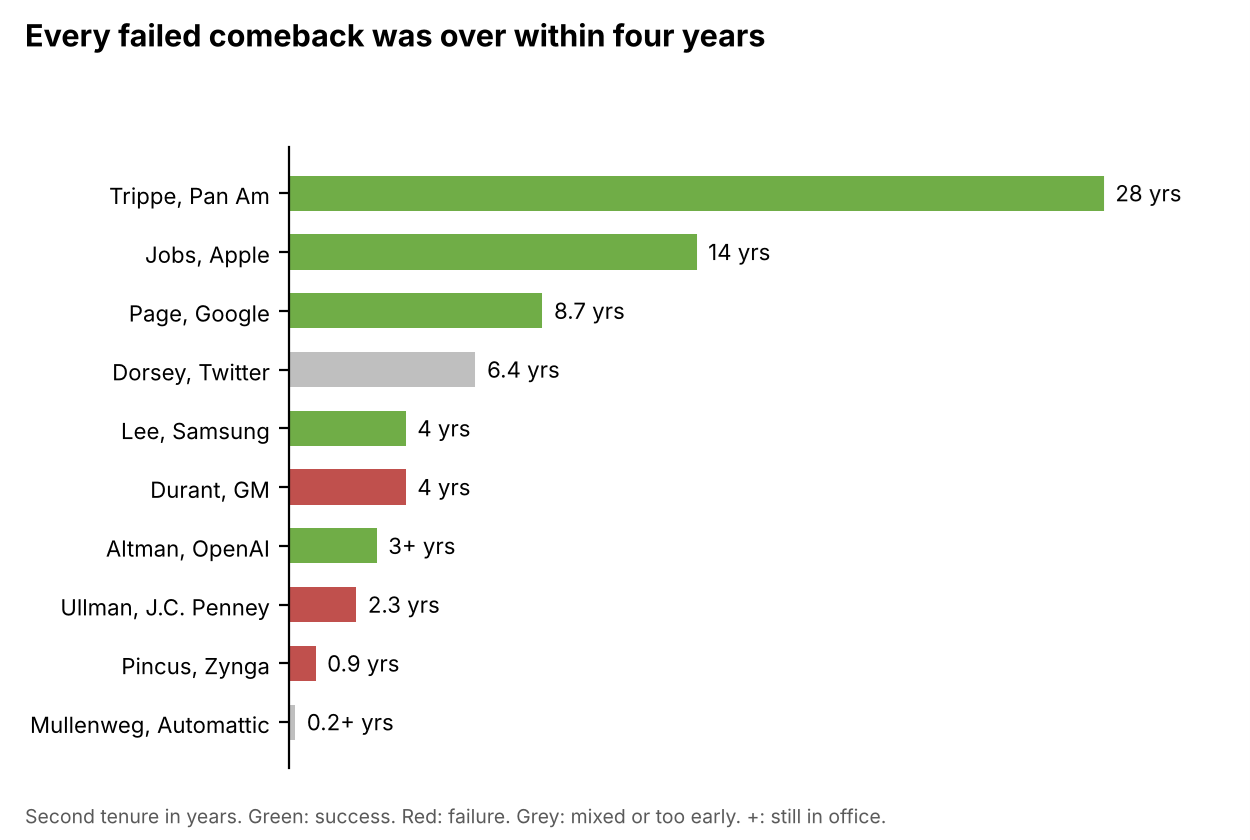
2. The famous exceptions share a profile. Of ten well-known comebacks, five succeeded.
Every failure was over within about four years.
3. A reversal within days is not a comeback. Huang's 11 days away put him with Sam Altman at OpenAI, not with CEOs gone for years.
What to do? Treat a comeback as a reason to recheck a stock, not to trade it, and judge the second act on its first full year.
Nvidia carries a Weiss rating of B-, a BUY.
Eleven Days in Santa Clara
Huang resigned on Thursday, Nov. 12, after 33 years as CEO of the company he co-founded.
He stepped down days after acknowledging an affair.
The board hired law firm Wachtell Lipton to examine whether his conduct compromised national security or company secrets.
On Tuesday, Nov. 17, chairman Harvey Jones opened the earnings call by ruling out Huang's return.
A petition for his reinstatement still drew 180,000 signatures, with support from Elon Musk.
On Monday, the board voted unanimously to bring him back, saying it was satisfied with his candor and ability to lead.
Steve Jobs, Jack Dorsey and Sam Altman all made similar returns to companies that had pushed them out.
So should you cheer a comeback, or read it as a warning?
The Average Comeback Costs You 10% a Year
Summary: Companies led by returning CEOs trailed those led by first-time CEOs by about 10% a year.
University of North Carolina researchers reviewed 6,429 CEOs of S&P 1500 companies.
Their data ran from 1992 to 2017.
They found 167 cases in which a former CEO came back to the top job.
The annual stock returns of those companies ran 10.1% below companies led by first-stint CEOs.
Their shares also lagged their own industries.
Founders Fare Worse
Founders made up 44% of the returning CEOs.
Among all CEOs in the study, the share was just 4%.
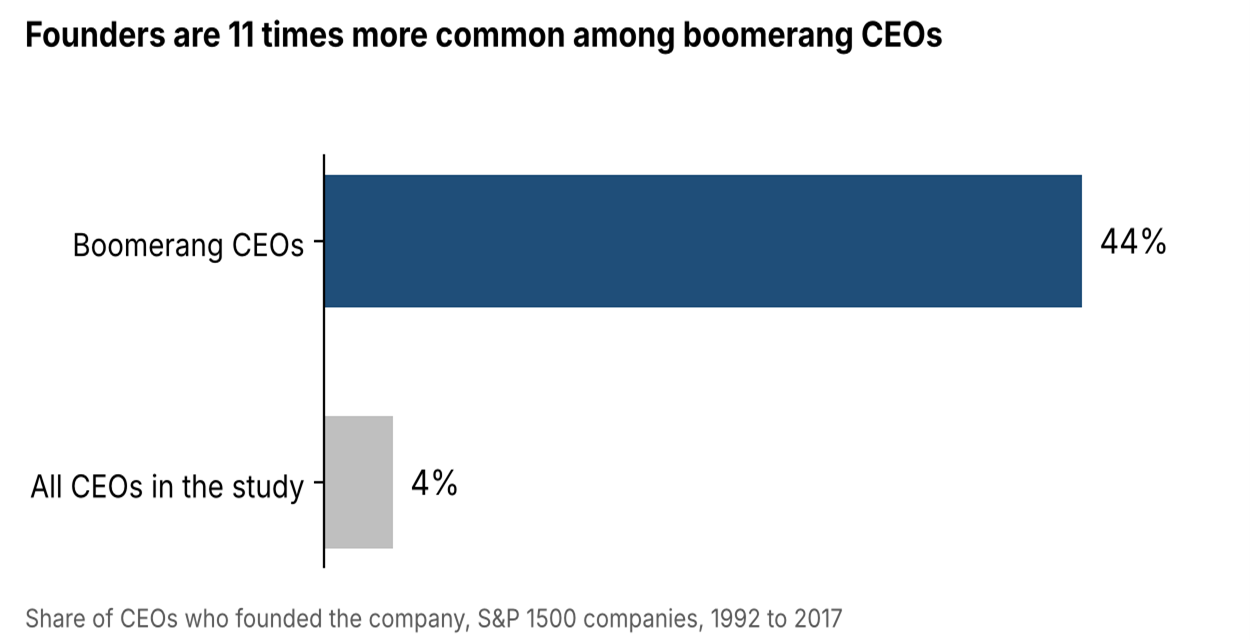
And the returning founders performed worse than returning non-founders.
The gap was widest at companies in fast-changing industries.
Nvidia is a founder-led company in a fast-moving industry, so both findings bear on your holding.
Why the Second Act Stalls
A CEO who has been away often comes back to a business he barely recognizes.
Boards also reach for a former chief partly because they have no one else to turn to.
That makes a boomerang hire as much a sign of a thin bench as of a strong leader.
Five Famous Wins, Three Expensive Losses
Summary: The best-known comebacks look better than the average, and their outcomes split on one thing: how long the returning CEO stayed.
Ten Boomerang CEOs: How the Second Act Turned Out
| Company and CEO | Time out | Second tenure | Outcome |
|---|---|---|---|
| Apple, Steve Jobs | 12 yrs | 14 yrs | Success |
| Google, Larry Page | 10 yrs | 8.7 yrs | Success |
| Samsung Electronics, Lee Kun-hee | 23 mos | 4 yrs | Success |
| Pan Am, Juan Trippe | 10 mos | 28 yrs | Success |
| OpenAI, Sam Altman | 4 days | 3 yrs+ | Success so far |
| Twitter, Jack Dorsey | 6.7 yrs | 6.4 yrs | Mixed |
| J.C. Penney, Mike Ullman | 17 mos | 2.3 yrs | Failure |
| Zynga, Mark Pincus | 21 mos | 11 mos | Failure |
| General Motors, Billy Durant | 6 yrs | 4 yrs | Failure |
| Automattic, Matt Mullenweg | 3 days | 2.5 mos | Too early |
Source: Weiss Ratings analysis of company filings and press reports. Tenures rounded.
The Winners Stayed Long Enough to Change The Business
Apple (AAPL, "B") lost about $1 billion in the fiscal year Steve Jobs came back.
One year later, it earned $309 million.
Two weeks before Jobs resigned in 2011, Apple became the world's most valuable company.
At Alphabet (GOOGL "B-"), revenue was $29.3 billion in 2010, the year before Larry Page returned as CEO.
By 2019, the year Page handed over the top job, revenue reached $161.8 billion.
Apple and Alphabet both carry a Weiss rating of B, a BUY.
At Samsung Electronics (SSNLF "D+"), operating profit hit a record ₩36.8 trillion in 2013 under Lee Kun-hee.
That was more than three times the 2009 level, which was already a record before he returned.
Pan Am's board pushed Juan Trippe aside in 1939, and he was back after about ten months.
By his retirement in 1968, Pan Am flew to 85 countries.
OpenAI's valuation has grown nearly tenfold since Altman's brief ouster in 2023.
Two caveats apply.
OpenAI rode an industry-wide AI boom, and Samsung rode the memory chip and smartphone cycle.
Not all of either gain belongs to the CEO.
Twitter Sits in the Middle
Twitter's revenue more than doubled in Jack Dorsey's second stint, reaching $5.08 billion in 2021.
But the company still lost money in both 2015 and 2021.
In 2021, up to Dorsey's exit, Twitter's stock was down 13%.
The S&P 500 was up 22.5% over the same stretch.
Our ten names tilt toward success because they are the comebacks people remember.
The 167-company study is the better guide to the odds you actually face.
The Losers Came Back to Clean Up a Mess
Summary: Two of the three failures were repair jobs, and the third ended when the CEO tried to prop up a falling stock.
J.C. Penney. Mike Ullman returned in April 2013 after Ron Johnson's turnaround strategy backfired.
In Johnson's one full year, sales fell 24.8%.
That left them at $12.98 billion.
Ullman stopped the slide, but 2014 sales were still just $12.3 billion.
Penney filed for bankruptcy in May 2020.
Zynga. Mark Pincus returned in April 2015 after his successor failed to halt falling revenue.
The stock fell 18% on the news.
It closed that day at $2.38.
Zynga lost $117 million that year.
Pincus stepped aside again 11 months later.
General Motors (GM "B"). Billy Durant regained control in 1916, and GM grew eightfold within four years.
When the 1920 market turned, he tried to prop up GM's stock price.
He lost more than $90 million between April and November 1920.
Then he was forced out for good.
Apple was a repair job too, and it worked.
Jobs pared back a lineup of 15 product lines, dropping printers and the Newton.
Then he stayed 14 years.
The failures never got that far.
Why Nvidia's Case Is Different
Summary: Huang was gone 11 days, so the research penalty for CEOs returning after years away does not fit his case.
Three recent reversals happened within days.
Sam Altman was out at OpenAI for four days in 2023.
Matt Mullenweg was out at Automattic for three days in September.
Huang was out at Nvidia for 11 days.
In each case, the CEO was back before the business had time to change.
For Nvidia shareholders, the open questions are about governance, not strategy.
Nvidia carries a Weiss rating of B-, a BUY.
Stock drops on leadership news are normal, and they will happen again.
Our rating, built on the company's data, is a better guide than a week of headlines.
Five Rules for the Next Comeback Headline
1. Treat a comeback as a reason to recheck the stock, not to trade it. The average comeback has cost shareholders, but the average is not destiny.
2. Measure how long the CEO was gone. A return within days undoes a boardroom decision; a return after years carries the research penalty.
3. Ask what the CEO is coming back to fix. In our sample, two of the three failures were repair jobs, though Apple shows one can work.
4. Judge the second act on its first full year. Pincus was gone in 11 months, while Apple's turnaround showed in Jobs's first full year back.
5. Let the rating, not the headline, drive the decision. Check the current Weiss rating before reacting to leadership news.
A Comeback Is a Bet Against the Odds
Returning CEOs have trailed first-time CEOs by about 10% a year in stock returns.
The winners, from Jobs to Trippe, stayed long enough to change the business.
Two of the three losers came back to repair someone else's damage, and all three were gone within about four years.
Nvidia's 11-day reversal is a board correcting itself, not a CEO returning to a company that has moved on.
With Nvidia rated B-, a BUY, the rating is a better guide than the headlines.
Most comebacks make better stories than investments.
Cheers,
Gavin