
 |
| By Marija Matic |
I told you last week that The Biggest Bitcoin & Ethereum Updates Aren’t in the Headlines. Indeed, the click-bait phrasing is designed to play with investor sentiment to drum up attention.
That’s why I walked you through what the actual data says is brewing in these two market leaders.
But not just crypto’s heavy hitters that deserve a closer look.
Some of the strongest altcoins’ most important developments have slid under the radar. And despite hitting all-time highs recently, two I’ve been watching have barely been mentioned by mainstream media at all.
These cryptos have shown signs that they could become favorites in the coming bull market. If true, then they’re the sort of projects you want exposure to before the market takes off again.
So, let’s take a look past the headline to understand the real stories behind these two altcoins … and whether they should demand more of your attention.
Venice Token: Privacy AI with a Deflation Engine
If you’ve only followed the headlines, you may have easily overlooked Venice AI (VVV, “B-”). Founded by the well-known crypto figure Erik Voorhees, this is a privacy-first, "uncensored" AI platform.
Think of it as a rival to mainstream AI chatbots that promises not to log or store your prompts. It has grown to an estimated 2–3 million users.

That alone is already impressive. But moreso is its price action this year. While the broad market was correcting and consolidating, its VVV token is up an astounding 748% year-to-date!
Over just the past three months alone, it’s posted a 94% gain. It now trades near $14.
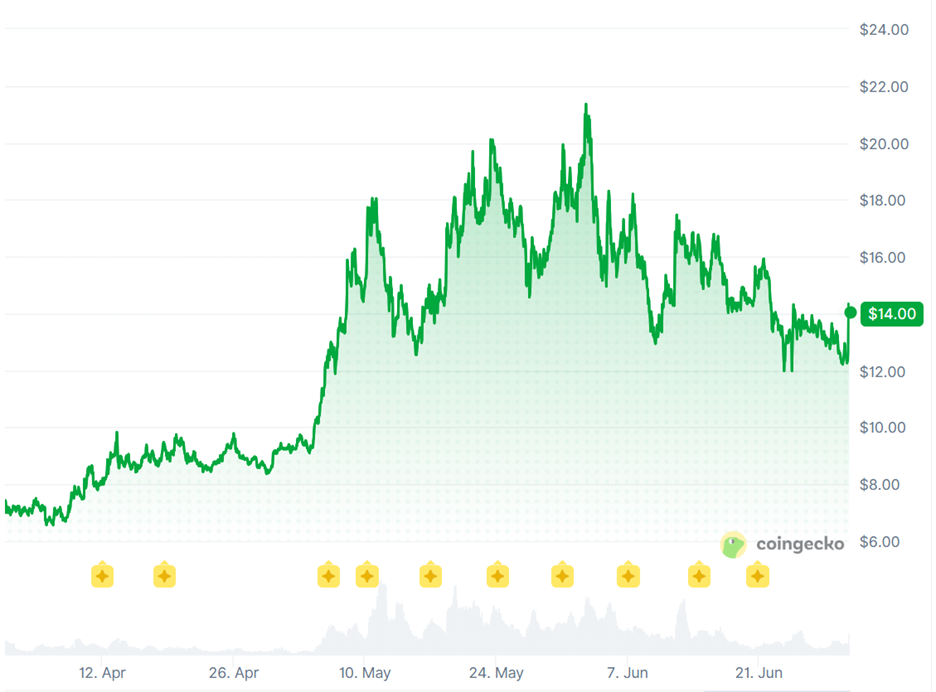
The reason for this rapid rise? The VVV token directly ties the business to its investors when they lock up the token.
In crypto, this process is called "staking," and it earns you a yield.
It’s a bit like leaving cash in an interest-bearing account. With Venice, staking also gives you access to the paid product and a stream of usage credits.
The core idea is one equity investors will recognize: Venice takes part of its real subscription revenue and uses it to buy back and destroy VVV.
Think of it in the same vein as a stock buyback.
More paying users means more buying-and-burning, which means a scarcer token. That story has carried VVV up several hundred percent this year.
Here’s why this matters: VVV’s entire investment case rests on the deflation engine outrunning supply — which makes the next milestone one to watch closely.
In July 2026, the last of a planned series of cuts to new-token creation takes effect. With that, yearly issuance drops to just 3 million (down from 8 million at the start of the year). From there, the squeeze only tightens for as long as paying users keep growing.
On the product side, Venice is building toward a "V2" platform that adds video generation. And it's pushing into unexpected corners, including supplying the private, uncensored AI that runs inside humanoid robots.
The most speculative prize is the so-called "agentic economy" — the idea that autonomous AI software will eventually pay for its own computing power, settling the bill in tokens like VVV.
If that arrives, it's a genuinely new source of demand. If it doesn't, it's just a good story.
Either way, the one number that drives everything downstream — the buybacks, the scarcity, the whole thesis — is subscription growth.
That’s what interested investors should watch as Bitcoin consolidates.
Rain: Prediction Markets with a Very Unusual Treasury
Rain (RAIN, Not Yet Rated) is a decentralized prediction-market protocol.
Like Polymarket and Kalshi, Rain lets people trade on the outcomes of real-world events. But unlike those more famous examples, Rain's twist is that it's fully permissionless.
Where the big platforms hand you a curated menu of pre-approved bets, Rain lets anyone spin up a market on practically anything, in any language.
On Rain, you can take a hyper-local conspiracy theory, a niche internet feud or even something as small as an office sweepstake and turn it into tradeable odds.
The pitch, in the team's own spirit is to take public opinion, online debates, and real-world chaos and price them.
That openness has carried it to become the most notable prediction play in crypto.
The timing is the whole story.
Rain timed a major upgrade — better plumbing to attract professional traders, plus AI that automatically creates and settles markets — to roll out just before the FIFA World Cup, which kicked off on June 11 and runs into mid-July. To prime the pump, the project committed $100 million to make trading smoother.
A global sporting event represents peak demand to a prediction market. And with the tournament now under way, the coming weeks will be a live test of whether Rain's infrastructure (and the bet riding on it) holds up.
Underpinning this moment is key context the headlines don’t cover: Rain may be up against two formidable leaders in this space, Polymarket and Kalshi. But neither has a tradeable token at all!
That means RAIN is one of the few liquid ways in crypto to bet on the prediction-market theme itself.
That scarcity is part of what drove it to record highs in recent weeks. RAIN has doubled since late May and is still hovering around its all-time high near $0.016.
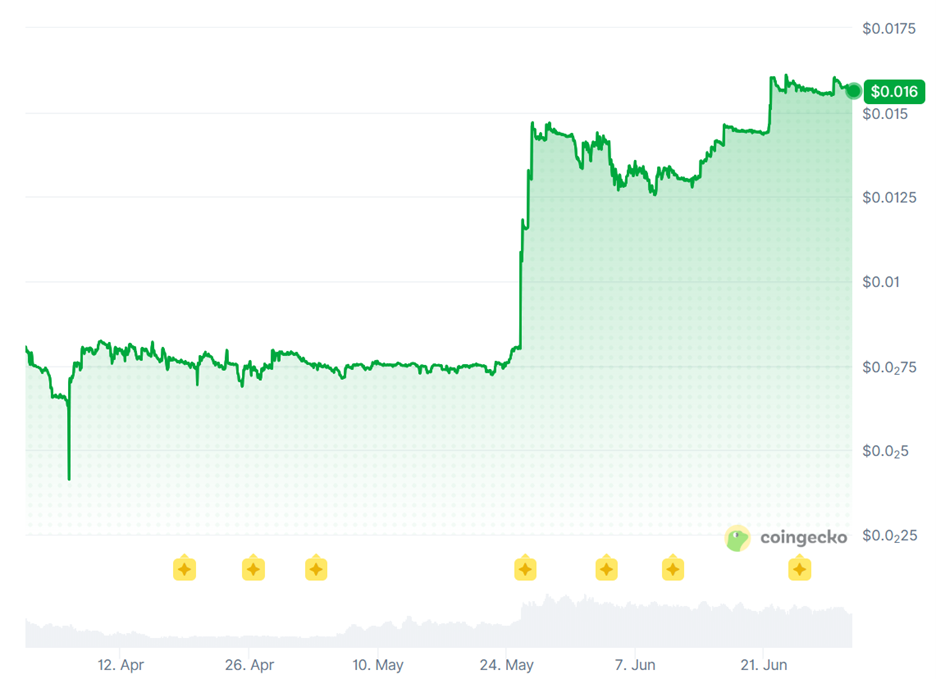
But here is the part a seasoned investor will find genuinely remarkable: A Nasdaq-listed company called Enlivex (ENLV) — which focuses on biotech research into aging — has made RAIN the centerpiece of its corporate treasury.
Enlivex has disclosed RAIN holdings worth around $1.16 billion. The eye-watering detail is that's roughly 6x the entire stock-market value of Enlivex itself (about $188 million).
In other words, a small biotech's balance sheet is now dominated by a volatile crypto token from a field that has nothing to do with its medicine.
It's the most extreme example yet of a company parking its treasury in crypto. And so far, the bet has paid off.
That said, there are notable risks. In fact, RAIN is a more speculative project than Venice at this time.
So, I’ll state them plainly …
- Supply: A large share of RAIN tokens is not yet circulating. Big scheduled unlocks — including one worth several hundred million dollars hit in May — mean the token could see persistent dilution pressure that buybacks may struggle to offset in the future if the demand drops.
- Regulation: Prediction markets are squarely in regulators' crosshairs as Spain recently moved to block Polymarket and Kalshi over unlicensed-gambling concerns. The whole category's legal status is unsettled, which increases risk.
- Governance: Promised community control — via a Decentralized Autonomous Organization, or DAO — is still "a future phase," per the project's own March whitepaper. For now, control is concentrated.
- Attention: Near-term, RAIN's price is strapped to a single event: how the app performs during the World Cup. That's the textbook setup for a "sell-the-news" move. A lot of optimism is already priced in, and once the final is played in mid-July the obvious catalyst is gone. So, the one number worth watching is real prediction volume on the app once it's fully public.
- Competition: Polymarket has confirmed its own token is coming, probably later in 2026. Whenever it lands, it could either siphon speculative attention away from RAIN or strengthen it, if its prediction market grows.
In short, Rain is the sort of “big risk, big reward” projects that crypto is known for.
Interested investors should keep an eye on how RAIN’s price responds once the World Cup ends. And how on-chain metrics — like total value locked (TVL) and active users — are impacted, as well.
That’ll give a good indication of whether RAIN was supported by hype and opportunity, or if it can really challenge Polymarket and Kalshi enough to carve out its own niche.
CoinGecko1 is always a good start to see price action and learn more about the cryptos on your radar. And for DeFi projects, DeFiLlama2 contains a wealth of information.
Bottom Line
If your crypto research starts and ends with scanning headlines, there is a lot of information you’re missing.
That could be the difference between you finding a promising project before it takes off … and chasing the market with the masses.
Best,
Marija Matić