The Biggest Bitcoin & Ethereum Updates Aren’t in the Headlines
 |
| By Marija Matic |
I don’t know about you, but I tend to get frustrated with crypto headlines.
Many play up the market’s speculative nature, fanning the flames of sentiment rather than focusing on pure fact. Indeed, investors need to dig far deeper than popular headlines to get a meaningful update on how their favorite cryptos are really doing.
That’s true even for crypto’s biggest names: Bitcoin (BTC, “B+”) and Ethereum (ETH, “B+”).
But it’s no longer just crypto investors who need to keep an eye on these projects. With companies adding both BTC and ETH to their balances and ETF inflows increasing, these two blockchain giants now impact and are impacted by the TradFi market.
Even if you’ve never bought a crypto in your life, you’ll want to stay informed.
So, here’s the latest about crypto’s two biggest players …
Bitcoin: A Fascinating Governance Fight Is Brewing
Over the past few weeks, headlines have focused on Bitcoin’s price. Through mid-June, the OG crypto has been pinned in the mid-$60,000s.
But here’s the kicker: The price story is entirely a borrowed one. Almost none of its recent correction is about Bitcoin directly.
That’s vital to understand: It’ll keep you safe from believing any “Bitcoin is dead,” headlines.
In fact, my colleague Mark Gough broke down BTC’s recent price action and the real forces behind it yesterday.
If you haven’t yet, I suggest you read when you have a moment.
In the meantime, there’s a more interesting story long-term holders need to know about: quantum computing.
Many investors are worried that a powerful enough quantum computer could one day crack the math that protects Bitcoin wallets. If there’s no upgrade, recent research suggests that day may come sooner than people assumed.
Around 6–7 million BTC — including the long-dormant coins believed to belong to Bitcoin's anonymous creator, Satoshi Nakamoto — sit in older-style wallets that would be the most exposed.
This threat has split developers into two camps.
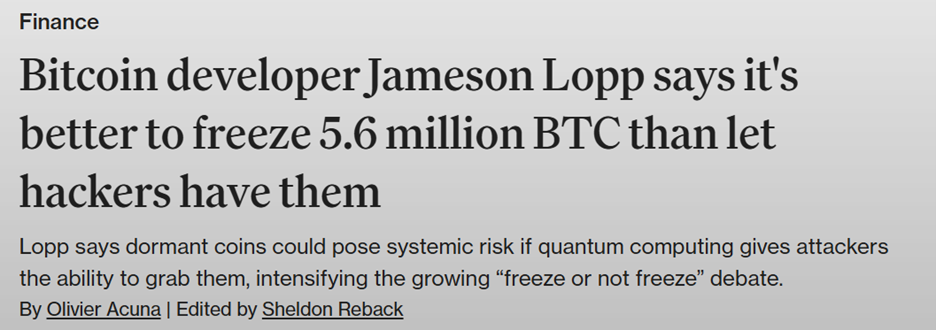
One, led by a well-known engineer named Jameson Lopp, wants to set a hard deadline: Move your coins to a new, quantum-safe wallet by a certain date, and anything left behind gets frozen. Locked forever.
It sounds drastic, but the logic is simple: Better the network freezes vulnerable coins itself than let a future attacker steal them and shatter trust in the whole system.
The other camp, led by Blockstream's Adam Back, calls that overkill. They agree the quantum-safe upgrades should be built now — so anyone who wants to can move their coins to safety voluntarily — but they reject the idea of seizing coins that don't migrate.
Their reasoning is that the threat is likely decades away. And if it ever does loom, Bitcoin's developers can coordinate a fix fast.
That’s not entirely unrealistic. Critical bugs have been patched in hours before. Beck and his supporters believe the same can be done again, rather than confiscate people's coins on a deadline set years in advance for an attack that may never come.
Why an investor should care: Bitcoin has no CEO and no board, so there's no one who can simply decide this.
Change happens more like a slow, rolling referendum with no fixed voting day. An idea gets argued over for years — across developer mailing lists, online forums, community gatherings, and peer-reviewed cryptography papers.
It only becomes real if a broad enough coalition of developers, miners, businesses and the ordinary people running the software all voluntarily choose to adopt it.
Everyone effectively casts a "vote" by deciding which version of Bitcoin to run on their own machine. Which means a change that fails to win that rough social consensus simply never takes hold.
It's slow and messy by design, and that's the point. No one can force a change through.
Watching a leaderless, trillion-dollar network argue its way toward an answer on a question that pits its founding promise — only you can ever touch your coins — against its own survival tells you a great deal about how durable it really is.
Every BTC holder — whether you keep custody of your own coins or hold them in an ETF — should keep up with this slow-moving debate.
Ethereum: Game Theory in the Wild
Two things are happening at once with Ethereum: a large technical upgrade, and an unglamorous but far-reaching argument about who pays for a system that, by design, nobody owns.
And these developments are set to intersect in an interesting way. Let’s start with the upgrade …
Ethereum's next big overhaul — nicknamed Glamsterdam — is in final testing, on track for a Q3 2026 launch.
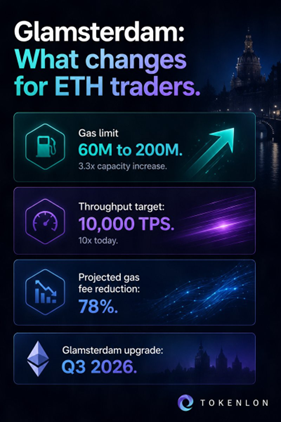
It’s the most significant change to the network since 2022 and it matters for two key reasons …
- It will triple the network’s capacity, which will make Ethereum cheaper and smoother to use,
- And it brings the job of assembling transactions into blocks — currently handled by a handful of outside middlemen — back inside Ethereum's own rules.
This tells me that, after years of pushing activity onto its cheaper side-networks, Ethereum is trying to make its main network competitive again.
In the face of this big change, on-chain activity reveals a quiet vote of confidence: About 475,000 ETH was pulled off exchanges in early June.
That tells us that holders are settling in rather than getting ready to sell.
Now the interesting part:Who actually pays for Ethereum?
The Glamsterdam upgrade will soon make Ethereum cheaper to use. But that means less money will flow into the ecosystem to pay for upkeep.
That makes the, "who funds the shared infrastructure" question a more prominent issue. The answer will be central to whether Ethereum stays competitive long-term.
Because, while Ethereum is critical infrastructure used by millions of people, the engineers who maintain its core software … aren't on anyone's payroll. As a decentralized network, there is no single company running things.
So, the costs of operation have always been covered by a patchwork of an early endowment, grants and donations.
This is the central tension of any system that nobody owns — it creates enormous shared value, but shared things are chronically underfunded.
That’s because each person is better off letting someone else foot the bill.
So, while the system works, it's lumpy and unreliable. Economists call it the free-rider problem.
Which brings us to a proposal that was published just last week.
On June 21, Clément Lesaege — co-founder of the on-chain arbitration project Kleros and a respected voice in this debate — posted an idea on Ethereum's main research forum.3
The gist of it is what if the people who help run the network (stakers) could redirect a small slice of their earnings, capped at 10%, into a shared pot that funds development and growth?
There’s a lot here that makes sense.
The 10% ceiling is a deliberate nod to the age-old idea of a tithe. It caps the damage if the system is ever gamed.
Contributors also get to point their share at the projects they care about and then leave it on autopilot. At today's scale, even a 5%–10% slice would steer hundreds of millions of dollars a year into the ecosystem.
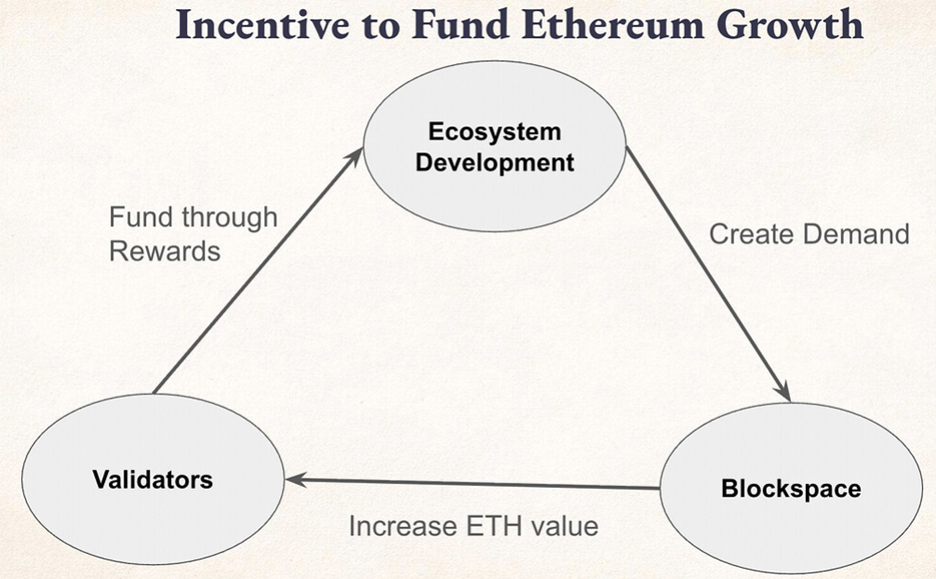
But the clever part is how it gets around the free-rider problem. Think of it as a classic prisoner's dilemma:
- For any one participant, the selfish move is to keep 100% of their earnings.
- But if everyone thinks that way, the network stays underfunded, falls behind, and everyone's holdings lose value.
- If everyone chips in a little, the whole network gets stronger and everyone ends up richer.
Each person acting in their own narrow interest leaves the group worse off. The proposed escape is neat: Nobody has to give anything unless a majority agrees to give together.
That means, like with Bitcoin, this proposal may be slow to take effect. More than half of participates need to vote the measure in.
But the moment that happens, it applies to everyone. Which means there can’t be a single “greater fool” left holding the bag while everyone else freeloads.
That said, Lesaege has been upfront that this idea is just a rough first draft meant to provoke a debate. Sure enough, it already has.
The sharpest objection, raised on the same thread, is the obvious one: If a majority can both set the rate and decide where the money goes, what stops them from simply paying themselves?
Lesaege's answer is that a self-serving majority would crater the token's value, and that the 10% cap makes cheating barely worth the trouble.
There's also a fairness worry. Most of the people who'd be setting these preferences are large staking firms acting on behalf of their customers, whose interests don't always line up.
Neither of these issues is truly resolved at this time. And given crypto's decentralized nature, the same debates surface across other ecosystems too.
There's a generational split, though, as many newer networks bake the answer in from launch. They set aside part of the coin supply, or a slice of ongoing issuance, to pay for development and ecosystem growth.
Ethereum and Bitcoin predate that playbook, built first as credibly neutral money and computing. Funding was left as an afterthought, which is why they're still retrofitting what younger chains simply designed in.
Ethereum isn't the first to wrestle with this — these arguments are as old as crypto — but how the largest smart contract network handles it is something every other network will be watching.
Which is why this debate is worth your attention … even if you never go near the technology.
Bottom Line
As an investor, skimming headlines and casually checking price action isn’t enough.
To stay ahead of crypto’s wild twists and turns, you need to know what’s happening in real time on the blockchain.
Right now, the two biggest crypto around are both facing serious debates that’ll either help them continue to lead the markets going forward … or inhibit their future potential.
Those are the real narratives you should keep an eye on. You can do just that by keeping up with our daily crypto updates. Or you can check out Juan Villaverde’s Weiss Crypto Investor.
That’s where Juan combines his market analysis with his Crypto Timing Model to spot the best chances to load up on long-term crypto investments.
Best,
Marija Matić