2 Ways to Play the Emerging 2-Tiered Crypto Market
 |
| By Jurica Dujmovic |
After years of radical transparency, capital on the blockchain has begun to migrate.
As more institutions come on-chain, that liquidity is flowing toward privacy-preserving execution layers.
This is a significant shift. The blockchain's founding premise was transparency. Every address, balance and pending order is visible to anyone with an internet connection and the time to look.
For a system trying to replace trust in institutions, openness was the point.
Then came the bots.
Maximal Extractable Value, or MEV, is what happens when market structure rewards those who can see your trade before you make it. Validators and searchers operating bots can front-run, sandwich and re-order transactions for profit.
The cost lands on the trader on the other side.
According to Alchemy and EigenPhi data, searchers extracted roughly $24 million in MEV profit from Ethereum (ETH, “B+”) alone in the 30 days between Dec. 8, 2025, and Jan. 6, 2026. On some Layer-2 networks, bots paid less than 10% of the fees they generated while consuming over half the gas on the chain.
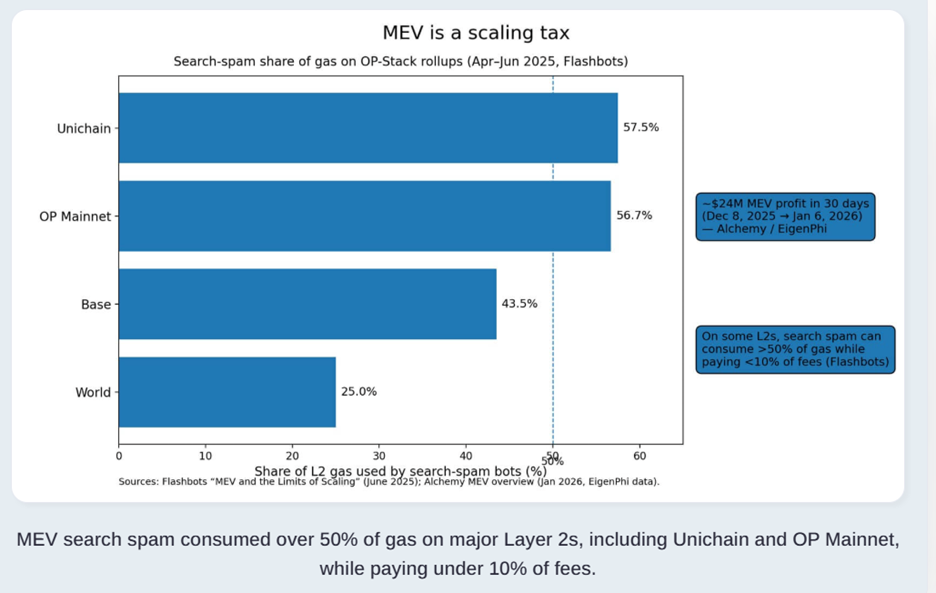
A peer-reviewed analysis of linked MEV attacks found attackers chaining sandwich and arbitrage strategies extracted over $5 billion total on Ethereum — with linked attacks outperforming standalone ones by an order of magnitude.
Put simply, the transparency that was supposed to guarantee fairness … has instead become a tool that turns a level playing field into a hunting ground.
While that’s a problem all around, it’s a particular issue for institutions looking to transact on-chain. Because a portfolio that fails to shield its trade executions loses its edge.
The Infrastructure Response
The market's answer is not protocol fixes or gentlemen's agreements. It is an entirely parallel execution layer — on-chain, but dark.
The clearest signal of this trend is Aztec Network (AZTEC, Not Yet Rated), which launched its Ignition Chain — the first decentralized, privacy-preserving Layer-2 on Ethereum — in late 2025 and launched its token on Feb. 12 of this year.
Aztec's architecture is technically distinct from a mixer or an anonymity tool.
Developers can write smart contracts with both private and public functions. This means trade's execution can stay hidden … even as its settlement remains publicly verifiable on the Ethereum blockchain after the fact.
That’s huge for institutions that want to shield their order books from competitors and still satisfy a regulator's audit request through selective disclosure.
Because the setup does not ask users to choose between privacy and compliance. It makes them separable.
Aztec also recently introduced a new client-side proving system called CHONK to significantly cut proving latency on consumer hardware — one of the primary friction points holding institutional deployment back.
This is a sign of a broader infrastructure shift. One that will split crypto into a two-tiered system.
On one level, public liquidity — via platforms like Uniswap (UNI, “B-”) and Aave (AAVE, “B-”) — remains available and visible on any block explorer to offer retail flow and price discovery.
But underneath will lie an expanding layer of shielded pools, encrypted order routing and private execution venues, all absorbing institutional size.
This is the structure that traditional finance settled on decades ago. Now, crypto is replicating it using blockchain technology.
What This Means for Investors Like Us
The benefit to institutions is clear.
For retail investors like us, there are opportunities here.
Namely, in protocol exposure.
Any protocol that moves serious institutional volume will eventually need a private execution layer, just as it needs a custody solution.
Aztec is a solid place to start your research.
Railgun (RAIL, “D”) — a zk-SNARK privacy system that operates natively on Ethereum, Arbitrum and Polygon without bridges or a separate chain — is another.
As of this year, it has become the de facto standard for institutional DeFi users who need to shield strategies without triggering compliance red flags. The protocol's "Proof of Innocence" mechanism allows users to cryptographically demonstrate that their funds do not originate from sanctioned or illicit sources without revealing transaction history.
Even Ethereum co-founder Vitalik Buterin has used Railgun to shield his own transactions, publicly framing privacy as normal financial hygiene rather than evasion.
The timing of all this cannot be ignored.
ZK proving costs — essential for privacy transactions — dropped 15x in 2025, making them ZKs cheaper to run. That makes privacy layers practical at the scale needed to handle institutional transactions.
At the same time, regulatory frameworks in both the U.S. and the EU are engaging with selective disclosure. For the first time, the powers that be are considering it as a legitimate compliance model, and not just a means of evading regulations.
But this window of opportunity — where early positioning in a category still carries asymmetric upside — won’t stay open for long.
If the regulatory environment stays the same, I expect we’ll see prices run once the next cycle of institutional capital starts pricing it in.
But that could be a big “if.”
The Regulatory Wrinkle
Privacy protocols on the blockchain have a sordid history with regulators. Makes sense, seeing as permanent opacity scares them.
The distinction the current generation is using to argue legitimacy is between permanent opacity and auditable confidentiality.
Railgun's Proofs of Innocence and Aztec's selective disclosure framework operate on the same principle. That’s why they’ve made privacy auditable on request.
This way, regulators get what they need, on a defined schedule, through a cryptographic proof rather than a wire transfer disclosure form.
As institutional capital pushes harder at DeFi's front door, pressure is building for regulators to accept the compromise.
Bottom Line
A BlockTelegraph analysis from January 2026 put the dynamic plainly: In 2026, privacy is the prerequisite for real-world liquidity.
The winners will not be the platforms built for anonymity as an end in itself. They will be the ones who pair privacy with selective disclosure.
Crypto spent its first decade proving it could replace trust with transparency. The next phase is proving it can replace trust with proof — without showing everyone the underlying numbers.
The window to benefit from this opportunity as a retail investor is open now.
But it will close once institutions begin to price it in.
Best,
Jurica Dujmovic