 |
| By Jurica Dujmovic |
Last week, I revealed three fundamental changes that are shaking up the crypto market …
And cementing it as a core part of the broad financial infrastructure.
I also let you know how these changes can likely impact your investment strategy.
Today, I want to delve into the details and lay out three specific effects I believe these changes will have just in 2026.
Let’s get started …
Prediction 1: At least two additional major banks will enter the crypto ETF market by mid-2026, though probably not all as direct issuers.
Morgan Stanley's filing for a spot Bitcoin (BTC, “A-”) and Solana (SOL, “B-”) ETF lit a fire under boardrooms.
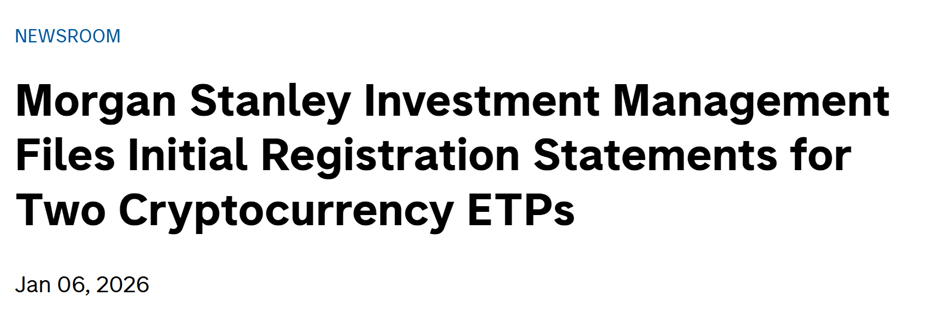
After all, with BlackRock generating $245 million in annual IBIT fees and another bank leading the way, competitors stop asking "should we?" and start asking "how fast can we?"
So, I expect we’ll see more of the same from other banks.
And since TradFi institutions rarely rush into non-BTC exposure right off the cut, I believe we’ll likely also see some banks take a safer route through white-label structures or sub-advisory roles.
For investors, this means broader adoption and increased demand fueling price hikes.
And it also means more exposure and correlation to the TradFi markets. If banks need liquidity, their crypto assets will likely be among the first to be harvested.
Prediction 2: Stablecoins become primary settlement rails for corporate treasury operations, but the stablecoin market will consolidate rather than expand.
As I said on Thursday, the legitimization of stablecoins has been a dominating narrative for a reason.
If transaction volumes hit $35 trillion to $40 trillion in 2026, they’ll officially become the standard operating procedure for cross-border payments and internal treasury flows.
The technology is simply better than SWIFT. It’s faster, cheaper and doesn't take weekends off.
But here's the catch: Full displacement will take years.
In fact, I expect most firms will parallel-run SWIFT and blockchain rails throughout 2026.
Why?
Because internal risk committees, ERP integrations and counterparty frameworks move at glacial speed compared to technology adoption.
But make no mistake — this year will be the turning point. Once treasury departments trust stablecoins for material flows, there's rarely a full rollback.
You’d think this would lead to an explosion of stablecoins.
But legitimization and adoption also come with additional regulation.
Reserve segregation, frequent attestations and licensing overhead create compliance moats — ones too big for small players to cross.
Smaller issuers get delisted from European exchanges once MiCA licensing wraps up, and U.S. reserve requirements finish the job.
Instead, only companies that have the resources to scale — like Circle and Tether — will be able to play.
Consider this your warning call. If you’re exposed to smaller, stablecoin-driven projects, you may want to watch them carefully as this consolidation plays out.
Prediction 3: AI-driven DeFi automation will be wrapped in regulation, not free-roaming AI agents.
Last year, I made the case that AI agents would change the face of crypto as we know it.
And while I still believe they can … I don’t think that’s how things will play out anymore.
In a truly free crypto market, sure AI agents absolutely could dominate. Because without human restrictions, they can …
- Optimize yields,
- Manage liquidity
- And assess risk.
All at the speed of crypto!
But the idea that these agents would be used by funds, SPVs and managed accounts dies when put against existing liability structures.
AI can’t act as a decision maker without human oversight. At least not when you need someone to explain a client’s losses.
Regulators don't care about yield optimization. They care about who's responsible when things break.
And AI can’t take responsibility.
Which is why I expect to see AI-enhanced DeFi products come with clear disclaimers in 2026. And their use will be targeted and limited.
The only place I believe we’ll see fully autonomous agents managing real money will be by individual tech-savvy crypto natives.
The Pattern Behind the Predictions
The pattern for 2026 is clear: Crypto infrastructure will be absorbed and adapted into traditional finance through paths of least resistance.
That looks like …
- Bank-issued ETFs instead of DeFi protocols.
- Compliance-heavy stablecoins instead of algorithmic experiments.
- Tokenized assets with familiar legal structures instead of truly decentralized ownership.
- AI automation within existing fiduciary frameworks instead of autonomous agents.
TradFi institutions can no longer deny how useful and beneficial blockchain technology is.
That said, it’s not powerful enough to escape institutional constraints.
This is exactly how financial infrastructure has always evolved.
As investors, this will have two big implications for your strategy.
First, is that crypto will become a bit more boring.
Stronger regulatory frameworks, sector consolidation and TradFi-driven crypto products mean more stability and fewer wild disruptors.
Second, that boring approach can make profiting from crypto a bit more predictable.
That means fewer wild swings and moonshots … but more steady, long-term gains.
The change won’t be immediate.
Regulations are still being written, adoption is slowly ticking up and exactly how crypto can mesh with TradFi is still being worked out.
But this is the start of a new crypto era.
We can’t trade the market we want. Only the one we have.
And the investors that succeed will be the ones who can adapt ahead of the crowd.
Best,
Jurica Dujmovic