3 Days to 5 Seconds: Crypto’s Infrastructure Investment
 |
| By Mark Gough |
The future of money rarely arrives with fireworks.
More often, it arrives as a quiet pilot transaction buried deep inside the infrastructure of global finance.
Which is how so many retail investors can miss it.
But here’s the key that the savvy among them understand: Infrastructure matters more than the headlines.
And the latest infrastructure buildout is one you should definitely take note of.
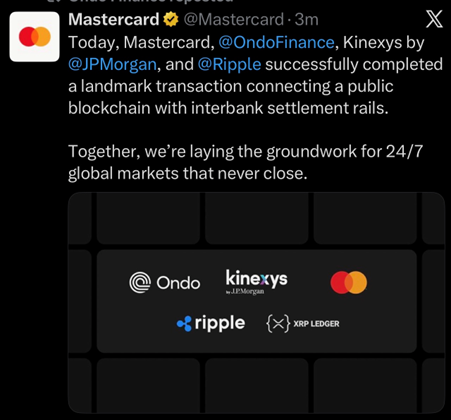
On May 6, Ondo Finance (ONDO, “C-”) — the leading crypto-native player in the tokenization race — teamed up with JPMorgan’s (JPM) blockchain unit Kinexys, Mastercard (MA) and Ripple (XRP, “C+”).
The goal? To complete the first near real-time, cross-border, cross-bank redemption of a tokenized U.S. Treasury fund.
And they succeeded.
What Actually Happened
Moving digital assets quickly has never been difficult. Public blockchains solved that years ago.
The real bottleneck has always been the fiat bridge.
As soon as digital assets need to touch traditional banking rails, the speed advantage usually disappears.
Banking cut-off times, manual compliance checks, correspondent routing and settlement delays take their toll and stretch the time needed to reach a settlement.
This pilot did away with all that.
It started when Ripple redeemed part of its position in OUSG, Ondo Finance’s tokenized short-term U.S. Treasury fund.
That is to say, it traded in the digital OUSG tokens for the cash value.
The redemption was processed on the XRP Ledger, where the tokenized asset leg settled almost instantly.
From there, Mastercard’s Multi-Token Network routed the payout instruction to Kinexys by JPMorgan, the bank’s institutional blockchain infrastructure platform.
Kinexys then withdrew funds from Ondo’s blockchain deposit account at JPMorgan and delivered the equivalent in U.S. dollars to Ripple’s Singapore bank account through JPMorgan’s correspondent banking network.
In simple terms, a transaction was initiated on the blockchain. Once verified and settled there, it instantly triggered a response in the real-world financial system.
What started as a click on a crypto platform resolved with dollars in a real bank account on another continent.
Traditionally, a move like this would take one to three business days as credit card companies and banks consolidate information and approvals across countries and time zones.
This settled in roughly five seconds.
And it was done outside of traditional banking hours.
That speed and access is the story.
Giving it real credibility is the fact that the names involved are not crypto-native startups chasing attention. They are some of the largest institutions already responsible for moving capital around the global financial system.
That is what makes this worth paying attention to.
Why These Names Matter
Kinexys is not a side experiment inside JPMorgan.
It is the bank’s dedicated blockchain infrastructure platform, already responsible for processing trillions of dollars in institutional transactions. And it was a notable presence at Consensus Miami 2026.
JPMorgan has been methodically building the infrastructure required for tokenized finance for years.
Mastercard’s role is equally significant.
Its Multi-Token Network was specifically designed to connect regulated financial institutions with tokenized digital asset infrastructure.
These aren’t experiments or large companies dipping their toes into what’s popular.
These financial titans are building interoperability between traditional finance and programmable asset rails.
One thing every investor should keep in mind …
Big firms do not invest significant capital like this unless very smart people point to data that suggests even bigger returns are on the other side.
The Bigger Picture
Tokenized U.S. Treasurys have emerged as one of the clearest product-market fits in digital assets.
The sector now managing more than $15 billion in tokenized Treasury exposure, according to RWA.xyz.
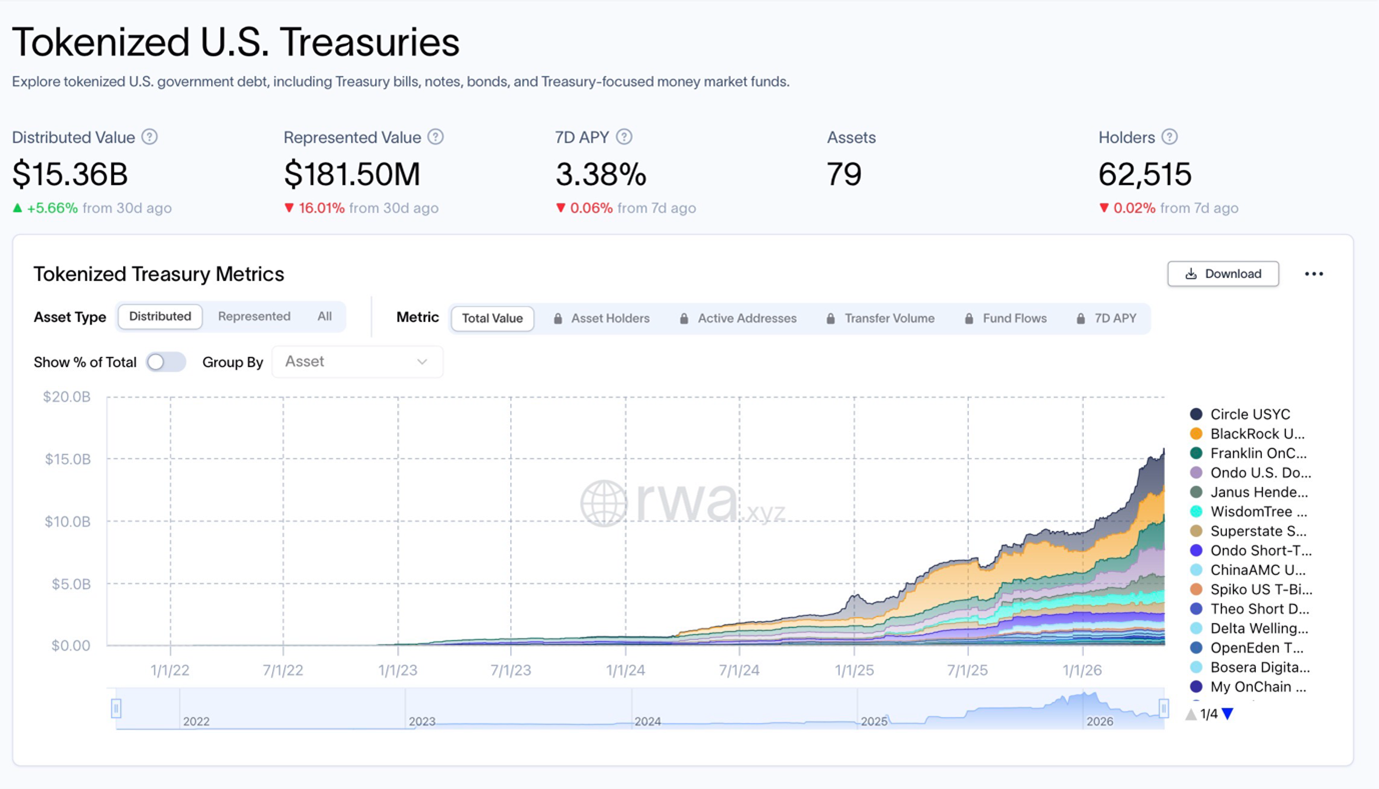
That makes it one of the most successful institutional crypto use cases outside of stablecoins.
And that should not be surprising. Because these are not speculative tokens or experimental DeFi products.
They are blockchain-based wrappers around one of the safest and most liquid collateral assets in global finance: short-term U.S. government debt.
That alone is compelling. When you add this recent pilot transaction, the logical conclusion is straightforward …
Treasurys are the collateral backbone of global finance.
They underpin repo markets, liquidity management, treasury operations, collateral frameworks and cross-border capital movement.
If those assets can move 24/7, across borders, with near-instant connectivity into regulated banking rails, the implications are enormous.
It wouldn’t be unreasonable to suspect then that tokenized Treasurys could become the preferred collateral layer for
- Fintech treasury operations,
- Hedge fund liquidity management,
- Corporate cash parking
- And global payment infrastructure.
Friday afternoon redemptions stop turning into Monday morning liquidity problems.
Idle capital becomes programmable.
Settlement risk compresses.
Cross-border treasury management becomes dramatically more efficient.
And the institutional world has clearly noticed.
The DTCC — which sits at the centre of U.S. securities settlement infrastructure — has already announced plans to launch its own tokenization settlement infrastructure in 2026.
When infrastructure providers of that scale start moving, the destination becomes obvious.
Your On-Chain Opportunity
Ondo’s position makes this even more interesting.
The protocol has quietly built one of the strongest strategic footholds in the tokenized Treasury market.
Its OUSG fund is among the leading institutional Treasury products in the space. It’s anchored by exposure to BlackRock’s BUIDL fund, which has emerged as the dominant institutional tokenized Treasury vehicle.
That gives Ondo something many crypto-native projects still lack: Institutional credibility.
More importantly, it gives Ondo direct exposure to one of the most commercially viable segments of the tokenization trend.
If that comes to pass, Ondo will already be sitting in one of the most strategically valuable positions in that ecosystem.
Final Take
Institutional crypto adoption is no longer about speculative token launches or headlines designed to excite retail traders.
It is about infrastructure.
It is about rebuilding the settlement architecture of global capital markets.
And that sort of building tends to create winners long before the wider market fully understands what is happening.
This pilot may not have moved every component fully on-chain.
But if your understanding of what took place ends there, you’re missing the bigger signal.
JPMorgan, Mastercard, Ripple and Ondo just demonstrated that public blockchain infrastructure can connect to real-world banking rails in near real time, across borders, outside traditional banking hours.
That is not theory.
That is operational proof.
Institutions are no longer debating whether blockchain-based settlement belongs in global finance. Now, they are actively building it.
The more important investor question now is simple:
Which protocols capture the flow when trillions of dollars eventually move onto these rails?
Because that’s where growth investors will find opportunity in the coming cycle.
Best,
Mark Gough