AI Is Trading Your Money. Here’s Who Gets Paid

 |
| By Juan Villaverde |
If you’ve ever used a managed brokerage account or let a financial adviser trade your account, you likely signed a form.
It had a dull name: a limited power of attorney. That’s what allows another person to legally buy and sell assets for you.
But critically, that person needed a license. And they had regulations that kept them in check. So, their access to your investments had clear, enforceable restrictions.
Now a piece of software can get much of that same power.
It takes a few minutes to set up. And the only one watching it is you.
But there is a second side to this story. Every trade a machine makes earns a fee for someone. And the firms that opened the door first are already seeing the traffic.
AI agents can now place real trades with real money. That will make some brokers richer and leave others behind.
So, let’s look at who sits in which camp. And how to protect yourself.
What an AI Agent Actually Is
An AI agent is a program that acts for you.
It’s not like the large language models most of us are familiar with. Chatbots like those just answer questions.
An agent does the work.
You tell it what you want in plain English. Then, it looks up prices, makes a plan and puts in the order.
Think of it as an assistant with the keys to your account.
But unlike a broker, it has no license and no boss keeping it in check.
Robinhood Opened the Door First
On May 27, Robinhood (HOOD) let these programs in. Customers could open a separate account, fund it, and link the AI agent of their choice.
By late July, nearly 100,000 customers had opened such an account, with over $100 million inside. By late September, the count passed 150,000.
Agents now tap Robinhood's tools almost 30 million times a day.
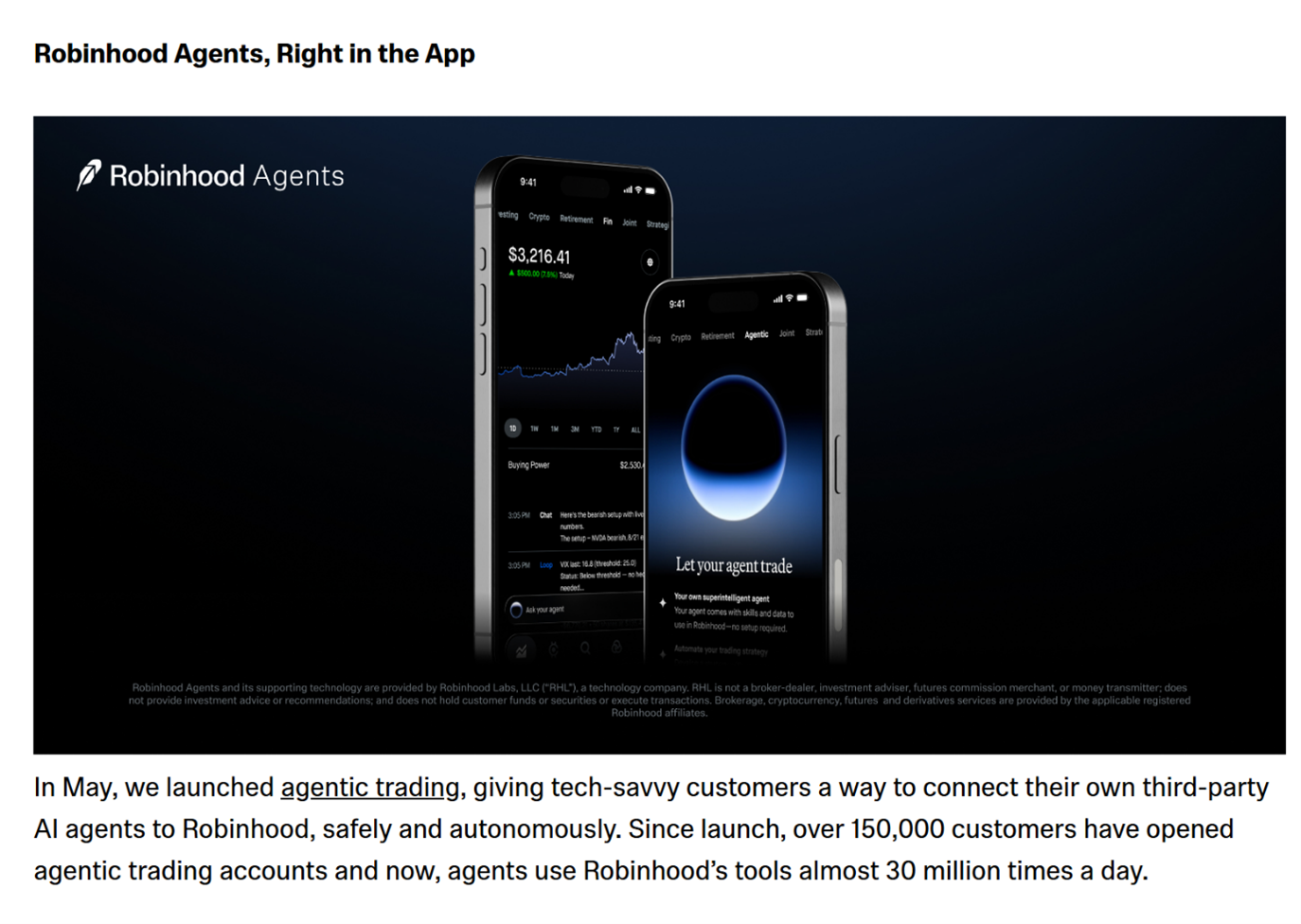
That is still small. The money in those accounts is a rounding error next to the $369 billion the firm holds.
But the firm plans to open agents to all 28.6 million of its funded customers.
Why More Robot Trades Mean More Revenue
Here's the important bit: A broker like Robinhood earns most of its money when customers trade.
In the second quarter, Robinhood took in $1.31 billion. Of that, $776 million came from trades, up 44% from a year ago.
Now picture a program that never sleeps. It can trade at 2 a.m. It does not get bored or scared.
If agents trade more often than people do, the firms paid per trade collect more.
That is the bet. And it points to a few names in particular.
The Firms That Could Win
The way to play this from the crypto side is to invest in the blockchains that facilitate the trading from these agents.
But be careful when making your choice. Not every coin directly benefits from its network’s growth. You’ll want to make sure that the token’s value is actually tied to the network’s performance.
On the TradFi side, here are four firms that stand to benefit from this trend.
Robinhood (HOOD). It moved first and has the most users wired in. Options, stocks and its new event contracts all grew fast last quarter.
The risk: Crypto revenue fell 38% in the same quarter. And if agents rack up losses, the blame could land on the firm that let them in, fairly or not.
Coinbase (COIN). In June, the centralized crypto exchange let ChatGPT and Claude trade crypto inside a walled-off part of a customer's account, with caps on what the agent can spend.
It has since added U.S. stocks. And it’s building the payment rails agents use to pay each other.
The risk is the core business. Revenue from trades fell 22% in the second quarter, to $599 million. Coinbase still rises — and falls — with crypto prices.
Interactive Brokers (IBKR). Its accounts grew 35% in a year, to 5.6 million by September. In July, it opened its accounts to nearly any AI tool.
But there is a twist: Its agent only drafts the trade. The client must review it and send it on their own.
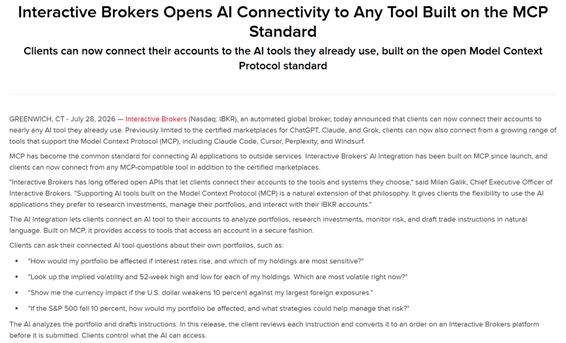
That makes IBKR the careful one of the group.
It could win the trust of cautious clients. Or it could lose speed to rivals that let agents act alone.
Webull (BULL). This is the smallest name on our list, with only 5.1 million funded accounts. Its revenue from trading jumped 66% last quarter, to $148 million. And now, Webull allows AI models to place trades.
The thesis here is that small firms can grow fast.
But they can also stumble fast. On Oct. 7, a House committee said Webull's ties to China pose a security risk.
Webull disputes the report. That didn’t stop its stock from falling 19% that day.
Slower to Open the Door
Charles Schwab (SCHW) holds $13.4 trillion in client assets across 40.1 million active accounts.
On Sept. 30 it unveiled Charley, an AI helper that rolls out this month. It can add a beneficiary, update a watchlist or set an alert. It does not trade on its own.
Schwab's own survey shows why: For bigger moves, its clients still want "a person" to do it.
Fidelity is private, so you can't buy its stock. It has no public way for an outside program to plug in at all.
Neither one is hurting. Schwab opened 424,000 new accounts in August, up 11%. Fidelity's daily trades rose 31% in a year.
The risk for them is the next wave of active traders. If those traders want agents, they may open accounts elsewhere.
Read the Terms Before the Pitch
Wherever agents go, the fine print travels with them.
Robinhood's is the clearest example …
"You assume all risk for trades executed by AI agents," its help page says. And the firm "does not control, supervise, monitor, recommend, or audit agents."
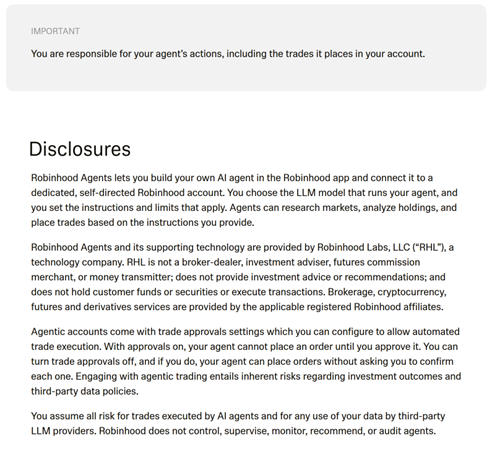
For an outside agent — like one from ChatGPT — the switch that makes you OK each trade is off by default. That agent can trade only in its own account. But it can read all your accounts at the firm, with balances and past orders.
The Fake Version Got There First
Long before any broker offered this, crooks were selling "AI trading bots."
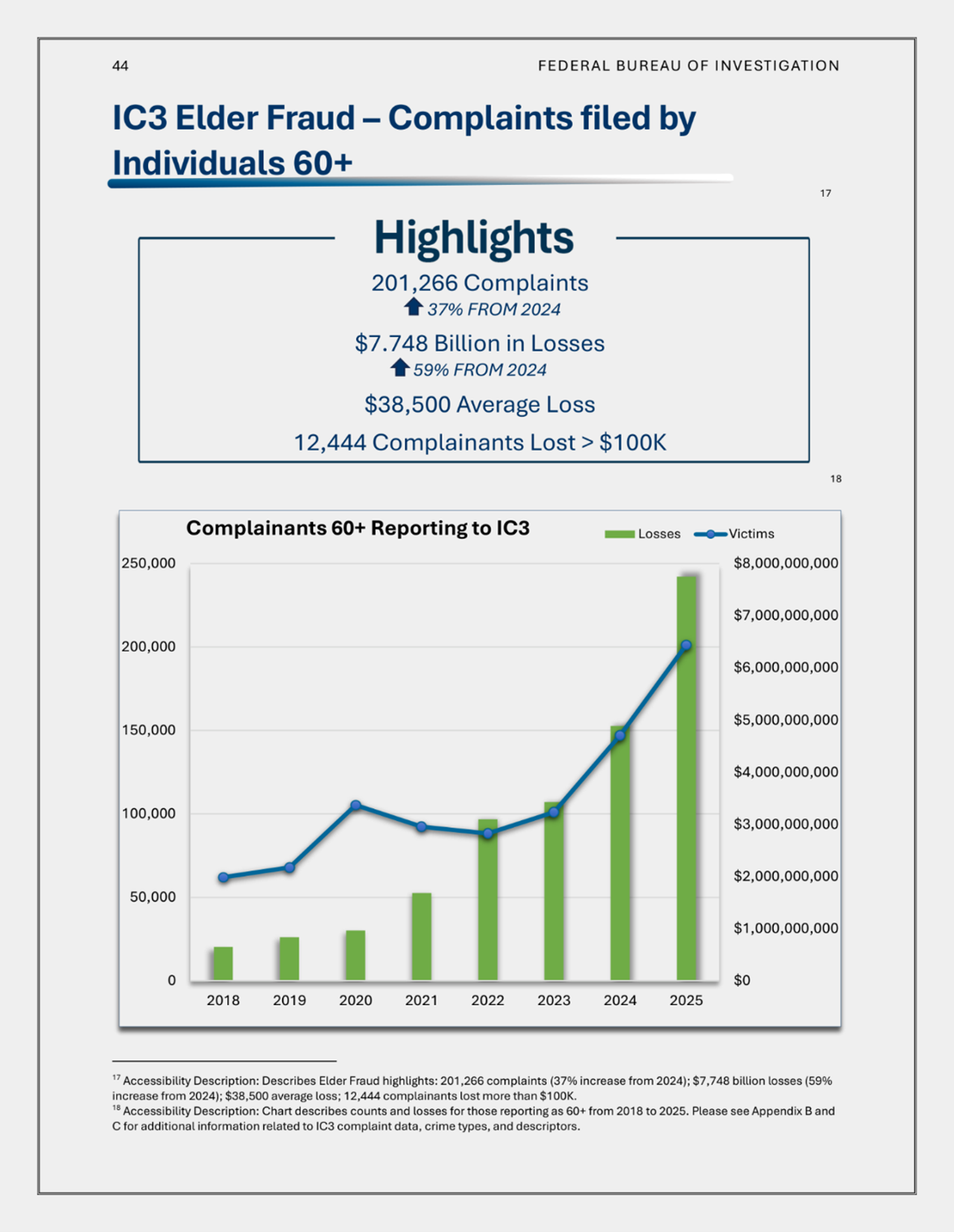
In 2025, Americans age 60 and up reported $7.7 billion in losses to internet crime, up 59% in a year, the FBI says. Over $4.3 billion of it involved crypto.
And scams that used AI in an investment pitch cost victims over $632 million.
The CFTC, which polices futures markets, puts it bluntly: "AI technology can't predict the future."
A real agent lives inside a brokerage account you opened in your own name. It never promises a return.
A fake one asks you to send money to a new app, shows big gains, then wants a "fee" before you can withdraw.
Before You Hand Over the Keys
You don't need to hand an agent your account to profit from this shift. You can own shares of the firms that sell the keys, right inside your Schwab or Fidelity account.
Watch two numbers each quarter: revenue from trades, and how many customers link an agent. If those don't grow, the story isn't playing out.
If you do try an agent one day, go back to that old form. It answered four questions. Answer them again.
How much can it touch? Use a separate account with only what you could stand to lose.
Does it ask before it acts? Turn trade approvals on and leave them on.
Can it take money out? The answer should be no. Get that in writing.
How do you stop it? Find the off switch before you need it.
And one rule covers the fakes: No real AI tool will ever ask you to send it money.
If one does, you are not talking to an agent. You are talking to a thief.
Best,
Juan Villaverde