 |
| By Marija Matic |
Something unprecedented is happening in the economy: Autonomous AI bots called agents are spending money on behalf of their users.
Without waiting for human approval at each step.
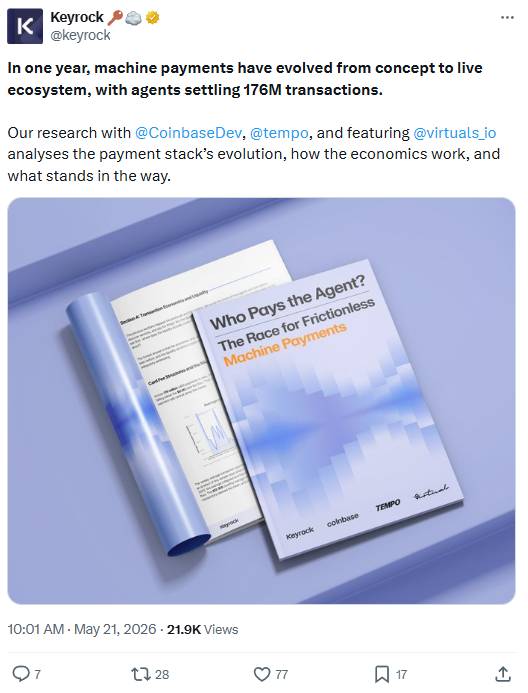
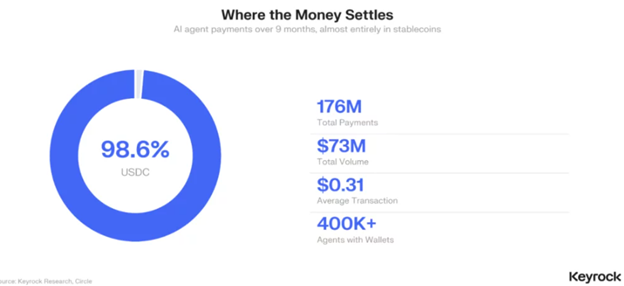
Over the past year, AI agents settled over $73 million across 176 million transactions on blockchain rails. The average transaction size was just 31 cents.
But those are early day numbers.
Gartner projects AI agents could intermediate $15 trillion in purchases by 2028. McKinsey sees retail agentic commerce reaching $3–$5 trillion by 2030.
For context, the entire U.S. dollar cash economy sits at roughly $10 trillion today.
The smart money is already starting to prepare.
Amazon (AMZN), Coinbase (COIN), Stripe, Google (GOOGL), Visa (V) — all are building competing rails for a future where machines are primary economic actors on the internet.
The infrastructure race is already underway. And crypto is at the center of it.
What an AI Agent Actually Does
An AI agent is software that can plan, decide, and act — even by spending money — without a human approving every step.
Think of it like the difference between using ChatGPT to help plan your next vacation … and ChatGPT being able to actually book your tickets, too.
You can simply tell an agent: "Book me the cheapest business class flight to Tokyo departing Friday, use my points if it saves more than $200, and notify me only when it's done."
The agent scouts options, validates availability, compares prices and executes.
No human in the loop for each micro-decision.
By Q1 2026, over 104,000 unique AI agents were registered across directories worldwide, buying API access, data feeds, cloud compute, and services automatically, around the clock.
Here’s a quick list of possible agentic AI use cases, broken down into three notable categories. Some of these can be deployed today, but others are still waiting for the proper infrastructure …
1. Agent-to-Agent Commerce
- A travel-booking agent purchases a flight from an airline's fulfillment agent.
- A data-sourcing agent pays a research agent for a real-time market feed.
- A DeFi portfolio agent executes a hedge trade with a counterpart liquidity agent.
- A content agent licenses an image from a stock photography agent.
- An IoT device agent pays another device agent for compute or bandwidth.
2. Agent-to-Website / Agent-to-Service Commerce
- Your personal AI assistant orders weekly groceries from a retailer's website.
- A legal research agent pays per-article for access to a law journal's paywalled database.
- A marketing agent purchases ad credits on a digital advertising platform.
- A home automation agent renews a smart home subscription service.
3. Agent-to-Human Commerce
- An AI concierge sells personalized travel packages directly to customers
- A DeFi protocol's agent offers yield products to retail users
- An AI tutoring agent charges students per lesson completed
- An insurance protocol agent issues and prices policies autonomously
This category is the most regulatory-sensitive. Humans expect consumer protections, refund rights and familiar interfaces.
Stablecoins-on-fiat rails — like Visa's Trusted Agent Protocol — will co-exist with crypto-native solutions here longest.
Why the Blockchain Fits
Several specific properties make blockchain infrastructure valuable for agentic commerce.
Micropayments at machine scale. At just 31 cents on average, AI agent transactions are cost prohibitive with current payment rails. Visa, for example, charges merchants roughly 1.5%–3% per transaction, plus a fixed fee of 10–30 cents.
With those fees, any transaction under $10 doesn’t make financial sense.
But blockchain rails on Layer-2 networks like Base or Solana (SOL, “B-”) can process these transactions for fractions of a penny.
No account or contract required. Traditional payment systems require know-your-customer protocols, billing accounts and pre-negotiated relationships.
But an agent doesn’t have time for that.
That’s where blockchain tech comes in. Specifically, how it has mastered trustless transactions.
When an agent hits a paid endpoint, the server responds with machine-readable payment requirements. The agent then pays in USDC and retries with a payment receipt.
Instant, automated payments, no prior relationship needed.
Programmable dispute resolution. When two AI agents transact and something goes wrong, there is no customer service desk.
Disputes must be resolved programmatically.
Fortunately, smart contracts have been running on the blockchain for years. These are if/then algorithms that provide pre-agreed, deterministic rules.
If the catalyst is triggered, then the transaction is initiated.
Settlement finality and global reach. Cross-border settlements via traditional banking can take days and involve multiple intermediaries, each taking a fee.
(The infrastructure build-out for this is still in its early days, but making promising advances.)
Stablecoin transactions on the blockchain settle in seconds and work across geographies without a correspondent banking network.
Chain-agnosticism. In the near future, AI agents will be smart enough to choose how to enact your prompts. That is, they can choose the best chain for your request.
In short, the underlying blockchain becomes invisible infrastructure. Agents optimize for yield, speed, and cost, selecting the best available chain automatically.
What to Watch
This new sector is building steadily. But so far, only the rough scaffolding is up.
Here are the next developments interested investors should watch …
First will be any regulation updates. While the current regulatory landscape hasn’t focused on AI agents just yet, the groundwork is being laid.
MiCA in the EU and The GENIUS and CLARITY Acts in the U.S. all focus on stablecoin frameworks. Since 96% of agentic AI payments settle in USDC, those regulations will determine what AI can legally do and where identity requirements fall.
That brings me to the next development, the identity layer.
When machines can run our finances, the question then becomes who is ultimately responsible when an AI agent spends money?
Projects or frameworks that address this are ones to watch.
Because that will inform how agents will be able to access your funds. Will they have access to your bank account as it is, or will you need a dedicated fund just for AI transactions?
Likely, this gap between crypto-native agent commerce and the traditional ecosystem will be bridged by hybrid infrastructure.
Regulated entities issuing payment credentials to AI agents, effectively giving machines their own financial accounts, is another a near-term development worth tracking.
The Bottom Line
Blockchain is being adopted by the AI industry simply because the existing financial infrastructure cannot handle AI’s demands.
That includes billions of autonomous micro-transactions, programmable dispute resolution and the ability to operate without prior relationships and human-staffed approval processes.
All are areas in which crypto has more solid footing.
Trustless settlement, programmable dispute resolution, micropayment economics, and 24/7 operation without human oversight are cornerstones of crypto tech.
And all are architectural requirements for a world where autonomous software agents transact at scale.
At Consensus Miami 2026, the EasyA Hackathon drew nearly 1,000 developers building agentic applications for over $500k in prizes.
The judges rewarded projects that pushed AI agents beyond chatbots and into real-world coordination, automation and commerce.
In short, the AI agent economy is coming.
For users, it means a new, and hopefully, easier way to control and streamline your financial needs.
For investors, these early stages are speculative. But the first round of winners will likely be those already building and testing ways to connect blockchain tech and TradFi institutions.
Best,
Marija Matić
P.S. An early-stage crypto sector is very speculative. Investors must have a high risk tolerance to target them. But the potential pay off can be worth the risk for savvy investors.
You should know, though, that crypto isn’t the only market with ground-floor access. Private equity, once a playground exclusive to the ultra-wealthy, is open to retail investors.
And so are the potential returns “Alpha Round” investors in pre-IPO companies have seen. We’re talking gains high enough to turn a $1,000 investment into more than $64 million.
Chris Graebe, our private equity specialist, has seen four successful exits from such Alpha Round investments in the past six months. Now, there’s a new startup that’s caught his eye.
It’s a space play with real long-term potential. And, it’s poised to benefit from SpaceX’s own highly anticipated IPO.
To learn more about this startup and how you can be an Alpha Round investor, I encourage you to watch Chris’ urgent briefing here.