AI May Need Crypto. And Wall Street Knows It
|
Key Takeaways
|
 |
| By Juan Villaverde Reviewed by: Beth Canova |
Just over a decade ago, the concept of decentralized finance was Wall Street’s boogeyman.
Back then, crypto was whispered conversation — the topic du jour of the financial outcasts, not respected analysts. And just trying to buy even the popular Bitcoin (BTC, “B+”) token took a ton of technical knowledge very few had access to.
But something changed in the past few years.
Today, crypto is discussed not just openly, but excitedly, on exchange floors and in the halls of Congress.
Banks and institutions with decades — centuries, in some cases! — of experience managing assets and funds now include crypto in their balance sheets and products.
And even some retirees have exposure to what once was considered the Wild West of Finance … through regulated ETFs bought through the brokerage account they’ve had for years.
It’s safe to say that, somewhere along the way, crypto stopped being the thing that scared your financial adviser.
And became critical infrastructure to bring TradFi assets into the 21st century.
Today, the tech innovation that keeps Americans up at night is AI.
And in a twist few saw coming, AI may need crypto to work.
AI: The New Tech Boogeyman
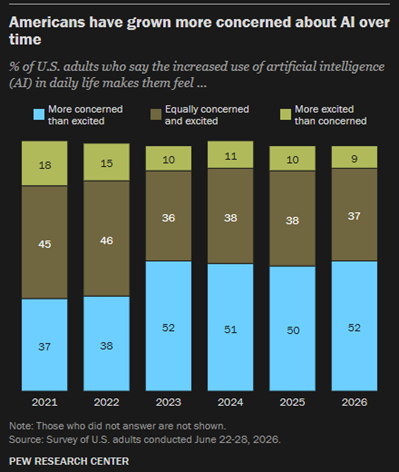
In a Pew Research survey from late June 2026, 52% of U.S. adults said they are more worried than excited about AI in daily life. Only 9% said the opposite.
Back in 2021, the worried group was 37%.
The fears are real and close to home. People worry about their jobs. And about their electric bills, as the huge data centers that run AI eat electricity like candy.
In some states, that alone has turned into a campaign issue, with voters blaming rising bills on the AI boom.
Crypto, by contrast, barely comes up.
How Crypto Got Boring
That is not because crypto went away. It is because it grew up.
Three changes did most of the work.
First, Wall Street moved in.
In 2024, the SEC let firms sell BTC funds that trade like any stock. BlackRock (BLK, “B”) now runs the biggest one, the iShares Bitcoin Trust (IBIT, Not Yet Rated).
It held about $66 billion at last count. You can buy it in a Schwab or Fidelity account in a few clicks.
Second, Congress wrote clearer rules.
In July 2025, the GENIUS Act became the first major federal crypto law. It covers stablecoins, which are digital dollars. Each coin is meant to be worth exactly $1, backed by cash and short-term Treasury bills.
The law makes issuers hold those reserves and report them every month.
Third, the digital dollar caught on.
There are now about $296 billion of stablecoins out there, by DefiLlama's count. And the market has quickly become crypto’s biggest business. Thanks in large part to how stablecoins can benefit TradFi institutions.
The second largest stablecoin, USDC, is even issued by a public company, Circle (CRCL, “D+”).
Related story: Wall Street Took Over Crypto, But It Couldn’t Stop Bitcoin’s 4-Year Cycle
Rules, audits, and the same brand names that run your retirement account made crypto mature quick.
That may feel boring to those of us who remember crypto’s early days.
But it’s also the part that makes it indispensable for what comes next…
Why AI Needs Crypto
Here is a problem most people have never thought about.
The next wave of AI is not chatbots. It is AI agents.
Think of an agent as a digital assistant that does tasks for you on its own. It can book a trip, research a stock or write code.
To do that work, it needs to be able to buy things on its own.
Sure, that includes any large purchases you might authorize. But it also has to pay for all the small fees needed to make that large purchase, like …
- A bit of computing power.
- A page of live data.
- A quick check from a smarter AI model.
AI agents buy these things in tiny amounts, often for a few cents at a time.
That is where credit cards break down.
A typical card payment costs a business a percent of the sale plus a flat fee. Stripe — the online payment processor — has a standard U.S. rate of 2.9% plus 30 cents, for example.
On a $50 dinner, that is fine. On a 5-cent purchase, the fee is six times the price.
Stablecoin payments on blockchain rails balance out this equation. With them, there is, essentially, no flat fee. And they can move in seconds, at any hour of the day.
As Eric Jardine of Chainalysis put it to Fortune, it is "this perfect combination of speed plus low cost to settle," the kind of thing "you would need if you were doing true AI-to-AI commerce."
Related Story: Wall Street Sees Crypto as the Building Blocks of the AI Economy
And the shift is already happening.
Coinbase (COIN, “D+”) is the largest centralized crypto exchange in the U.S. And it recently built a tool called x402 which lets AI agents pay for things with stablecoins.
Blockchain research firm Chainalysis counted more than 138 million of these payments on Base, the network Coinbase runs. That is up from about 1,500 in mid-2025.

Here’s the piece that matters: More than 87% of those transactions were for less than 10 cents.
What did the agents buy? Computing power, live web data, code security scans and help from more capable AI models.
In other words, the stuff that makes AI run.
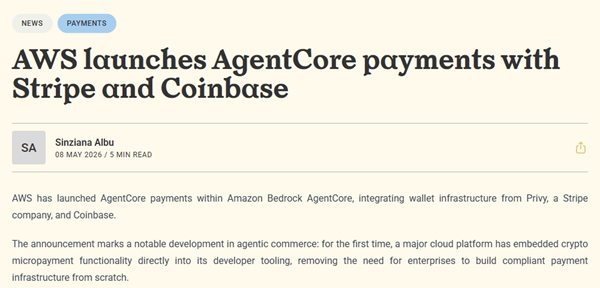
Big tech is building for this too. In May, Amazon (AMZN, “B”) began to test a payment tool for AI agents on its cloud service. It runs on rails from Coinbase and Stripe.
So the tech people fear most … may end up leaning on the tech they’ve finally started to accept only recently in the mainstream.
Your Next Step
If you want to know whether "crypto as AI's payment rail" is real or just talk, there are three things anyone can check.
- Stablecoin supply. DefiLlama posts it for free. If AI agents are paying in digital dollars, that number should keep climbing.
- What Coinbase says about x402. Its quarterly reports and calls are public. Look for real dollar amounts, not just counts.
- Who joins. Amazon, Stripe and Coinbase are in. Watch to see which, if any, other big names — like a major bank or card network — decide to build on these rails as well.
If all three continue to move the right way, crypto won't just be less scary. It will be part of the machinery your money already runs on.
Naturally, the pure crypto way to play this is to buy the token of the networks operating the rails.
But if you want exposure to cryptos future without owning a single crypto, you can. Because a handful of stocks sit close to the money.
Coinbase runs x402 and the Base network. Circle issues USDC, the digital dollar most of these agent payments use.
Both are public. Neither is a sure thing, and both swing with the crypto market.
But they are names to study first.
Best,
Juan Villaverde
P.S. On Tuesday, I told Weiss readers why I believe the best crypto buying opportunity is just ahead …
Why now is the time to prepare …
How my Crypto Timing Model routinely beats a simple buy-and-hold strategy on Bitcoin …
And how it can help you make the most out of the coming bull run.
If you missed my presentation yesterday, I urge you to watch it now.
It won’t be online long.