 |
| By Jurica Dujmovic |
Most coverage of the AI infrastructure buildout follows the money toward the winners: the chipmakers, data-center operators, power utilities and sovereign wealth funds writing nine-figure checks for compute access.
What gets almost no attention is who is getting squeezed out by the same buildout.
And one of those should definitely catch consumer attention.
Corporate filings, analyst forecasts and direct industry testimony now show that the consumer PC market and everyone in its supply chain is at risk.
Think about how much you rely on your home PC or laptop for work and personal use. And if you’re a parent, you know how vital this tech now is when it comes to K-12 education.
And very soon, prices for these everyday devices will reflect the squeeze.
The Market Threat to Your Laptop
At its core, this is a simple supply and demand problem.
And AI is the catalyst.
The clearest corporate signal came in December 2025. That’s when Micron Technology announced it would shutter its Crucial consumer brand after 29 years.
The company's EVP and chief business officer, Sumit Sadana, stated: "The AI-driven growth in the data center has led to a surge in demand for memory and storage.”
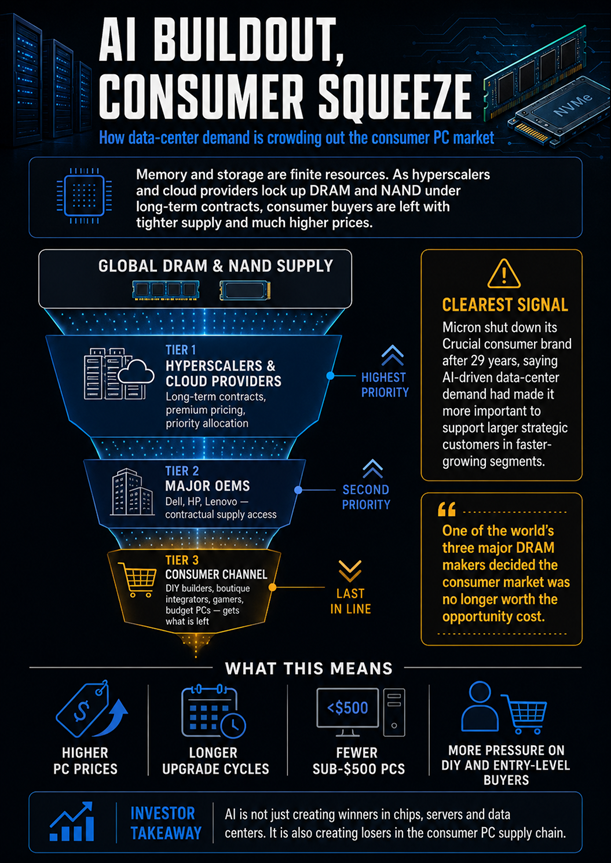
She went out to outright state that the company — a leading Dynamic Random Access Memory (DRAM) manufacturer — chose to cut its consumer line to focus on “strategic” customers.
In short, building memory for your personal needs is just not good enough business for Micron.
That decision will make more sense once you understand where the money is going.
Memory and storage are finite resources. Hyperscalers and cloud providers are locking up capacity at scale — under long-term contracts and at premium prices.
In Nvidia's (NVDA) fiscal year 2021, for example, its gaming and data center divisions brought in roughly $9.8 billion and $6.8 billion in revenue, respectively. By fiscal year 2026, gaming had grown to $22 billion while data center had surged past $193 billion.
In five years, data center revenue went from lagging gaming to exceeding it by more than 8x.
Advanced Micro Devices (AMD) tells a parallel story: In Q1 2026 it generated $5.8 billion from data center versus $720 million from gaming, with data center up 57% year over year.
It makes sense then that memory manufacturers are redirecting production toward higher-margin enterprise components.
Meaning the consumer channel — the one that directly impacts your needs today — receives whatever is left over.
And it’s paying magnitudes more for the privilege.
The Supply/Demand Squeeze
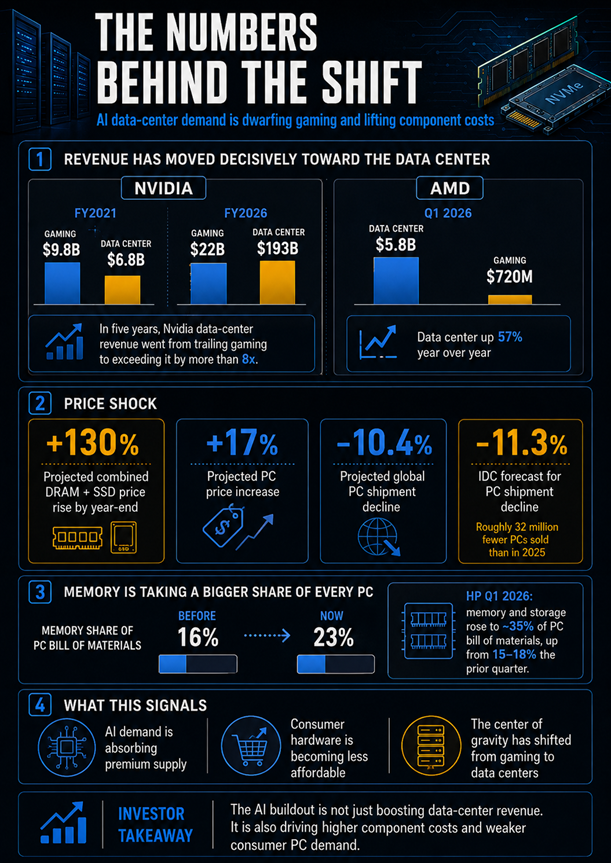
In a February 2026 report, Gartner projected …
- a 130% rise in combined DRAM and SSD prices by year-end, and
- a 17% increase in PC prices, and a 10.4% decline in global PC shipments.
Here’s why this matters …
As a consumer, you won’t be able to find a new computer for less than $500 after 2028, based on Gartner’s analysis.
Why? Because the components are now more expensive.
In 2025, memory accounted for roughly 15%-18% of the cost for an HP computer. Today, that cost has risen 100% to represent 35% of an HP device’s bill of materials.
Manufacturers simply can’t justify lower prices when the components are getting more expensive.
And it’s not just PC makers feeling the pressure. This squeeze travels all the way down the supply chain into products that contain no memory at all.
Companies that produce accessories live entirely on whether consumers are building or upgrading PCs. And at higher prices, that becomes less likely.
The Key Takeaway for Investors
The investor framing that is not getting sufficient attention is this: AI may be creating a structurally bifurcated computing market.
And the dividing line is access to supply.
Enterprise customers secure priority allocation, multi-year pricing visibility and contractual guarantees.
Consumers, DIY builders, boutique system integrators and lower-end device makers absorb whatever is left at spot prices that can move week to week.
As Gartner analyst Ranjit Atwal put it, "higher prices will narrow the range of devices available” to retail consumers. This will prompt buyers to hold on to devices for longer, and fundamentally alter upgrade cycles.
If you have exposure to the consumer PC supply chain, there’s one main question you need to ask …
Does the company I’m exposed to have the inventory positioning, supply agreements and balance sheet to outlast this downturn?
Experts are torn as to how tight this squeeze can get.
Investors positioned in data center infrastructure, memory manufacturers and hyperscalers are on the right side of it.
But if you only have exposure to consumer PC hardware companies — particularly those without direct exposure to the enterprise memory or server markets — you may want to reconsider your strategy.
Best,
Jurica Dujmovic