 |
| By Beth Canova |
The most important crypto announcement of May did not come from a crypto company.
It came from Amazon (AMZN).
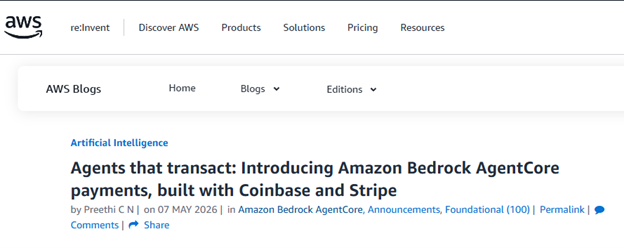
On May 7, Amazon Web Services launched a product letting autonomous AI agents pay for services in real time.
The headlines called it a stablecoin integration.
That misses the bigger story …
Amazon, Visa (V), Mastercard (MA) and Alphabet (GOOGL) have now picked the same financial rail for the AI economy.
And the crypto asset that wins isn't the one most retail investors bet on.
What AWS Actually Built
The product is Amazon Bedrock AgentCore Payments, built with Coinbase and Stripe.
When an AI agent inside an AWS application needs to pay for something — whether that's an API call, a data feed or an end purchase — the money moves in USD Coin (USDC, Stablecoin), Circle's regulated dollar-backed token.
Stablecoins, for readers new to them, are digital tokens pegged 1-to-1 to a fiat currency. Think of them as digital dollars you can use on a blockchain.
Why a hyperscaler decided to bake this in is straightforward: When a software agent triggers hundreds of micro-transactions at fractions of a cent, credit cards stop working.
The per-swipe fee is too expensive, and the two-day settlement window is too slow. And all those extra steps need active human intervention … undermining the entire premise of autonomous AI agents.
But agentic transactions begin to make much more sense when paid for in stablecoins on crypto rails. Settlement clears in roughly 200 milliseconds on Coinbase's low-cost Base network and on Solana (SOL, “B-”). Both of which can process transactions for a fraction of a cent.
Visa Already Did the Math
Amazon is not the first.
Visa has been quietly piloting stablecoin settlement for over a year. By the close of Q1 2026, that pilot was running at $7 billion in annualized volume, up 50% from the previous quarter, across nine blockchains.
Mastercard is not far behind. Its Agent Pay framework plugs into the Multi-Token Network it already uses for tokenized bank deposits. Google launched its Agent Payments Protocol last September with more than 60 partners, including PayPal (PYPL), American Express (AXP) and Coinbase (COIN).
These are not pilots from startup conferences. They are the standard-setters of global payments.
And they’re all choosing on-chain rails for their futures.
The Trade That Looked Right but Wasn't
This is where most retail crypto investors took the wrong turn.
Through 2025, "AI crypto" was the trade everyone wanted in. Bittensor (TAO, “E-”) was the headline name. Virtuals Protocol (VIRTUAL, “D+”) drew waves of capital.
The pitch was clean: AI agents will use crypto, so own the AI tokens.
The trade has not aged well. Bittensor is down 64% from its all-time high. Virtuals Protocol is down 86%.
The combined market cap of the entire "AI agents" sector is roughly $3.6 billion today.
Compare that to USDC alone: $76.5 billion. Twenty times larger than the entire AI-token sector combined.
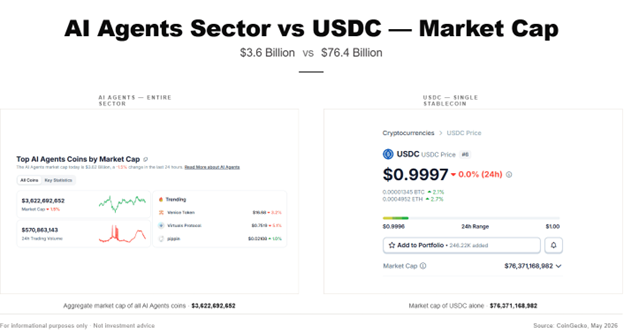
AWS, Visa, Google and Mastercard didn't pick an AI token to settle in. They all picked stablecoins.
AI tokens compete on a story. The dollar on-chain wins on utility.
Stablecoin transaction volume in 2025 reached $33 trillion, larger than Visa's annual throughput.
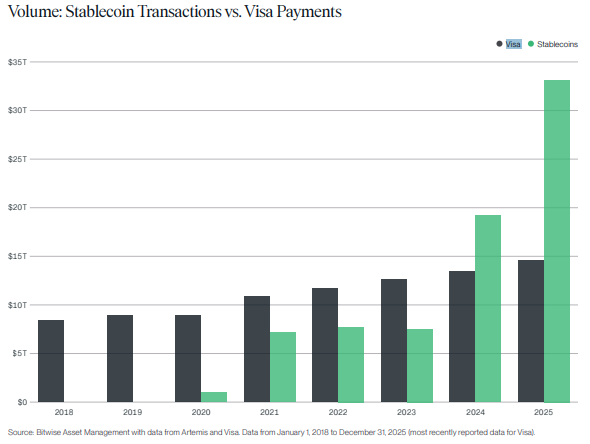
Savvy investors can see where this leads: Opportunity sits with the companies and cryptos that are building out the infrastructure to make AI-initiated stablecoin payments possible in your everyday life.
Why This Got Real in 2026
Corporate treasury teams wanted to use stablecoins for years. Legal ambiguity kept them out.
That changed on July 18, 2025, when the GENIUS Act became U.S. law. It’s the first federal framework for payment stablecoins, requiring full reserve backing, federal licensing and standard anti-money-laundering compliance.
In plain terms, it gave stablecoins the same regulatory shape that money-market funds have had for decades. It is also why Bedrock AgentCore Payments could launch within a year of the bill becoming law.
The Bottom Line
For an investor who lived through the shift from paper checks to ACH, and from ACH to Visa, this story should feel familiar.
Every time a new class of payer arrives, it builds its own rails when the old ones cannot carry the load.
The difference this time is that the new payer is not human, but programmable software. And the rail chosen for it is not Visa, nor any avenue provided by TradFi.
It has chosen stablecoins.
The AI token sector — already down 80% through the crypto winter — may be the arena of speculative traders looking for their moonshot.
But for more conservative investors looking to play this massive shift, the savvier approach is to figure out which infrastructure layer is actually catching the flow.
Trillions of dollars are coming onto these rails. The question is which protocols capture them.
Best,
Beth Canova
P.S. Stablecoin payment rails aren’t the only infrastructure play that should be on your radar. As SpaceX’s IPO proves, the next frontier is beyond our atmosphere. And there’s a lot parties interested in exposure.
But our startup investing specialist Chris Graebe thinks there’s a better way to play it than hoping to catch SpaceX on the way up … after it’s big IPO next week. And with four successful startup exits already under his belt, you may want to listen.
Because he’s found another space-leveraged startup. One that is poised to benefit from SpaceX’s big day itself.
To learn more about it, click here.