As AI Spending Hits $40 Billion, You Should Follow the Profits, Not the Hype

 |
| By Jurica Dujmovic |
Everyone says AI is inevitable. That it’ll change the world.
So, let’s imagine what that will look like practically.
You open your credit-card statement at the end of the month. The goal? To tighten your budget. And you see three AI subscriptions.
One helps with emails.
Another creates images.
A third seemed indispensable when you signed up, but you barely remember using it last week.
So, which one do you keep?
This decision deserves more attention from investors.
The AI industry can attract people with a remarkable demonstration. But building a dependable business requires customers to keep paying after the demonstration becomes familiar.
For investors, the question is whether those repeat payments can produce enough profit to justify the price of the stock.
AI’s Headline Numbers Only Tell Part of the Story
Menlo Ventures’ 2026 consumer AI report offers an encouraging starting point.
It estimates global consumer AI spending at $40 billion, compared with $12 billion in 2025. Meanwhile, the share of U.S. adults using AI rose from 61% to roughly 64%.
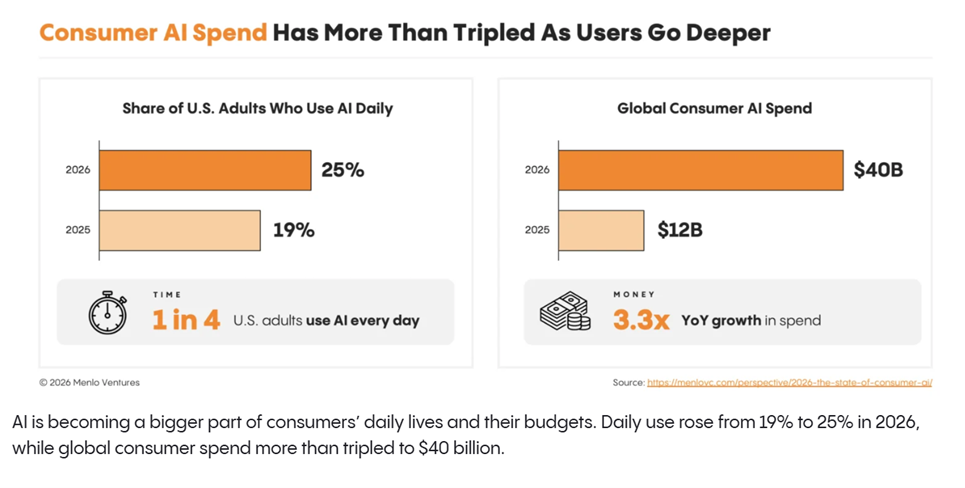
The findings suggest a market with growing financial commitment.
But they don’t establish how many subscribers will renew next year. Or how much providers earn from serving them.
That is where I would suggest you focus your investment research. Because the company that keeps customers can devote more of its resources to improving the product or generating profit.
Consider two hypothetical AI services, each with 100,000 paying customers.
Both charge $20 a month, producing $2 million in monthly subscription revenue before refunds and other adjustments. But one loses 2% of its subscribers each month. The other loses 10%.
The first must replace 2,000 customers every month simply to maintain its subscriber count. The second needs 10,000.
If both spend $40 to acquire each replacement, that is $80,000 versus $400,000 in monthly acquisition spending just to stand still.
More Subscribers Does Not Automatically Mean More Money
For an AI service, keeping those customers introduces another complication: Using the product costs the provider money.
A subscriber who asks an occasional question places different demands on a system than someone frequently using models to generate videos or run lengthy automated tasks throughout the day.
And at a fixed subscription price, heavier usage can increase expenses … without producing additional revenue.
Microsoft’s consumer subscription documentation makes that trade-off visible.
Its Microsoft's (MSFT) 365 plans include AI features with usage limits or credit allowances that vary by plan. Microsoft also says limits can change as new models become available.
This is a big part of the puzzle more investors need to pay attention to.
A provider needs enough capacity to make the subscription useful, while keeping the cost of serving customers under control. Tightening access may protect margins but disappoint subscribers. Offering more generous access may improve retention while increasing costs.
Efficiency improvements can help.
But the relevant test is whether the company’s actual cost per paying customer improves after accounting for how much more those customers use the service.
Cheaper individual tasks do not guarantee a cheaper monthly customer.
Then there is the bundle.
Google’s AI subscription plans combine AI capabilities with cloud storage and other benefits. Microsoft similarly places AI features inside its broader Microsoft 365 subscriptions.
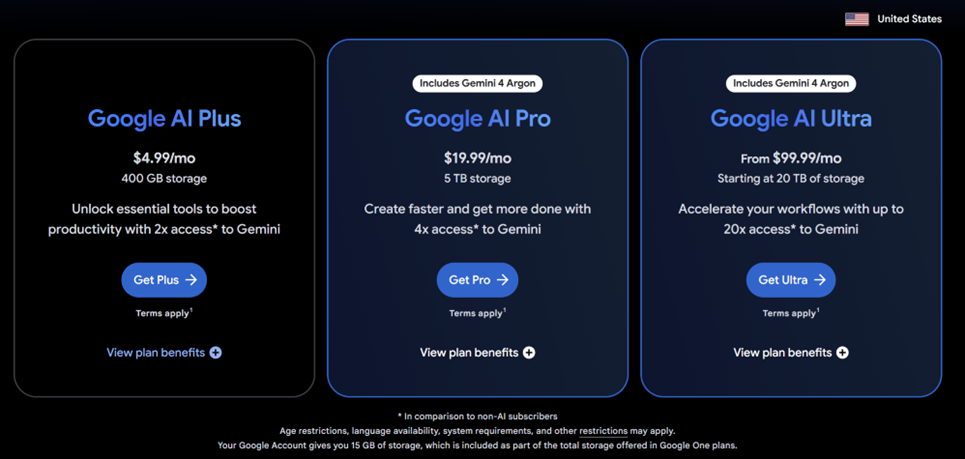
For Alphabet and Microsoft, this creates a route to selling AI through products customers already know.
Someone who wants storage or productivity software may find the combined package easier to justify than another separate subscription.
It also makes the results harder to interpret.
A customer who renews a bundle may primarily value the storage, the applications or the AI. The renewal alone cannot tell shareholders which feature earned the payment.
That distinction matters when assessing growth.
If AI encourages an existing subscriber to move to a more expensive plan, the additional revenue is the increase in the bill.
Counting the entire subscription as newly created AI revenue would exaggerate the benefit.
AI can also be valuable without a direct upgrade. It might persuade a customer to stay who would otherwise cancel. But that benefit needs evidence, too. A company should be able to demonstrate stronger retention or improved economics, rather than simply pointing to more accounts with AI access.
What to Look for In Your AI Investments
When you read earnings reports, I would therefore look for paying-customer growth alongside information about renewals and spending per customer.
Where companies disclose it, I would also examine whether users who came on board through free trials remain after their first full-price bill.
The next question is how much revenue remains after delivering the service.
Strong subscription growth accompanied by deteriorating margins calls for an explanation. It may reflect a deliberate investment in expansion, but investors still need to understand when and how that spending is expected to pay off.
One note of caution: Disclosure will not always be complete.
If a company reports only a broad user total, it may be tempting to fill the gaps with optimistic assumptions. Don’t.
Free users, paying subscribers and customers receiving AI through a bundle offer different evidence of demand.
The AI businesses worth owning … will turn repeat payments into durable profits at a valuation that investors can justify.
Best,
Jurica Dujmovic