Bet on the Plumbing When Crypto & Wall Street Collide
 |
| By Juan Villaverde |
Just over two weeks ago, on June 12, I participated in the SpaceX initial public offering (IPO). That may not be the smartest investment I ever made. But I love space, rockets and satellite technology.
As a mostly crypto investor, however, I hardly keep any fresh cash in a brokerage account. But here's the thing — it didn’t matter.
That’s because I did not buy SpaceX shares on the Nasdaq.
Instead, I bought crypto tokens that represented real shares via a crypto exchange. And I paid for them with USDC stablecoins.
From a pure user experience, buying stock in Elon Musk's rocket company felt identical to buying Bitcoin (BTC, “B+”), Ethereum (ETH, “B+”) or any other crypto asset. The shares are tokenized, divisible — just like any crypto asset — and they trade on a crypto exchange.
Our Weiss crypto team has written a lot about tokenization and the growing real-world asset (RWA) sector. But investors need to know that it’s not just stocks that are coming on-chain.
The overlap is flowing in the other direction, too.
When Financial Worlds Collide
Trading stocks normally requires funding a brokerage account … which usually means tedious dealings with conventional banks.
That’s something that I, having been in crypto for years now, no longer have much patience with.
To my surprise, however, my stockbrokers recently announced they're allowing USDC deposits. I can also withdraw directly into a crypto wallet of my choosing — just like a crypto exchange. And I can trade crypto there, too. Including just about any altcoin.
Accordingly, my "TradFi" brokerage account is starting to look a lot like a crypto exchange.
And my favorite crypto exchange is starting to look a lot like a TradFi brokerage.
Last month, I attended the big 2026 Consensus Miami conference. Industry leaders, regulators, lobbyists, entrepreneurs and enthusiasts all mingled and talked about where crypto is … and where it could go.
I've been to my fair share of these events over the years. But something felt unmistakably different this time.
Gone was the Wild West energy of Initial Coin Offerings (ICOs) promising fast 50x returns.
Also absent was the tribal infighting among altcoin communities, where each claim their new Ethereum-killer would be “the future of crypto.”
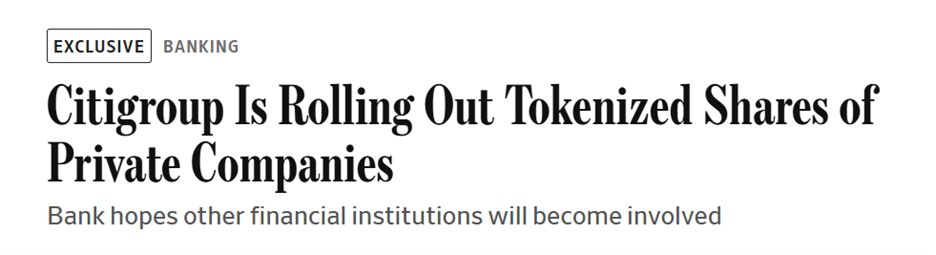
Instead, I saw investment banks talking about tokenizing shares.
I also saw payment applications that let you spend crypto seamlessly with a VISA (V) card. High-performance exchanges built for institutional market-makers.
In short, I see a future for crypto that’s even brighter than I’d thought before.
As the event wound down, another thought hit me: Two worlds, crypto and Wall Street, are merging right before our eyes.
That’s ironic because the early years of crypto were almost antagonistic to Wall Street. The same was true the other way around, as well.
And yet, after a decade of scams, failed altcoin projects and investor disillusionment, Wall Street finally arrived. And it’s gone all-in on the technology — make no mistake about that.
The titans of Wall Street look at this technology and see 24/7 liquidity, instant auditability of all transactions, and the ability to move value at the speed of light.
They will not be fooled by a whitepaper filled with buzzwords, struggling to justify why a flashy new application must have its own token.
Their funds will flow only into projects with real utility that can generate real revenue.
In short, the adults are now on the blockchain.
Which means crypto is no longer antithetical to finance.It is the financial industry of the future.
TradFi Giants’ Next Steps
At Consensus, I was also struck by something expected: JPMorgan (JPM) and Morgan Stanley (MS) have both quietly abandoned launching their own private blockchains.
Put simply, these finance giants are no longer interested in building a closed-system blockchain that only they can control.
The reasoning was refreshingly honest: No investment bank will ever trust a competitor’s blockchain.
But they will trust a neutral layer. Like Ethereum. Or Solana (SOL, “B-”).
This matters because it signals genuine commitment. Wall Street has now confirmed its intension to use public blockchains to trade stocks, bonds and derivatives.
To me, this is bigger than mere adoption.
I can see a future where the companies of tomorrow won't list on the NYSE or Nasdaq. They’ll list as a tokenized asset on the blockchain.
The technology is sound. And listing new assets on chain is trivially easy. And in a very real sense, this is a validation of everything crypto has been building toward.
Bet on the Infrastructure
So, how do you invest in the merging of two markets?
I think the best place to start, especially if you’re approaching this opportunity from the crypto side, is to know what to avoid. Namely …
- Memecoins,
- utility tokens with no real-world value proposition,
- and governance tokens that govern nothing worth governing.
That already rules out 99% of what's currently trading in the crypto markets.
Then, you’ll want to find the projects that are laying down the pipes.
What I’m talking about is largely invisible infrastructure. The way the internet became invisible infrastructure for communication and commerce.
For this financial revolution, investors will want to target the projects building the infrastructure that’ll connect the crypto world to the TradFi world.
That means …
- Interoperability protocols,
- On-chain compliance layers,
- Tokenization platforms that institutional players will actually trust,
- And the Layer-1 networks that are built to handle institutional volume, like Ethereum and Solana.
Those will be the winners of the next decade.
And judging by the speed at which this industry has evolved over the past few years alone, that future will be upon us sooner than most people expect.
Still, this train is likely to move slower than many crypto natives are used to. Regulation, technical limitations and institutional inertia will all act as brakes on the pace of progress.
But the direction is set.
The only question is whether you invest in the infrastructure now … or wait until it’s already supporting a brand-new financial system.
For myself, I plan to leg into this opportunity carefully. To see my strategy — and how my Crypto Timing Model can help — click here to listen to my recent crypto briefing.
Best,
Juan Villaverde