Coinbase Wants to Be Everything, Everywhere, All at Once
 |
| By Mark Gough |
There was a time when Coinbase (COIN) only did one thing.
You deposited some money there.
Bought Bitcoin or another cryptocurrency.
Then you either left it on the platform or transferred it to a private wallet.
That version of Coinbase is disappearing fast.

Yesterday, the company announced another wave of products that span stocks, AI, lending, payments, credit cards and tokenized assets.
Taken together, these developments point to something much bigger.
Coinbase no longer wants to be somewhere you occasionally visit to buy crypto …
It wants to become the primary account through which you invest, trade, borrow, spend and move money.
This is not a sudden change of direction.
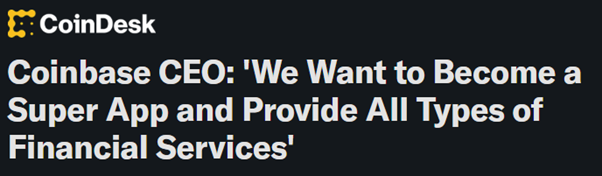
During a 2025 interview with Fox, CEO Brian Armstrong described the company’s longer-term goal as building a financial app that covers spending, saving, payments and investing.
He made the ambition clear:
“We want to be a bank replacement for people; we want to be their primary financial account.”
Armstrong added that the company intends to “provide all types of financial services,” rather than limit itself to crypto.
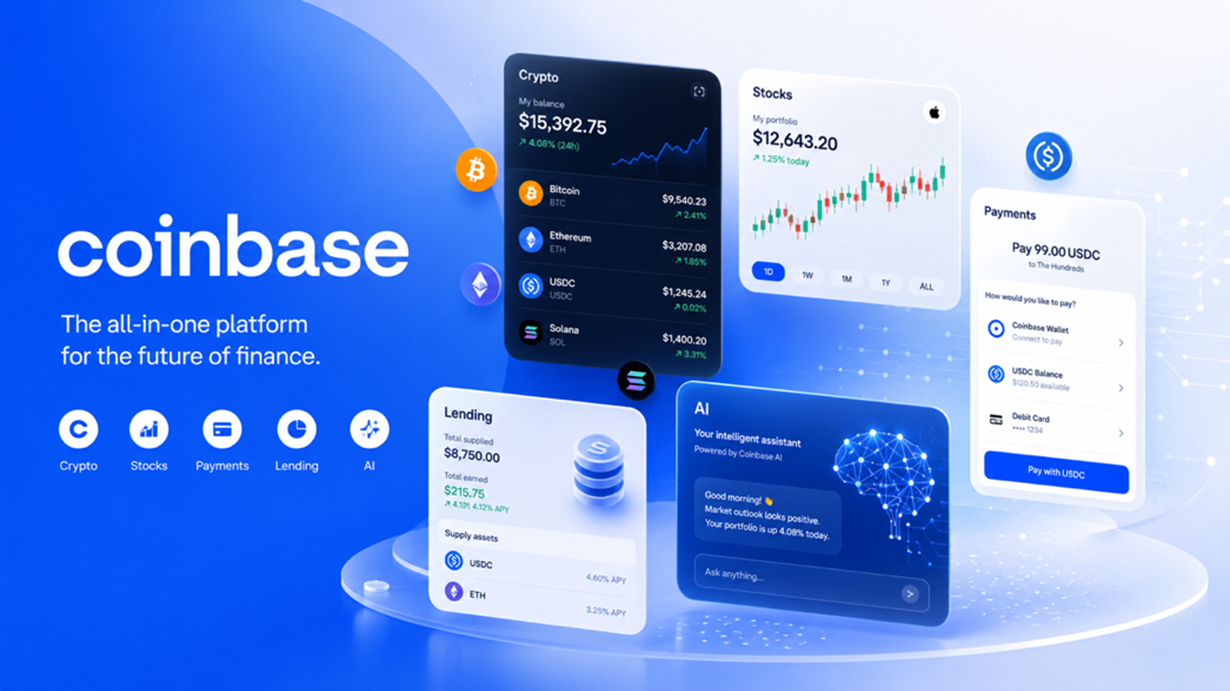
The latest announcements suggest this vision is now beginning to take shape.
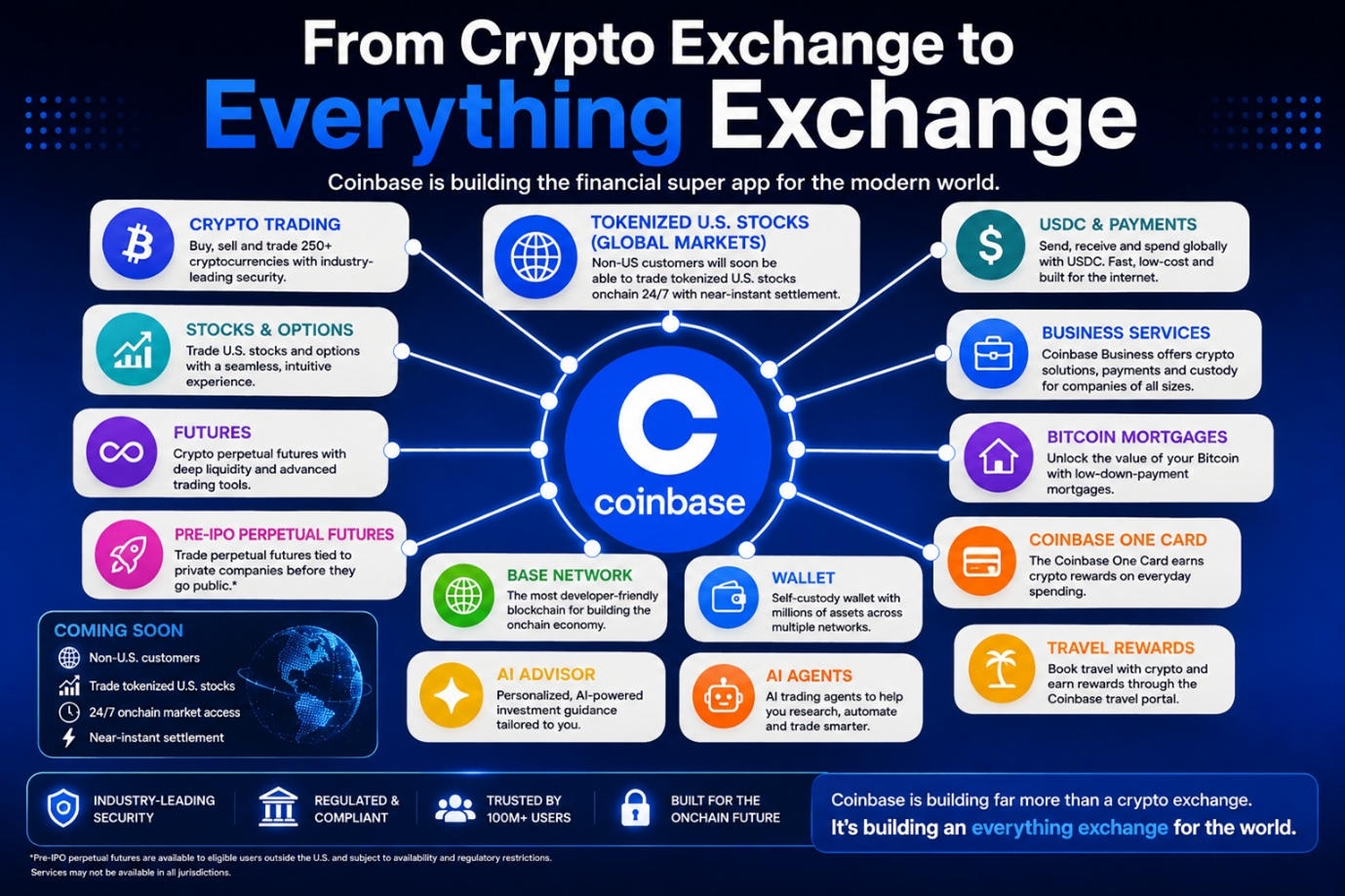
From Crypto Exchange to Everything Exchange
Coinbase has used the term “Everything Exchange” for some time.
The platform already offers spot crypto trading, derivatives, staking, lending, custody, stablecoin payments and institutional services.
It has since expanded into equities, prediction markets and pre-IPO perpetual futures.
The company says non-U.S. customers will soon be able to trade tokenized U.S. stocks backed one-for-one by the underlying shares.
These assets are expected to include dividend payments and shareholder rights. Investors may also be able to trade them around the clock, use them as collateral or transfer them directly.
For U.S. customers, the exchange already allows stock portfolios to be transferred onto the platform.
Users can access major stocks, ETFs and indices alongside crypto, with fractional shares and commission-free equity trading.
There are also plans to combine the U.S. spot exchange, international derivatives platforms and Deribit into a unified global liquidity pool.
That could result in tighter price spreads, deeper liquidity and better execution across spot crypto, perpetual futures and options.
Private Markets Are Coming, Too
Earlier this month, Coinbase launched pre-IPO perpetual futures, beginning with SpaceX (SPCX).
Similar products based on Anthropic and OpenAI are expected to follow.
These contracts do not provide ownership. They give eligible non-U.S. traders price exposure to the companies’ estimated valuations before they list publicly.
The contracts carry clear risks, including uncertain valuations, thin liquidity and sharp liquidations.
Still, they show how products developed in crypto can create markets around assets that were previously difficult for ordinary investors to access.
The Financial Adviser Inside the App
What really caught my attention was Coinbase Advisor.
This is an AI-powered investment adviser initially available to selected Coinbase One members in the United States.
Users will be able to ask questions, build portfolios and create strategies through a conversational interface.
The system can build portfolios, reduce risk or create thematic exposure using crypto, equities, derivatives and USDC-based products.
Coinbase Advisor is registered with the U.S. Securities and Exchange Commission as an investment adviser and with the Commodity Futures Trading Commission as a commodity trading adviser.
That does not mean regulators approve its recommendations.
But it does place the product inside an established regulatory framework.
The adviser is non-discretionary. It can analyze information and suggest trades, but it cannot execute them without the user’s approval.
Users could move from a question to a proposed strategy without leaving Coinbase.
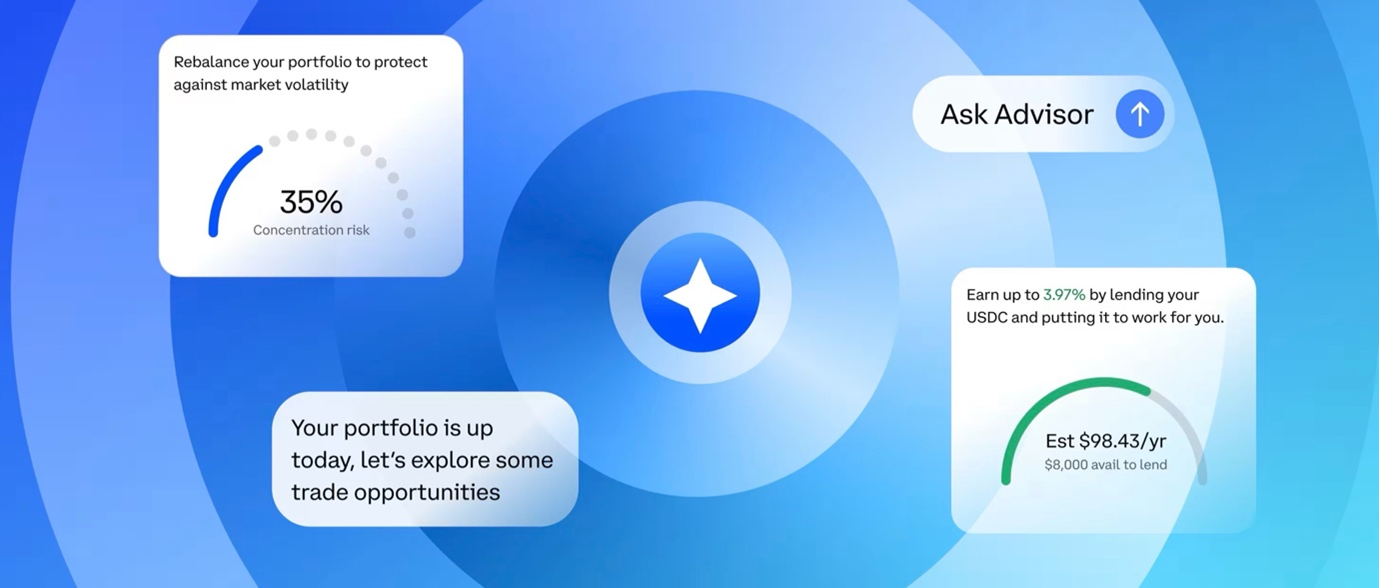
Whether the advice is consistently good remains to be seen.
AI can process huge amounts of information quickly, but it can also produce weak or incomplete conclusions.
Investors still need to understand what they own and why they own it.
The Numbers Behind the Expansion
At the end of the first quarter, Coinbase reported approximately $294 billion in assets on its platform and $5.2 trillion in trailing 12-month trading volume.
More importantly, 44% of first-quarter net revenue came from subscriptions and services rather than trading transactions.
Coinbase has historically been heavily exposed to the crypto cycle.
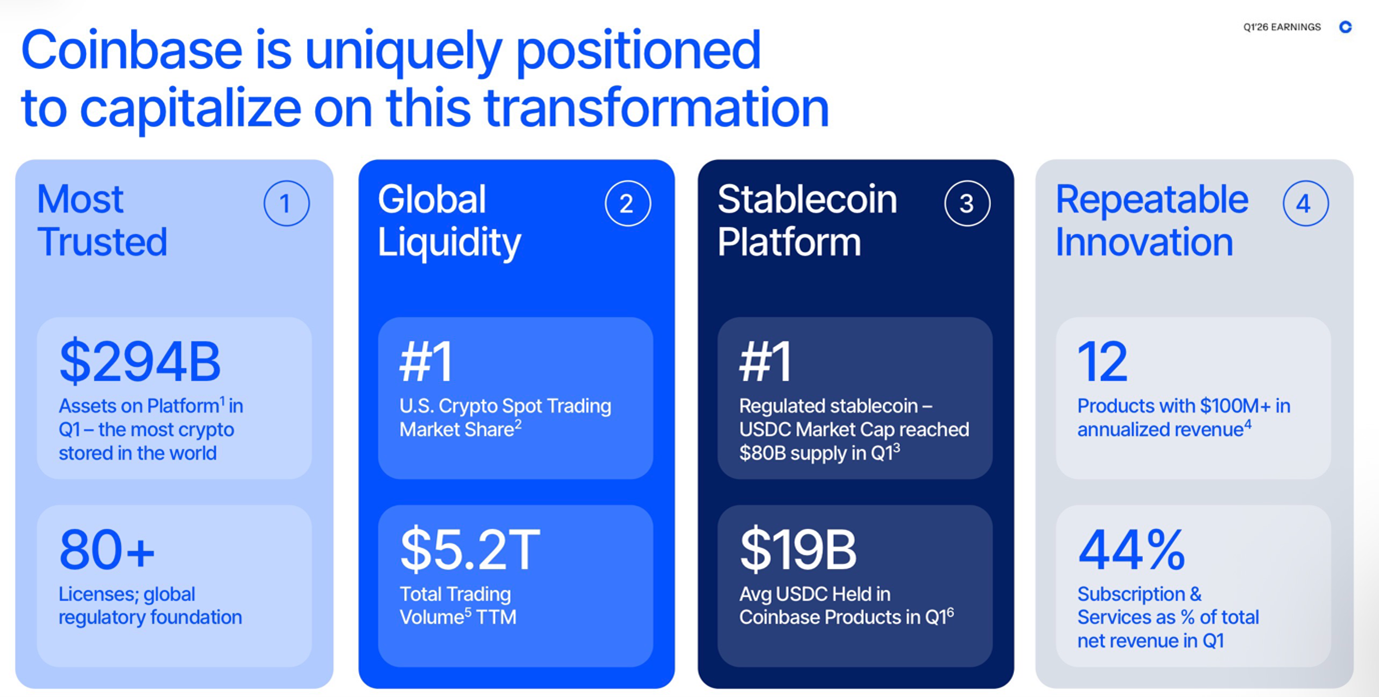
When activity rises, trading revenue surges. When the market slows, revenue can fall sharply.
Building recurring revenue through subscriptions, payments, USDC, lending and other financial services makes the business less dependent on crypto trading volumes.
The Risks Have Not Disappeared
The strategy is ambitious, but it is not without risk.
Tokenized stocks, derivatives, lending and AI-generated investment advice all sit within complicated legal frameworks.
Many products will not be available everywhere, and regulation could slow the rollout.
Which means the platform is also becoming more complex.
The simplicity that helped Coinbase attract new users could be diluted as the app fills with derivatives, prediction markets, lending products and AI tools.
Holding investments, stablecoins, loans and payment tools in a single account may be convenient.
But it increases dependence on a single company and its infrastructure.
Convenience does not remove counterparty, regulatory or operational risk.
The Bottom Line
Coinbase’s latest announcement was not simply another collection of product updates.
It was a statement of intent.
The company wants one account to replace several financial applications.
It still has a long way to go. Many products remain limited by geography, regulation or early-stage adoption.
But the direction is difficult to ignore.
Crypto exchanges were once viewed as narrow gateways into a speculative asset class.
Coinbase is now trying to turn that gateway into an entire financial platform.
We’ll see soon enough whether Coinbase can truly be the “Everything Everywhere All at Once” exchange …
Or whether it’s a jack of all trades that should have stayed a master of crypto.
One thing is clear: It may not replace your bank or your broker tomorrow. Or entirely.
But it clearly wants you to rely on them far less.
Best,
Mark Gough